Revise AQA microeconomics with interactive flashcards written to the
AQA (7136) specification, starting with the concepts AQA examines in
its own terms — behavioural economic theory, the varieties of market
failure and AQA's own definitions of shared ideas. Flip each card to
check yourself, rate how well you knew it, and the deck brings back
the cards you found hard. Every card links to the revision notes
page that teaches it, and the deck is growing.
185 cards · 54 topics · AQA Microeconomics
Sample cards
Why is economics a social science, and how
does its methodology differ from the natural sciences?
Economics applies the scientific method — observation,
hypothesis formation, testing, refinement — to
human behaviour and societies.
Unlike the natural sciences it cannot run controlled
laboratory experiments, so economists build
models resting on simplifying assumptions
and test them against real-world data.
Different assumptions can lead economists to different
conclusions from the same data.
State the formula for price elasticity of demand (PED), and how to interpret its value.
PED=%ΔP%ΔQD
PED is negative for a normal demand curve — classify on the magnitude:
0 = perfectly inelastic.
Between 0 and 1 = relatively inelastic.
1 = unitary.
Above 1 = relatively elastic.
Infinity = perfectly elastic.
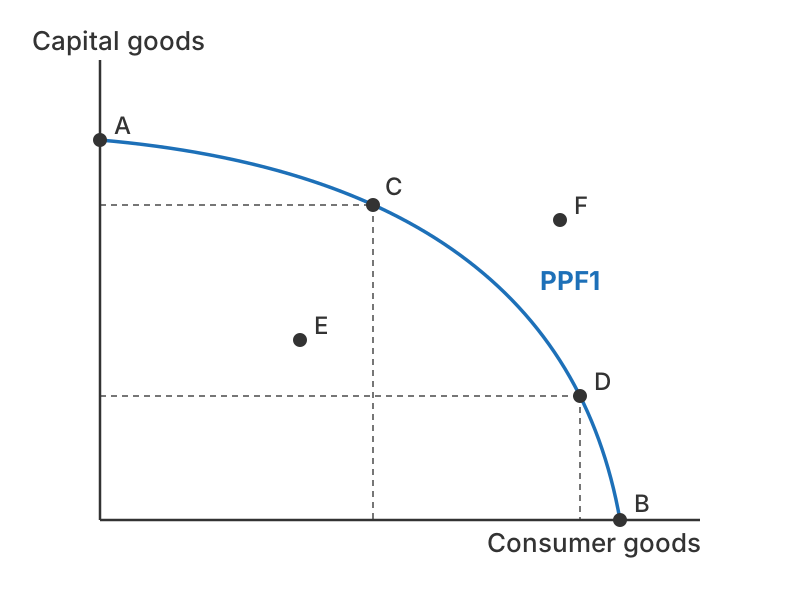
Interpret the
points on a production possibility diagram:
on, inside and outside the frontier.
Points on the frontier (A, C, D, B) are
productively efficient — all resources
fully and efficiently used.
Point E inside the frontier means
unemployed or inefficiently used resources: more of both goods is possible at zero opportunity
cost.
Point F outside is
currently unattainable with existing
resources and technology.
A movement along the frontier, such as C to D, shows the
opportunity cost of producing more consumer
goods.
These three are a taste of the deck. The full 185-card deck
loads right here — flip, rate and shuffle the cards, with your
progress saved on this device.