Price Discrimination
Types of Price Discrimination
Price discrimination occurs when a firm charges different prices to different consumers for the same product, where the price differences are not due to differences in costs. There are three main types of price discrimination:
- First-degree price discrimination occurs when a firm charges each consumer the maximum price they are willing to pay, capturing all consumer surplus as profit e.g. auctions.
- Second-degree price discrimination occurs when a firm charges different prices based on the quantity purchased or the version of the product, such as bulk discounts or premium versions. Also known as Purchasing Economies of Scale.
- Third-degree price discrimination occurs when a firm charges different prices to different consumer groups based on characteristics such as age, location, or income e.g. train tickets.
Third-Degree Price Discrimination
Third-degree price discrimination occurs when a monopoly charges different prices to different consumer groups for the same product based upon a characteristic such as age, location, or income. This allows the firm to increase total profit.
Conditions Required
- The firm must have market power. Therefore there must be few/no substitutes available.
- Different sub-markets must have different PED and the firm must be able to identify these differences. For example, peak and off-peak train travel, or student and adult cinema tickets.
- The firm must be able to separate the markets and prevent resale of cheaper products or arbitrage. Often this is achieved through the use of ID.
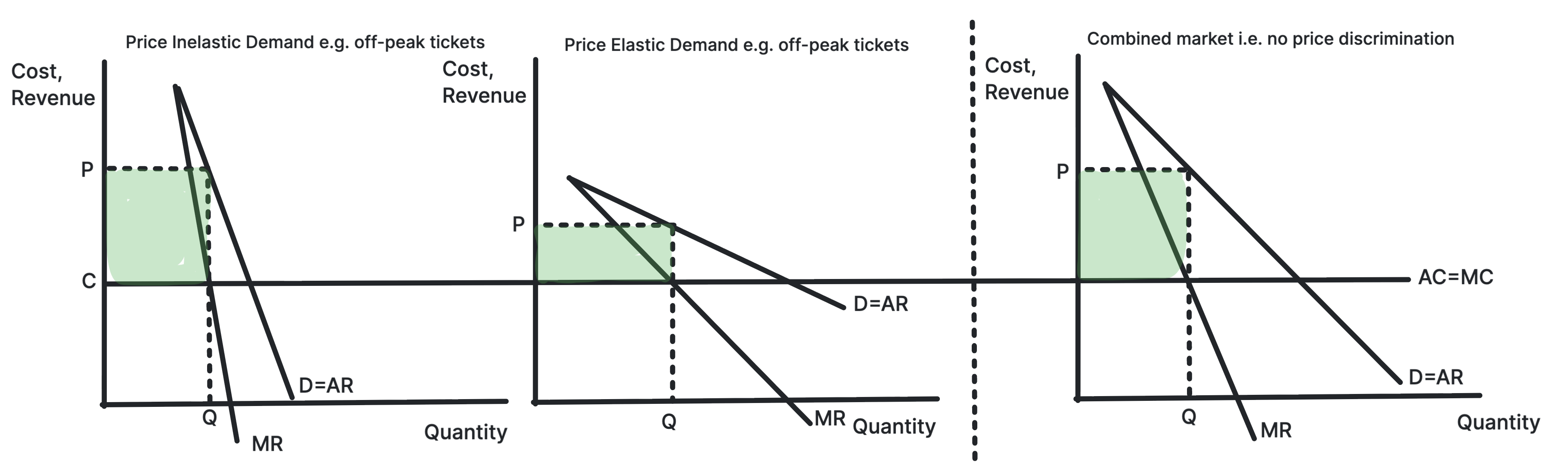
The result is that the monopoly charges a higher price in the market with more inelastic demand, and a lower price in the market with more elastic demand, increasing total profit compared to charging a single price for all consumers.
Costs and Benefits of Price Discrimination
Consumers:
- Consumers with more inelastic demand may pay a higher price than they would in a single-price monopoly, reducing consumer surplus.
- Consumers with more elastic demand may pay a lower price than they would in a single-price monopoly, increasing consumer surplus.
- Consumers with more elastic demand may enjoy quieter services or more availability of products at a lower price.
- Consumers in general may benefit from higher quality products or services, as the monopoly can use the additional profit to invest in research and development.
Firm:
- The firm can increase total profit by charging different prices to different consumer groups, allowing it to capture more consumer surplus.
- The firm may incur additional costs to identify different consumer groups and prevent resale, which may reduce the overall profit gained from price discrimination.
Stuck on this topic? Work through it with an online A-Level Economics tutor in a free 15-minute intro call, or send an essay on it for A-Level Economics essay marking.