Consumer Behaviour
Rational Economic Decision Making
In classical economic theory, economic agents (consumers, producers, workers, governments) are assumed to make rational decisions. Rationality means making choices that maximise self-interest based on a logical calculation of the expected net benefits of each available option. The agent will choose the option with the highest net benefit.
How Different Agents Are Assumed to Act Rationally
Consumers aim to maximise their utility (satisfaction or happiness from consuming goods and services).
Producers/Firms aim to maximise profit (total revenue minus total costs).
Workers aim to maximise their net welfare from employment, balancing wages, benefits, and working conditions.
Governments aim to maximise social welfare or the public interest (e.g., improving living standards).
Utility Theory: Diminishing Marginal Utility
Utility: The satisfaction or happiness a consumer derives from consuming goods and services.
There are two ways to measure utility:
- Total utility: The total satisfaction or happiness a consumer derives from consuming a given quantity of goods and services.
- Marginal utility: The additional satisfaction or happiness a consumer derives from consuming one more unit of a good or service.
The law of diminishing marginal utility states that as a consumer consumes more units of a good or service, the additional satisfaction (marginal utility) derived from each additional unit will eventually decrease. In other words, the first unit consumed provides the highest marginal utility, and subsequent units provide less and less additional satisfaction.
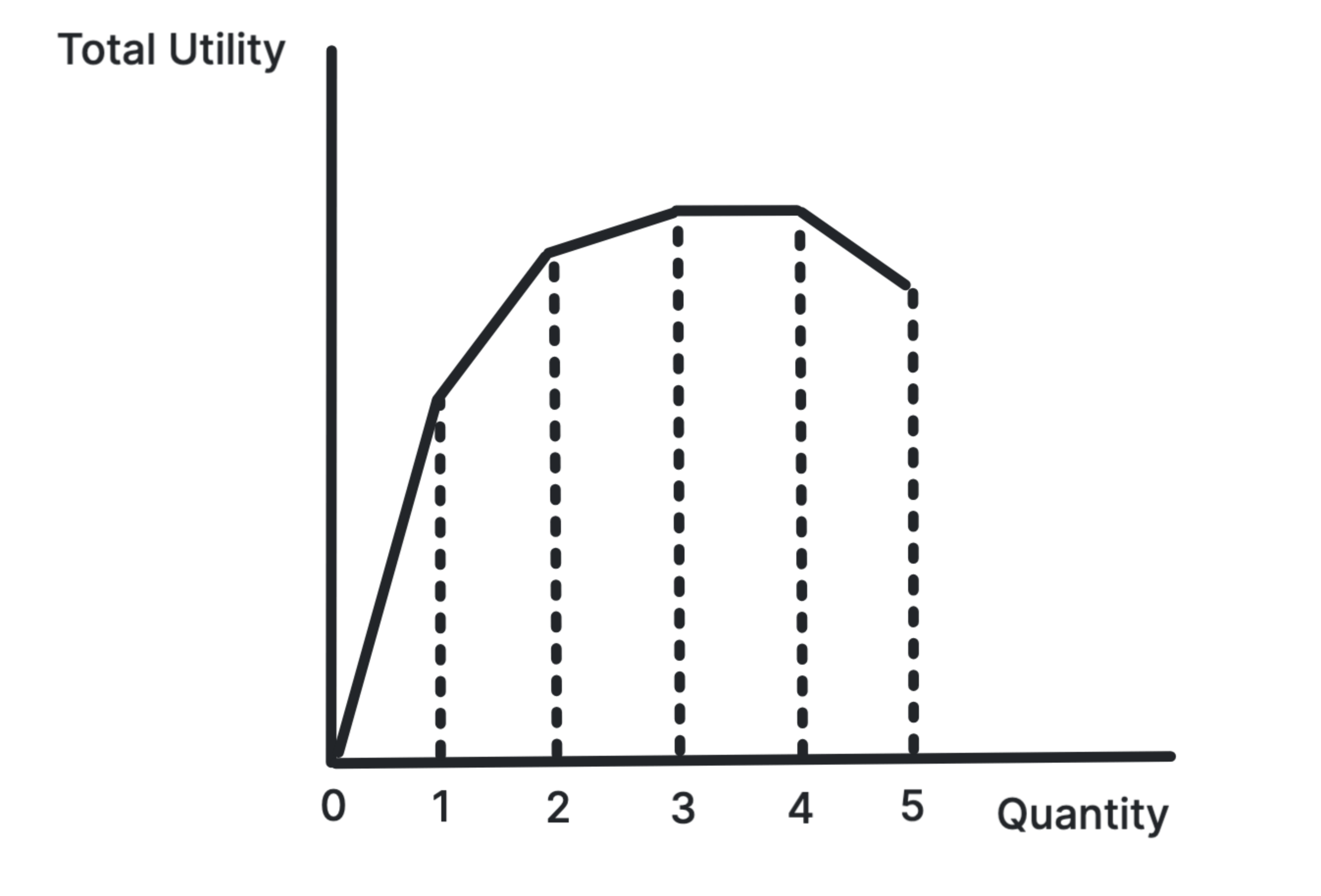
The diagram above shows the relationship between total utility and quantity consumed. This can be explained using chocolate cake as an example.
- The first slice of chocolate cake provides the highest level of satisfaction (high marginal utility), so total utility increases significantly
- The second and third slices of chocolate cake still provide satisfaction, but the additional satisfaction (marginal utility) is lower than the first slice, so total utility continues to increase but at a slower rate.
- By the fourth slice of chocolate cake, the consumer's total utility is maximised, and the marginal utility of consuming another slice is zero. This means that the consumer is indifferent to consuming another slice, as it does not increase their total utility.
- If the consumer continues to eat more slices beyond this point, the marginal utility becomes negative, meaning that consuming additional slices actually decreases their total utility. This could be due to feelings of being too full or experiencing discomfort.
The Importance of Marginal Analysis
In Economics, the term "marginal" refers to the additional or incremental changes resulting from adding one more unit of a good, service, or resource.
Marginal analysis is used throughout Economics by both consumers and firms to make optimal decisions.
- Consumers consider the marginal utility of consuming an additional unit of a good or service and compare it to the price they must pay for it.
- Firms consider the marginal revenue and marginal cost of producing an additional unit of output to determine whether it is profitable to produce that unit.
Stuck on this topic? Work through it with an online A-Level Economics tutor in a free 15-minute intro call, or send an essay on it for A-Level Economics essay marking.