Public Ownership, Privatisation, Regulation and Deregulation of Markets
Public Ownership vs Privatisation
Public Ownership: Refers to the ownership of enterprises by the government. It aims to provide essential goods and services, ensure equitable distribution, and control natural monopolies. Nationalisation is a form of public ownership where private enterprises are taken over by the government.
Privatisation: Refers to the transfer of ownership of enterprises from the government to the private sector. It aims to increase efficiency, promote competition, and reduce the financial burden on the government.
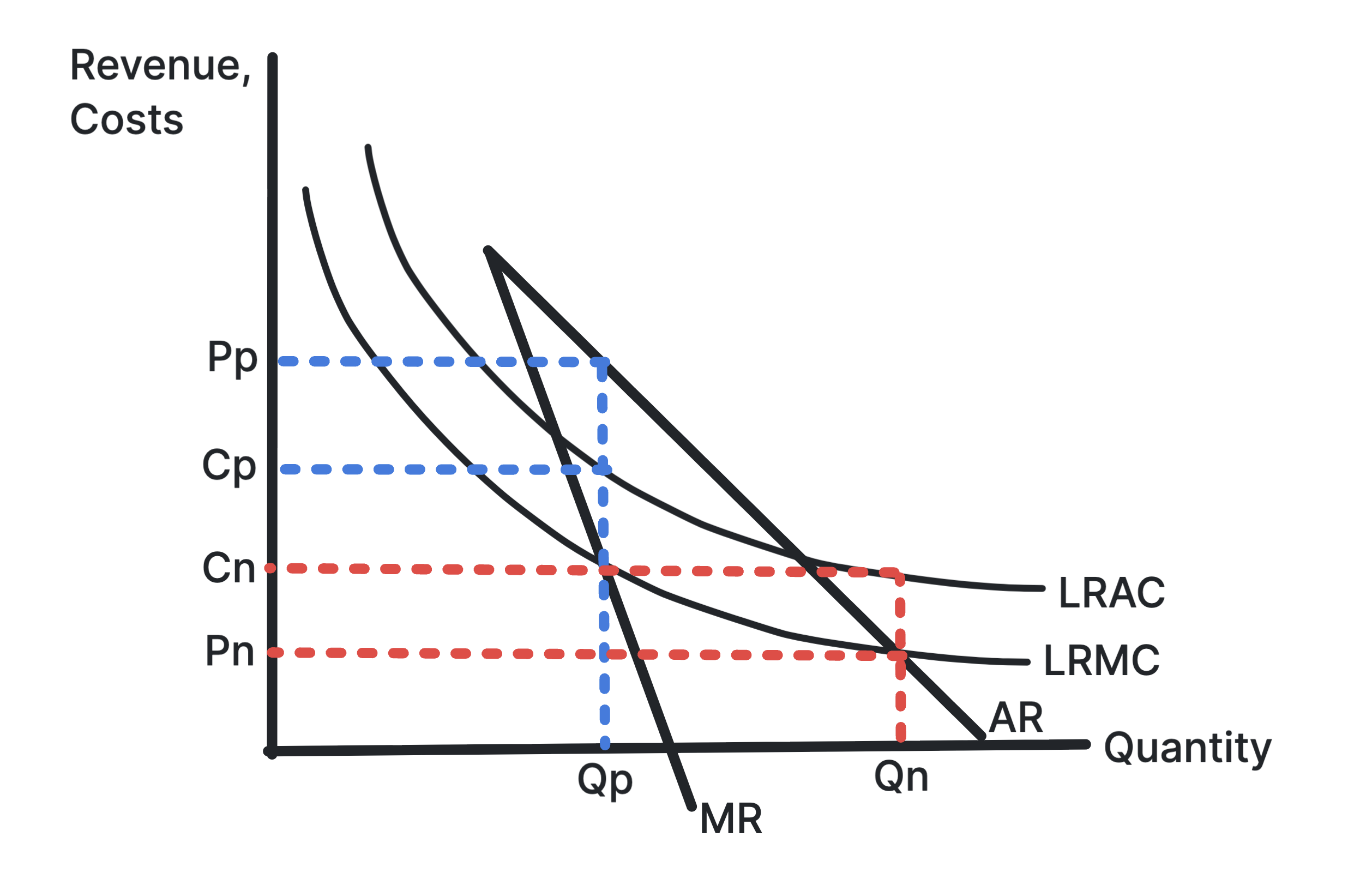
Public Ownership is represented by the red equilibrium on the diagram above as the Government produces at the Allocative Efficiency point (AR=LRMC). Public ownership results in:
- Lower prices for consumers
- Higher output
- Higher consumer surplus
- Lower profits for the firm
Privatisation is represented by the blue equilibrium on the diagram above as the firm produces at the Profit Maximisation point (MR=MC). Privatisation results in:
- Higher prices for consumers
- Lower output
- Lower consumer surplus
- Higher profits for the firm
| Arguments for Public Ownership | Arguments for Privatisation |
|---|---|
| Ensures essential goods and services are accessible to all, regardless of income or social status. | Encourages efficiency and innovation due to profit incentives and competition in the private sector. |
| Allows for equitable distribution of resources and wealth, reducing income inequality. | Reduces government financial burden and allows for better allocation of public funds. |
| Provides better control over natural monopolies and essential services, preventing exploitation of consumers. | Promotes competition, leading to lower prices and better quality of goods and services for consumers. |
| Can be used to achieve social and environmental goals, such as reducing carbon emissions or providing affordable housing. | Encourages investment and economic growth by attracting private capital and expertise. |
Regulation and Deregulation of Markets
Regulation: Refers to the imposition of rules and standards by the government or regulatory bodies to control the behaviour of firms and protect consumers, workers, and the environment. Regulation can take various forms, such as price controls, quality standards, safety regulations, and environmental regulations.
Examples of regulation in the UK:
- Ofgem: The Office of Gas and Electricity Markets regulates the electricity and gas markets in Great Britain, ensuring fair competition and protecting consumers.
- Ofcom: The Office of Communications regulates the telecommunications, broadcasting, and postal industries, promoting competition and protecting consumers.
- Financial Conduct Authority (FCA): Regulates financial markets and firms, ensuring transparency, fairness, and consumer protection.
Deregulation: Refers to the removal or reduction of government regulations and restrictions on businesses and industries. Deregulation aims to promote competition, efficiency, and innovation in the market.
Examples of deregulation in the UK:
- Airline Industry: The deregulation of the airline industry in the 1980s i.e. the privatisation of British Airways led to increased competition, lower prices, and improved services for consumers.
- Telecommunications: The deregulation of the telecommunications industry in the 1980s and 1990s i.e. forcing BT to open up its network to competitors led to increased competition, lower prices, and improved services for consumers.
| Benefits of Regulation | Costs of Regulation |
|---|---|
| Protects consumers from unfair practices, unsafe products, and environmental harm. | Can increase costs for businesses, which may be passed on to consumers in the form of higher prices. |
| Ensures fair competition and prevents monopolies or oligopolies from exploiting their market power. | Can create barriers to entry for new firms, reducing competition and innovation. |
| Promotes social and environmental goals, such as reducing carbon emissions or improving workplace safety. | Can lead to regulatory capture, where regulators are influenced by the industries they regulate, resulting in less effective regulation. |
Regulatory Capture
Regulatory Capture: Refers to a situation where regulatory agencies are dominated or influenced by the industries they are supposed to regulate. This can lead to regulations that benefit the industry rather than the public interest.
Causes of Regulatory Capture:
- Close relationships between regulators and industry, leading to biased decision-making.
- Revolving door employment, where regulators move between industry and regulatory positions, creating conflicts of interest.
- Lobbying and political influence by industry groups to shape regulations in their favour.
Consequences of Regulatory Capture:
- Regulations may be weakened or poorly enforced, allowing industries to engage in harmful practices.
- Public trust in regulatory agencies may be eroded, leading to skepticism about the effectiveness of regulations.
- Regulatory capture can result in market failures, as industries may prioritise profits over consumer welfare, safety, or the environment.
Examples of Regulatory Capture:
- The 2008 financial crisis, where regulatory agencies failed to adequately oversee the banking and financial sectors, leading to widespread economic consequences.
- The influence of the fossil fuel industry on environmental regulations, leading to weaker policies on carbon emissions and climate change.
Stuck on this topic? Work through it with an online A-Level Economics tutor in a free 15-minute intro call, or send an essay on it for A-Level Economics essay marking.