Revise Theme 1 with interactive flashcards written to the Edexcel A
(9EC0) specification. Flip each card to check yourself, rate how
well you knew it, and the deck will bring back the cards you found
hard — a study technique with strong evidence behind it. Every card
is cross-checked against our full revision notes, and each one links
to the page that teaches it in depth.
95 cards · 22 topics · Edexcel A Theme 1: Introduction
to Markets and Market Failure
Sample cards
What does ceteris paribus mean, and why do
economists rely on it?
Ceteris paribus — a Latin phrase meaning
‘all other things being equal’ or ‘all other factors held
constant’.
Economists cannot run laboratory experiments, so they
isolate the effect of one variable by assuming all others
stay constant.
State the formula for price elasticity of demand.
PED=%ΔP%ΔQD
Because demand curves slope downwards, PED is negative — interpret its absolute size: elastic if greater than 1, inelastic if less than 1.
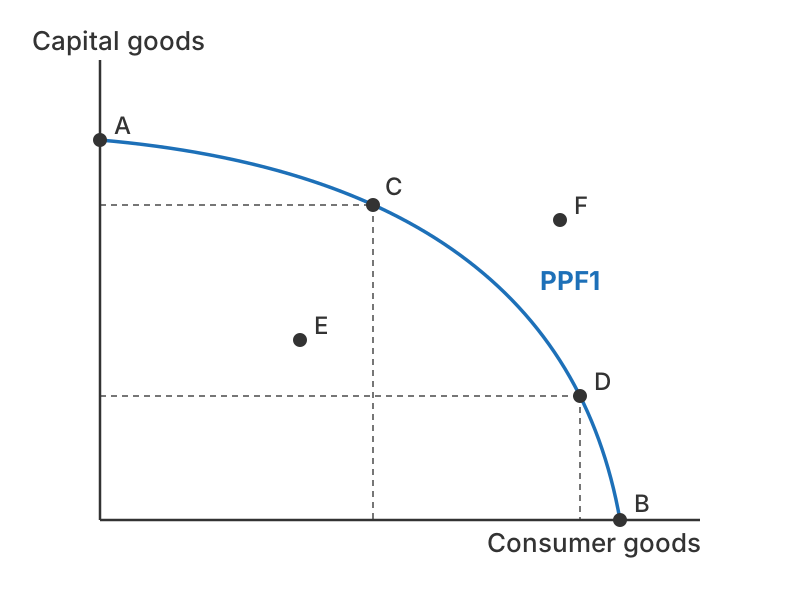
Sketch a PPF and mark an efficient point,
an inefficient point and an unattainable point. Where is
opportunity cost shown?
Points on the frontier (A, C, D, B) are productively
efficient — all resources are fully employed. E, inside the
frontier, is inefficient; F, outside it, is currently
unattainable. Moving from C to D gains consumer goods at the
opportunity cost of the capital goods given up.
These three are a taste of the deck. The full 95-card deck loads
right here — flip, rate and shuffle the cards, with your
progress saved on this device.