Revise AQA macroeconomics with interactive flashcards written to the
AQA (7136) specification — the objectives AQA names, its
index-number and national-income measurement toolkit, and AD/AS
analysis in AQA's own framing. Flip each card to check yourself,
rate how well you knew it, and the deck brings back the cards you
found hard. Every card links to the revision notes page that teaches
it, and the deck is growing.
104 cards · 25 topics · AQA Macroeconomics
Sample cards
State the four main objectives of
government macroeconomic policy.
Economic growth.
Price stability (low and stable inflation
— the UK's 2% CPI target).
Minimising unemployment.
A
stable balance of payments on current account.
Be aware of further objectives too — balancing the
government budget, a more equitable distribution of income,
and environmental protection — and that the importance
attached to each objective changes over time.
State the formulas for the unemployment rate and the employment rate.
Unemploymentrate=Unemployed/Labourforce×100
The unemployment rate is the percentage of the labour force unemployed and actively seeking work. The employment rate is the percentage of the working-age population in work.
The denominators differ — someone economically inactive is in neither numerator, so the two rates can move independently.
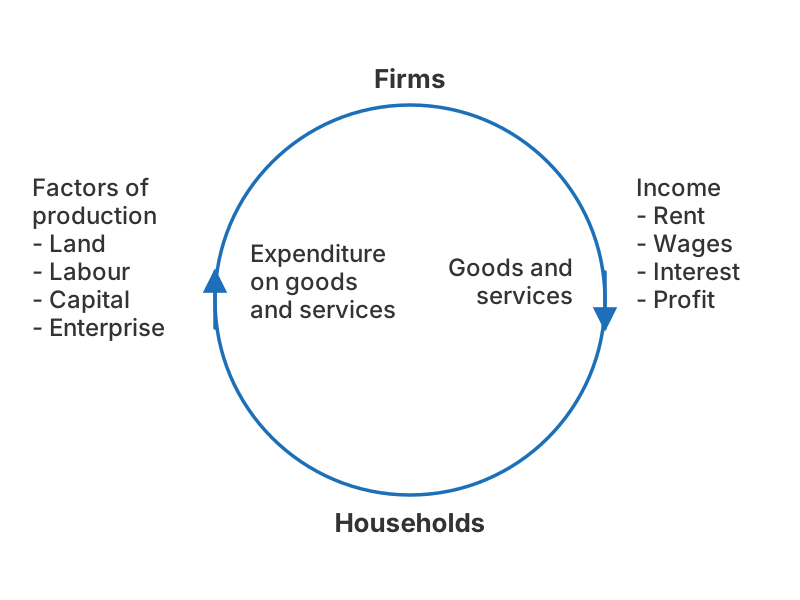
Draw the circular flow of income for a
simple two-agent economy.
Households and firms are linked by two pairs of flows.
Real flows: households provide the factors
of production — land, labour, capital, enterprise — and
firms provide goods and services.
Money flows: firms pay income — rent,
wages, interest, profit — and households return it as
consumer expenditure, which becomes firms' revenue.
The same flow measured at any point gives income = output =
expenditure.
These three are a taste of the deck. The full 104-card deck
loads right here — flip, rate and shuffle the cards, with your
progress saved on this device.