Trade
Absolute and Comparative Advantage
Absolute advantage: a situation in which a country can produce more of a good with the same resources than another country. This is based on productivity and efficiency.
Comparative advantage: a situation in which a country can produce a good at a lower opportunity cost than another country. This is based on the trade-offs between producing different goods.
The Theory of Comparative Advantage suggests that countries should specialise in producing goods for which they have a comparative advantage, leading to more efficient allocation of resources and increased overall global output.
Illustrating Comparative Advantage with PPFs
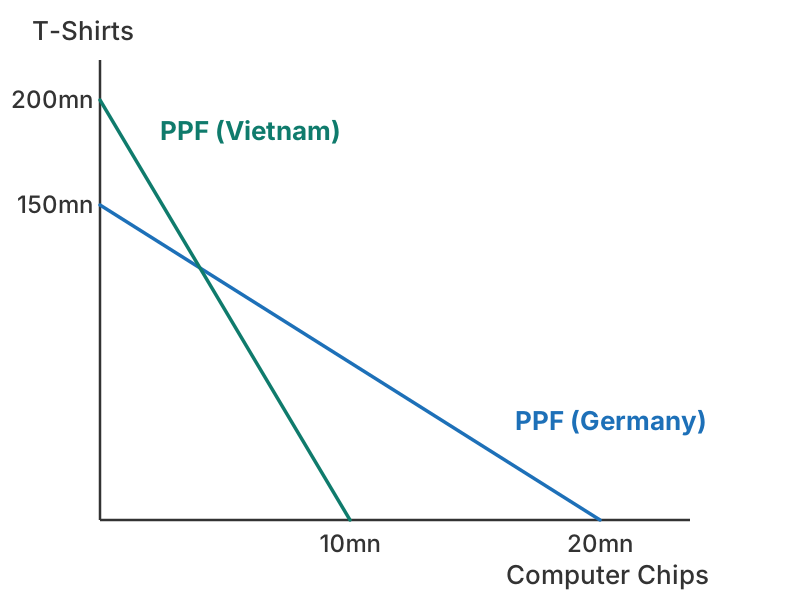
Absolute Advantage
In the diagram, Germany has an absolute advantage in computer chips because it can produce more computer chips with the same resources than Vietnam, while Vietnam has an absolute advantage in T-shirts.
If Germany produces both goods, it can produce 10m computer chips and 75mn T-shirts. If Vietnam produces both goods, it can produce 5m computer chips and 100mn T-shirts.
This generates a global output of 15m computer chips and 175mn T-shirts.
Comparative Advantage
Opportunity cost can be calculated using the output that must be given up to produce more of the other good.
Opportunity cost of 1 computer chip: T-shirts given up divided by computer chips gained.
- Germany: For every 1 computer chip, it gives up 7.5 T-shirts, so the opportunity cost is 7.5 T-shirts per computer chip.
- Vietnam: For every 1 computer chip, it gives up 20 T-shirts, so the opportunity cost is 20 T-shirts per computer chip.
Opportunity cost of 1 T-shirt: Computer chips given up divided by T-shirts gained.
- Germany: For every 1 T-shirt, it gives up 0.13 computer chips, so the opportunity cost is 0.13 computer chips per T-shirt.
- Vietnam: For every 1 T-shirt, it gives up 0.05 computer chips, so the opportunity cost is 0.05 computer chips per T-shirt.
According to the theory of comparative advantage, the country with the lower opportunity cost should specialise in that good.
In this case, Germany has a comparative advantage in computer chip production, while Vietnam has a comparative advantage in T-shirt production.
By following the theory of comparative advantage, the total global output can be increased to 20m computer chips and 200mn T-shirts, which is higher than the output that would be produced if both countries produced both goods without specialisation.
Assumptions of the Comparative Advantage Model
- Zero transport costs: does not account for the costs of moving goods between countries
- Perfect knowledge: assumes all agents have full information about prices, technology, and resources
- Factors of production are mobile within countries: assumes that resources can move freely between industries within a country
- Constant returns to scale: assumes that doubling inputs will double outputs
- No trade barriers: assumes there are no tariffs, quotas, or other restrictions on trade
Impacts of Specialisation and Trade
Advantages of Specialisation and Trade
- Increased efficiency: countries can produce goods at a lower opportunity cost, leading to more efficient allocation of resources.
- Higher output: specialisation allows for increased production and global output, benefiting all countries involved in trade.
- Lower prices: increased competition from international trade can lead to lower prices for consumers.
- Greater variety of goods: trade allows countries to access a wider range of products that they may not be able to produce domestically.
- Economic growth: trade can stimulate economic growth by providing access to larger markets and encouraging innovation and investment.
Disadvantages of Specialisation and Trade
- Dependency on other countries: countries may become reliant on imports for essential goods, making them vulnerable to supply chain disruptions.
- Job losses in certain industries: domestic industries may struggle to compete with foreign producers, leading to unemployment in those sectors.
- Income inequality: trade can exacerbate income disparities between skilled and unskilled workers, as well as between countries.
- Environmental concerns: increased production and transportation associated with trade can lead to higher carbon emissions and environmental degradation.
- Exploitation of workers: some countries may have lower labour standards, leading to poor working conditions and exploitation of workers in certain industries.
What Is the Pattern of Trade?
The pattern of trade refers to the changing composition and direction of a country's exports and imports.
It shows what goods and services are traded and with which countries.
Factors Influencing the Pattern of Trade
- Comparative advantage: Countries will specialise in producing goods and services in which they have a comparative advantage, leading to changes in the pattern of trade. For example, the UK no longer has a comparative advantage in manufacturing, leading to a decline in exports of manufactured goods and an increase in imports of manufactured goods.
- Impact of emerging economies: The rise of emerging economies, such as China and India, has shifted global trade patterns, increasing their share of exports and imports.
- Trade blocs and bilateral trade agreements: Membership in trade blocs or the establishment of bilateral trade agreements can influence the pattern of trade by reducing barriers and promoting trade between member countries. For example, the UK's exit from the EU has led to a reduction in trade with EU countries and an increase in trade with non-EU countries.
- Relative exchange rates: Fluctuations in exchange rates can affect the competitiveness of a country's exports and imports, influencing the pattern of trade. For example, a depreciation of the pound can make UK exports cheaper and more competitive, leading to an increase in exports and a decrease in imports.
Reasons for Protectionism
Governments may restrict free trade in order to protect domestic industries even though free trade can create efficiency gains.
| Reason | Explanation |
|---|---|
| Protect infant industries | New industries may need temporary protection until they become established and competitive. |
| Protect strategic industries | Some industries are important for national security and may need protection from foreign competition. |
| Protect sunset industries | Industries that are declining may need protection to preserve jobs and allow time for workers to transition to new sectors. |
| Protect jobs | Protecting jobs in certain industries can be a reason for implementing trade restrictions, especially in sectors that are vital for the economy or have high employment. |
| Prevent dumping | Dumping occurs when foreign producers sell goods below cost to gain market share. Protectionist measures can prevent this practice. |
| Balance of payments | Trade restrictions can help improve a country's balance of payments by reducing imports and supporting domestic industries. |
| Environmental and labour standards | Trade restrictions can be used to enforce environmental and labour standards, ensuring that imported goods meet certain ethical and sustainability criteria. |
Methods of Protectionism
Tariffs
A tariff is a tax on imports. It raises the price of imported goods, making domestic goods relatively cheaper.
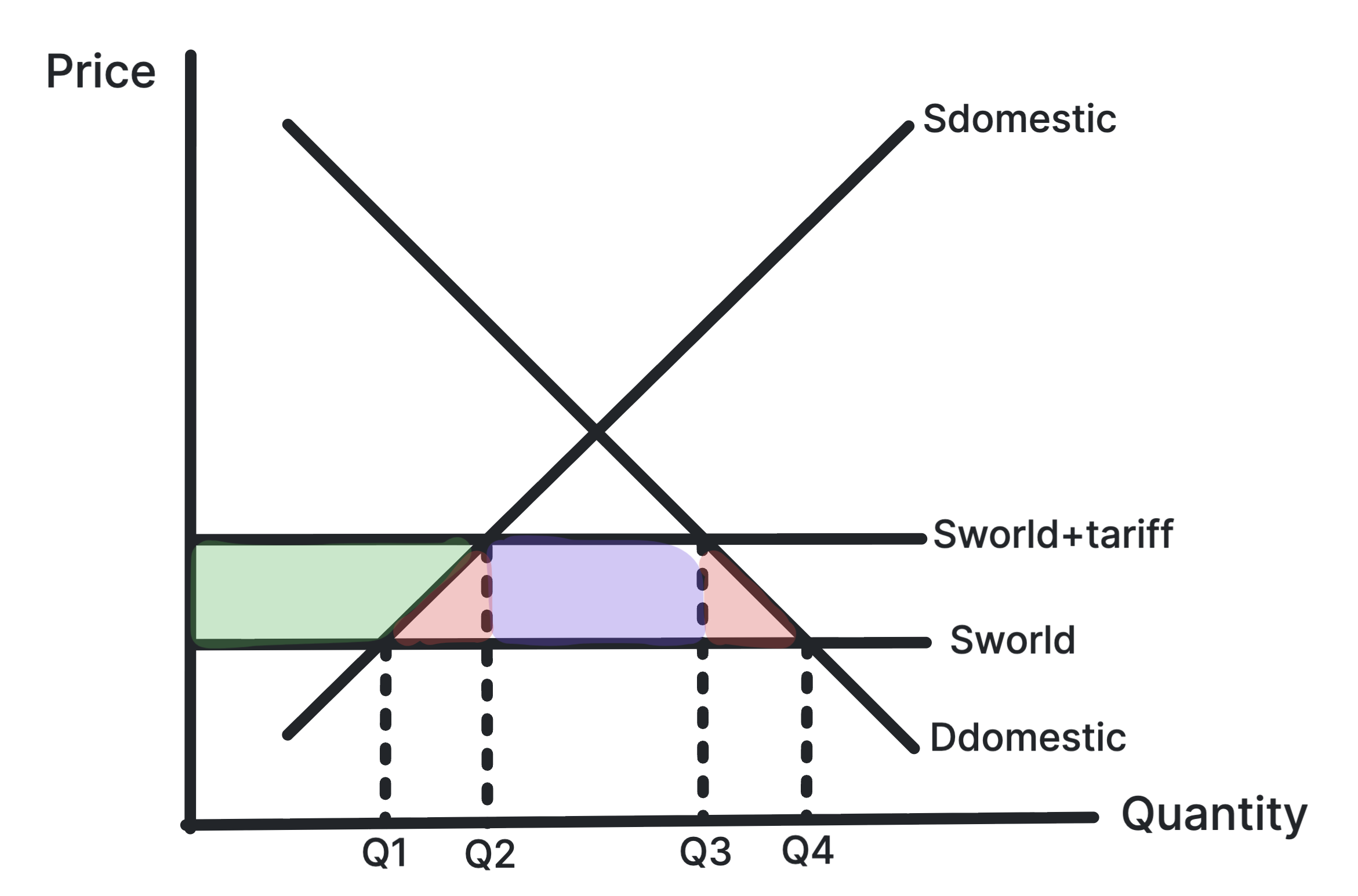
Before the tariff:
- Domestic sales: Q1
- Imports: Q4 - Q1
- Consumption by domestic consumers: Q4
After the tariff:
- Domestic sales: Q2
- Imports: Q3 - Q2
- Consumption by domestic consumers: Q3
The tariff raises the price of imports from P1 to P2, which reduces imports and increases domestic production, but also raises prices for consumers.
Areas on the diagram:
- Purple Area: Tariff revenue for the government
- Green Area: Gain in domestic producer surplus
- Red Area: Net welfare loss resulting from the tariff. It is the sum of the loss of consumer surplus, less the gain in domestic producer surplus and tariff revenue.
Quotas
A quota is a physical limit on how much of a good can be imported. It restricts supply and raises the price of imports, benefiting domestic producers but harming consumers.
Subsidies to Domestic Producers
Subsidies lower production costs for domestic firms and allow them to compete more effectively with imports, benefiting domestic producers.
Non-Tariff Barriers
Non-tariff barriers include product standards, health and safety rules, and administrative procedures that make imports more difficult and costly, effectively protecting domestic industries without using tariffs or quotas.
Evaluations of Protectionist Policies
The effectiveness of protectionist policies depends on the following:
- The elasticity of demand for imports: If demand is inelastic, tariffs and quotas may not significantly reduce imports.
- The ability of domestic producers to increase production: If domestic producers cannot meet the increased demand, or the UK does not produce effective alternatives, prices may rise further.
- The potential for retaliation by trading partners: Other countries may impose their own trade restrictions in response, leading to trade wars which harm consumers and producers in both countries.
- The long-term impact on efficiency and innovation: Protectionism such as subsidies may support inefficient firms and reduce incentives for innovation and productivity growth.
Types of Trading Blocs
Trading blocs involve different degrees of economic integration and characteristics:
Free trade area: e.g. USMCA (the United States-Mexico-Canada Agreement)
- Member countries remove tariffs and quotas on trade
- Each country retains its own trade policy with non-members
Customs union: e.g. MERCOSUR (Southern Common Market)
- Member countries remove tariffs and quotas on trade
- Member countries adopt a common external tariff on trade with non-members
Common market: e.g. European Union (EU)
- Member countries remove tariffs and quotas on trade
- Member countries adopt a common external tariff on trade with non-members
- Free movement of factors of production (labour and capital) between member countries
Costs and Benefits of Regional Trade Agreements
Benefits
- Trade creation: trade shifts from a high-cost domestic producer to a lower-cost producer in another member country, increasing efficiency and welfare
- Economies of scale: larger markets allow firms to produce at lower average costs
- Increased competition: encourages innovation and efficiency, benefiting consumers
- Greater choice for consumers: access to a wider range of goods and services from member countries
- Political cooperation: closer economic ties can promote political stability and cooperation between member countries
Costs
- Trade diversion: trade shifts from a lower-cost producer outside the bloc to a higher-cost producer within the bloc, reducing efficiency and welfare
- Loss of sovereignty: member countries may have to give up some control over their trade policies and regulations
- Unequal benefits: some member countries may benefit more than others, leading to tensions and conflicts
- Dependency: member countries may become overly reliant on trade within the bloc, making them vulnerable to economic shocks in other member countries
The Role of the WTO
The World Trade Organisation (WTO) exists to promote trade liberalisation and oversee global trade rules.
Its main functions include:
- Negotiating forum: hosting trade talks to reduce tariffs and quotas internationally
- Dispute settlement: acting as a court to resolve trade disputes between member countries
There can be tension between the WTO and trading blocs. Regional blocs favour their members, which can conflict with the WTO's broader aim of non-discrimination in global trade.
Stuck on this topic? Work through it with an online A-Level Economics tutor in a free 15-minute intro call, or send an essay on it for A-Level Economics essay marking.