Economic Growth and Development
Economic Growth vs Economic Development
Economic growth is a narrower concept that is measured by increases in real GDP.
Economic development is a broader concept. It includes economic growth but also considers improvements in living standards, welfare, and quality of life.
Development includes non-material factors such as health, education, and equality, so growth does not automatically mean development.
Single vs Composite Indicators
Single indicators measure one aspect of development, such as the infant mortality rate, literacy rate, or access to clean water.
They can be useful for specific comparisons, but they only give a partial picture.
Composite indicators combine several single indicators into one index to provide a more rounded view of development.
The Human Development Index (HDI)
The Human Development Index is the main composite measure of development and was created by the United Nations.
It combines three equally weighted elements:
- Health: life expectancy at birth
- Education: mean years of schooling for adults and expected years of schooling for children
- Income: real GNI per capita at PPP to account for differences in the cost of living
Countries receive a score between 0 and 1, with higher scores indicating higher levels of human development. For example, Norway has an HDI of 0.961, while Niger has an HDI of 0.394.
Advantages of HDI
- It is a composite measure that captures multiple dimensions of development, not just income.
- It allows for international comparisons of development levels.
- It highlights the importance of health and education in addition to income.
Limitations of HDI
- It does not capture inequality within countries, so two countries with the same HDI may have very different distributions of wealth and opportunity.
- It does not consider sustainability or environmental factors, which are important for long-term development.
- Data quality can be an issue, especially in developing countries where statistics may be unreliable or outdated. For example, life expectancy data is based on estimates and may not reflect current conditions.
Other Development Indicators
- Multidimensional Poverty Index (MPI): Measures multiple factors in health, education, and living standards.
- Inequality-adjusted HDI (IHDI): Adjusts the HDI score to reflect inequality in health, education, and income.
- Gross National Income (GNI) per capita: Measures the average income of a country's citizens.
- Access to clean water and sanitation: Measures the percentage of the population with access to safe drinking water and adequate sanitation facilities.
- Environmental indicators: Measures such as carbon emissions, deforestation rates, and biodiversity loss can indicate whether development is sustainable.
- Human Poverty Index (HPI): Measures the proportion of people below a certain poverty line, considering factors like life expectancy, literacy, and access to basic services.
- Social Progress Index (SPI): Measures the extent to which countries provide basic human needs and opportunities for their citizens, including health, education, and personal rights.
Economic Factors Affecting Development
Primary Product Dependency
Primary product dependency refers to an economy that relies heavily on the export of raw materials or agricultural products. This can limit development in several ways:
- Price volatility: Primary product prices can fluctuate significantly, leading to unstable export revenues.
- Limited ability to add value: Economies reliant on primary products may struggle to increase Real GDP beyond the value of raw exports, limiting long-term growth.
- Dutch disease: A focus on primary products can lead to an overvalued currency, making other exports less competitive.
Savings Gap: Harrod-Domar Model
The Savings Gap refers to the difference between the amount of savings available for investment in an economy, and the amount needed to achieve a desired rate of economic growth.
Harrod-Domar model: Suggests that economic growth is directly related to the level of savings and investment in an economy. A higher savings rate allows for more investment in capital goods, which can lead to increased productivity and economic growth.
Foreign Currency Gap
Foreign currency gap: Occurs when a country does not have enough foreign currency to pay for essential imports, which can limit economic growth and development.
This gap can arise from international debt payments, where a country must use its foreign currency reserves to service debt rather than import essential goods. It can also result from a trade deficit, where the value of imports exceeds the value of exports, leading to a shortage of foreign currency.
This affects development by limiting access to essential goods and services, such as machinery, technology, and raw materials, which are necessary for industrialisation and economic growth.
Capital Flight
Capital flight: Refers to the rapid outflow of financial assets and capital from a country due to economic or political instability.
Capital flight can have a negative impact on development by reducing the amount of capital available for investment in the domestic economy. This can lead to lower levels of economic growth, reduced job creation, and limited access to essential goods and services.
Demographic Factors
Demographic factors: Include population size, age structure, and population growth rate, which can influence the labour force, consumption patterns, and overall economic growth.
For example, a high population growth rate can strain resources and infrastructure, while an aging population can reduce the labour force and productive capacity.
Debt
High levels of debt can limit development by diverting resources away from productive investment and towards debt servicing. This can lead to a cycle of borrowing and repayment that hinders long-term economic growth and development. Debt can also create uncertainty and reduce investor confidence, limiting FDI and other forms of investment that are crucial for development.
Access to Credit and Banking
Access to credit and banking services is essential for development, as it allows individuals and businesses to borrow money for investment, consumption, and entrepreneurship. Limited access to credit can hinder economic growth by restricting the ability of individuals and businesses to invest in productive activities.
Infrastructure
Infrastructure refers to the physical and organisational structures that improve efficiency of businesses in an economy, such as transportation, communication, and energy.
Poor infrastructure can limit development by increasing costs, reducing productivity, and hindering access to markets and services.
Education and Skills
Education and skills are crucial for development, as they enhance human capital, increase productivity, and promote innovation. A well-educated and skilled workforce can adapt to new technologies, improve efficiency, and drive economic growth.
Absence of Property Rights
Property rights: Legal rights to own, use, and transfer property e.g. land, buildings, and intellectual property.
The absence of property rights can limit development by reducing incentives for investment and innovation. Without secure property rights, individuals and businesses may be less likely to invest in productive activities, as they cannot be assured of reaping the benefits of their investments.
Non-Economic Factors Affecting Development
- Corruption: Diverts resources away from productive investment, distorts decisions, and raises costs.
- Poor governance and political instability: Create uncertainty, deter foreign investment, and lead to inefficient resource use.
- Conflict and war: Destroy physical capital, disrupt production, and can set back development for decades.
- Geography: Being landlocked or having difficult terrain can raise transport costs and reduce trade competitiveness.
Market-Orientated Strategies
These strategies rely on free market forces and private sector activity to drive development.
| Strategy | Explanation | Evaluation |
|---|---|---|
| Trade liberalisation | Reducing tariffs and other trade barriers to encourage international trade, which can achieve growth through increased demand for exports and access to cheaper imports. | Depends on the country's comparative advantage and may expose domestic industries to competition, potentially harming infant industries. |
| Promotion of FDI | Encouraging foreign firms to invest in the country, bringing capital, technology, and expertise, which should increase productive capacity and create jobs. | Depends on the extent to which profit repatriation occurs and whether MNCs exploit local resources without benefiting the domestic economy. |
| Removal of subsidies | Encourages firms to operate efficiently and reduces government spending, which can be redirected to more productive uses. | Depends on whether the removal of subsidies leads to higher prices for essential goods, which can harm low-income households and increase inequality. |
| Floating exchange rate system | Allows the currency to adjust to market forces, which can help correct trade imbalances and attract FDI. | Depends on the country's vulnerability to exchange rate volatility, which can harm exporters and increase inflationary pressures, especially if the country is dependent on export demand or imports for essential goods. |
| Microfinance | Provides small loans to individuals or small businesses who lack access to traditional banking, enabling them to invest in income-generating activities e.g. setting up a small clothes mending business. | Depends on the interest rates charged and whether individuals use the loans productively or for consumption, which can lead to debt cycles. |
| Privatisation | Transfers ownership of state-owned enterprises to private investors, aiming to improve efficiency through profit incentives and reduce government expenditure. | Depends on the strength of regulation and whether privatisation leads to monopolies or reduced access to essential services for low-income households. |
Interventionist Strategies
These are government-led actions designed to correct market failure and direct development.
| Strategy | Explanation | Evaluation |
|---|---|---|
| Development of human capital | Investment in education and healthcare to improve the skills and productivity of the workforce, which can increase productive capacity and attract investment. | Depends on the quality and accessibility of education and healthcare, as well as the time lag before benefits are realised, which can limit short-term growth. |
| Protectionism | Imposing tariffs, quotas, or subsidies to protect domestic industries from foreign competition, allowing them to grow and develop. | Depends on the risk of retaliation from trading partners and whether protectionism leads to inefficiency and higher prices for consumers, which can harm overall welfare. |
| Managed exchange rate | The government or central bank intervenes in the foreign exchange market to stabilise the currency, which can support export competitiveness, reduce inflationary pressures, and attract FDI. | Depends on the cost of foreign currency reserves, and the impact of intervention on costs of imports, which can affect inflation and living standards, especially if the country relies on imported goods for essential consumption. |
| Infrastructure development | Government investment in transport, energy, and communication networks to improve productivity, and attract investment. | Depends on the efficiency of investment and whether infrastructure projects are well-targeted to support economic growth, as poorly planned projects can lead to wasted resources and limited development impact. |
| Promoting joint ventures with global companies | Encouraging partnerships with global companies can bring in foreign investment and technology transfer, which increase productive capacity and create jobs. | The success depends on the terms of the joint ventures, the ability to manage large corporations effectively, and the impact on local businesses and employment. |
| Buffer stock schemes | The government buys and sells commodities to stabilise prices, which can help smooth income for producers of volatile commodities. This leads to more investment and growth in the agricultural sector, which can support overall development. | Depends on the cost of maintaining the buffer stock and whether it effectively stabilises prices without distorting market signals, as well as the risk of overproduction or underproduction if the scheme is not well-managed. |
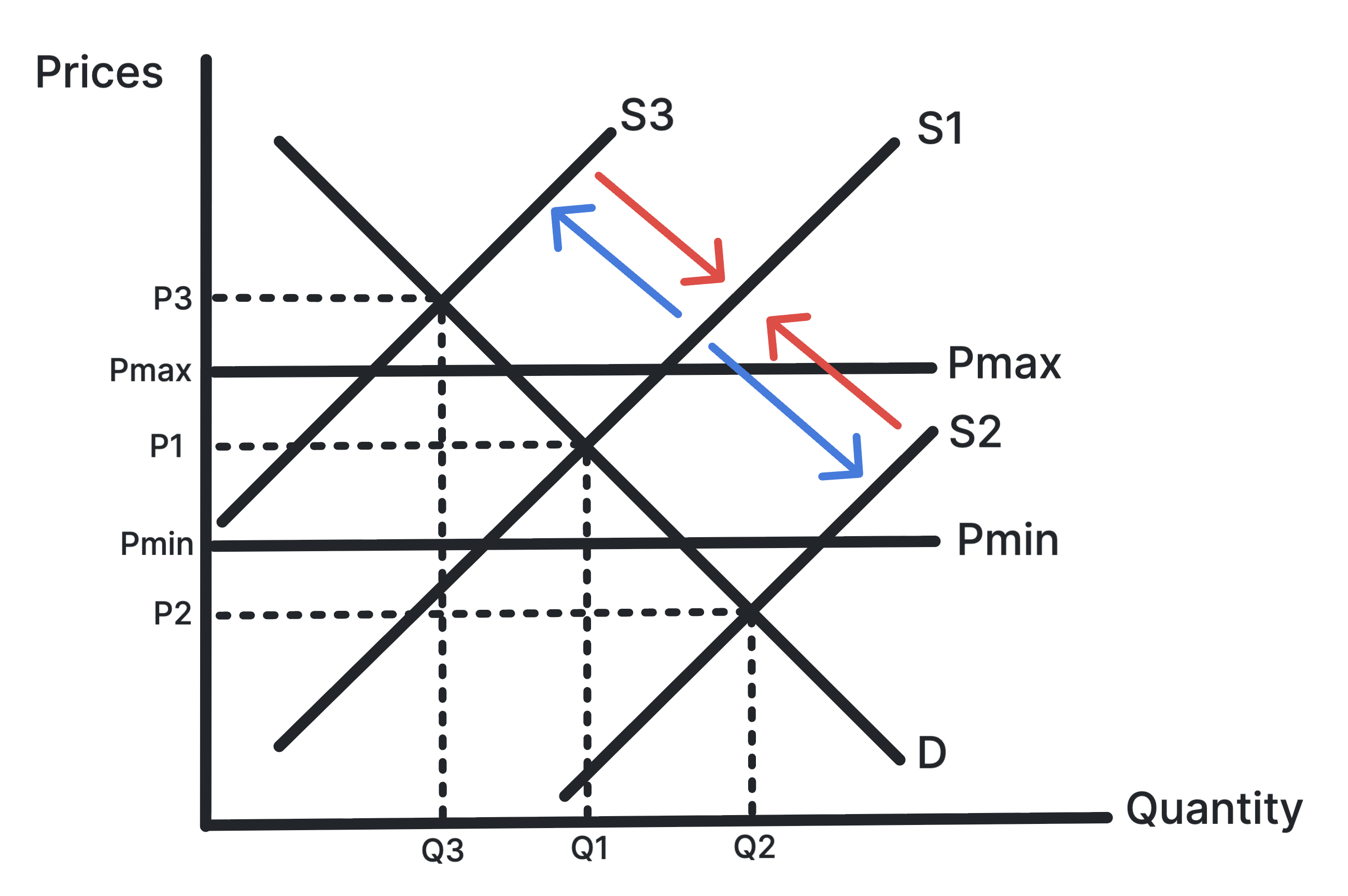
How Buffer Stock Schemes Work
A buffer stock scheme involves the government or an international organisation buying a commodity when prices are low (due to high supply) and selling it when prices are high (due to low supply). This helps to stabilise prices and income for producers, which can encourage investment in the sector and support overall economic development.
The Role of Aid in Promoting Development
There are three main forms of aid that can promote development:
- Humanitarian aid: Short-term assistance provided in response to emergencies, such as natural disasters or conflicts. It can help save lives and provide basic needs, but may not contribute to long-term development.
- Debt relief: Cancelling or restructuring a country's debt can free up resources for investment in development projects, such as education, healthcare, and infrastructure. However, it may not address underlying structural issues that hinder development.
- Official Development Assistance (ODA): Soft loans and grants provided by governments or international organisations to support development projects. ODA can help build infrastructure, improve education and healthcare, and promote economic growth. However, soft loans may create dependency and may not be effective if problems like corruption exist.
Stuck on this topic? Work through it with an online A-Level Economics tutor in a free 15-minute intro call, or send an essay on it for A-Level Economics essay marking.