Inflation and Deflation
Definitions: Inflation, Deflation, Disinflation
Inflation: A sustained increase in the general/average price level of goods and services in an economy.
Deflation: A sustained decrease in the general/average price level, giving a negative inflation rate.
Disinflation: A decrease in the rate of inflation. Prices are still rising, but at a slower pace.
Limitations of the CPI
Not Representative: The average basket may not reflect the spending patterns of different households, such as pensioners and students.
Regional Variations: CPI ignores differences in price changes across the country.
Quality Changes: It does not fully account for improvements in product quality over time.
Substitution Bias: It can be slow to reflect when consumers switch to cheaper alternatives.
Data Collection Errors: It is based on a sample survey, which can be inaccurate.
Causes of Inflation
Demand-Pull Inflation
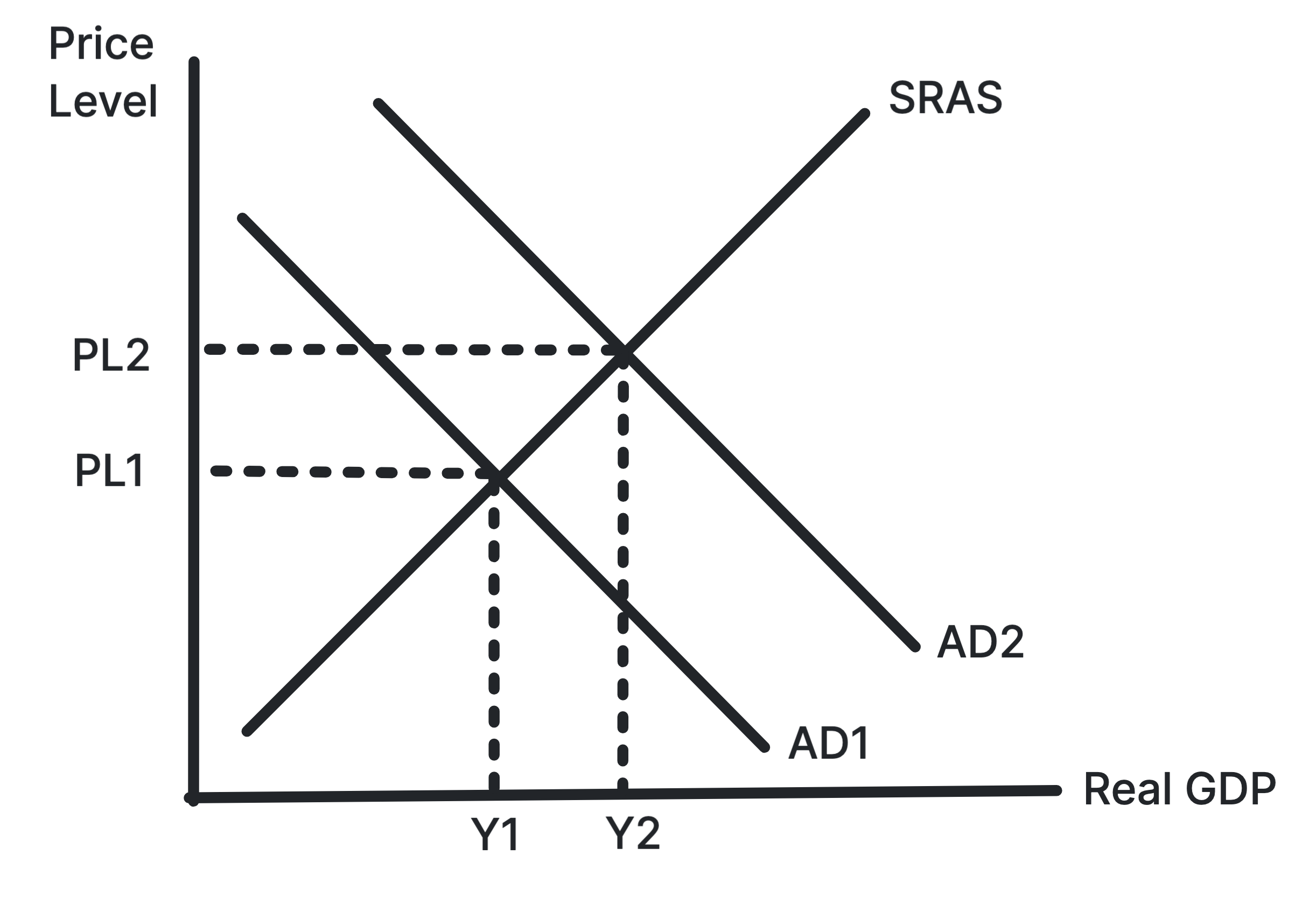
Demand-pull inflation: occurs when there is an increase in aggregate demand (AD), leading to upward pressure on prices.
Causes: Higher consumer confidence, higher government spending, lower taxes, lower interest rates, and stronger export demand etc. Anything that increases Consumption (C), Investment (I), Government Spending (G) or Net Exports (X-M) can cause demand-pull inflation.
Cost-Push Inflation
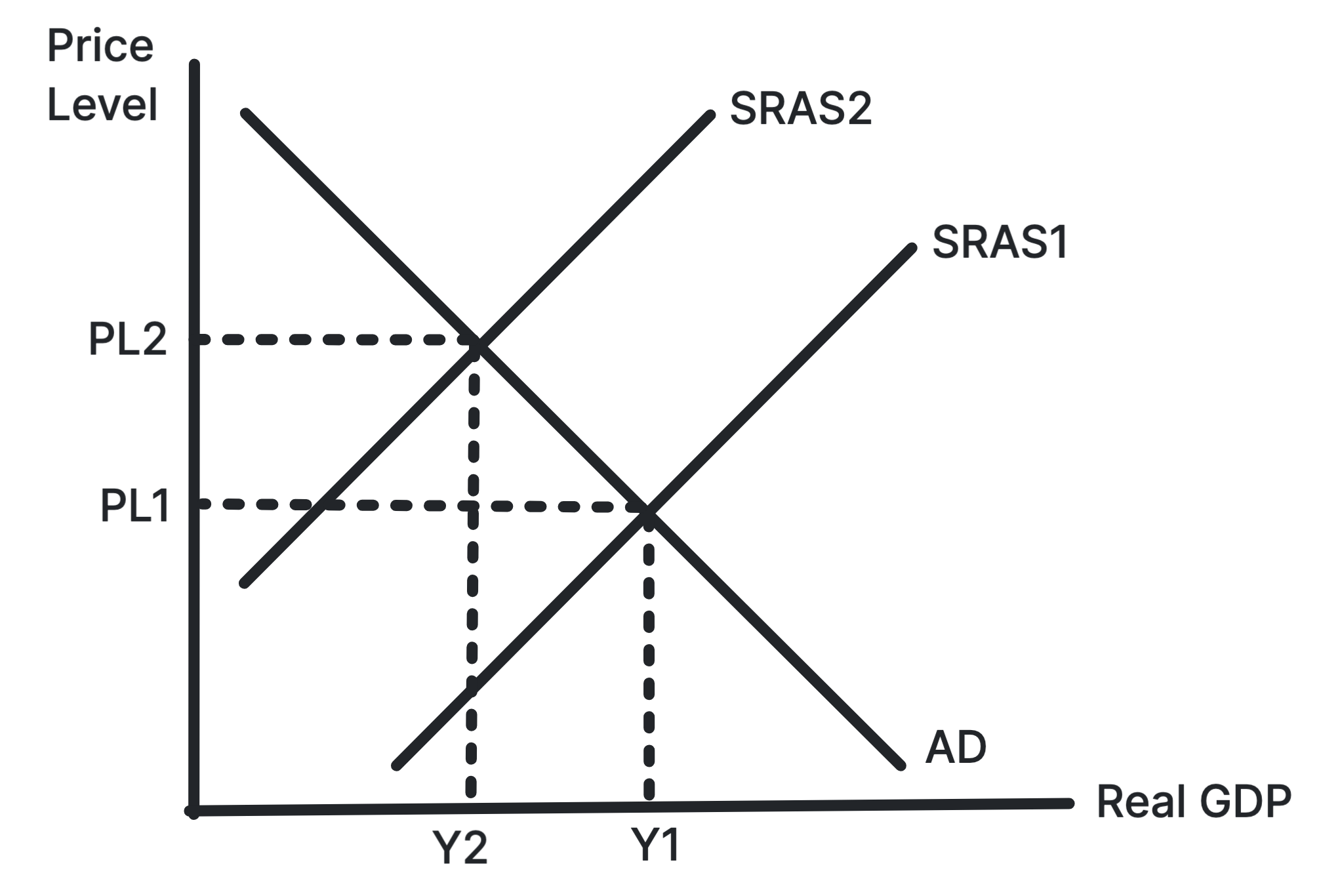
Cost-push inflation: Occurs when there is rise in the costs of production for firms, shifting the SRAS curve leftwards.
Causes: Higher global commodity prices, higher wages, higher indirect taxes, supply chain shocks, and a depreciation of the currency which increases import costs.
Growth of the Money Supply
Excessive growth in the money supply, such as through quantitative easing, can fuel demand-pull inflation and cost-push inflation.
- A large increase in the money supply can lead to higher consumer spending and demand-pull inflation as it results in lower interest rates at commercial banks and increased borrowing.
- An increase in the money supply can lead to higher production costs and cost-push inflation. For example, it can lead to a depreciation of the currency, which increases the cost of imported raw materials and components for firms.
- An increase in the money supply can lead to higher asset prices, which can increase the cost of capital for firms and lead to cost-push inflation.
Wage-Price Spiral
A vicious cycle where rising prices in the economy lead to higher wage demands from workers, which in turn increases firms' costs and leads to further price increases, which cause workers to demand even higher wages. This can sustain inflation even if the initial cause has been resolved.
Effects of Inflation
| Stakeholder | Potential Negative Effects |
|---|---|
| Consumers |
|
| Firms |
|
| Government/Economy |
|
| Workers |
|
Effects of Deflation
| Stakeholder | Potential Negative Effects |
|---|---|
| Consumers |
|
| Firms |
|
| Government/Economy |
|
| Workers |
|
The Quantity Theory of Money
The quantity theory of money is a classical economic theory that explains the relationship between the money supply and the price level in an economy. It is often expressed using Fisher's equation of exchange:
Where:
- M = Money supply
- V = Velocity of money (the rate at which money circulates in the economy)
- P = Price level
- Q = Real output (quantity of goods and services produced)
According to the theory, if the money supply (M) increases while the velocity of money (V) and real output (Q) remain constant, the price level (P) will rise, leading to inflation. Conversely, if the money supply decreases, it can lead to deflation. The theory suggests that controlling the money supply is crucial for maintaining price stability in the economy.
Stuck on this topic? Work through it with an online A-Level Economics tutor in a free 15-minute intro call, or send an essay on it for A-Level Economics essay marking.