Fiscal Policy
Fiscal Policy
Fiscal policy: Managed by the government. It is the manipulation of government spending (G) and taxation (T) to meet a desired macroeconomic objective.
Expansionary fiscal policy: aims to increase AD.
- Increase government spending
- Decrease taxation
Contractionary fiscal policy: Aims to reduce AD.
- Decrease government spending
- Increase taxation
Types of Taxation
- Direct taxes: Taxes on income or profits, such as Income Tax and Corporation Tax.
- Indirect taxes: Taxes on spending, such as VAT or Fuel Duty.
The Government Budget
Budget deficit: \( G > T \). This means government spending is greater than tax revenue, so the government must borrow and national debt rises.
Budget surplus: \( T > G \). This means tax revenue is greater than government spending, so the surplus can be used to repay debt.
Balanced budget: \( G = T \).
How Fiscal Policy Affects Aggregate Demand
Increasing Government Spending
The government can spend money on:
- Education
- Healthcare
- Infrastructure
- Research and Development
In any case, when the government increases its expenditure, this increases the G component of AD. Consequently, Aggregate Demand increases and shifts right.
Decreasing Taxes
Depending on which taxes are changes, the impacts on the components of AD differ:
Consumption:
- A fall in income tax increases disposable incomes, resulting in higher consumption.
- A fall in indirect taxes makes goods/services more affordable for consumers, resulting in higher consumption.
Investment:
- A fall in corporation tax increases retained profit for businesses, resulting in more funding available for investment.
- A fall in indirect taxes decreases costs of production for businesses, increases funding available for investment.
Exports:
- A fall in corporation tax can enable domestic firms to reinvest to improve productivity/quality and improve international competitiveness, resulting in a rise in export demand.
- A fall in indirect taxes makes exports relatively cheaper, resulting in a rise in export demand.
Imports:
- A fall in income tax increases disposable incomes for consumers, resulting in a rise in demand for imports.
- A fall in indirect taxes makes domestic goods relatively cheaper, resulting in a fall in demand for imports.
The overall impact will be an increase in aggregate demand, resulting in an outward shift.
Impacts of Fiscal Policy
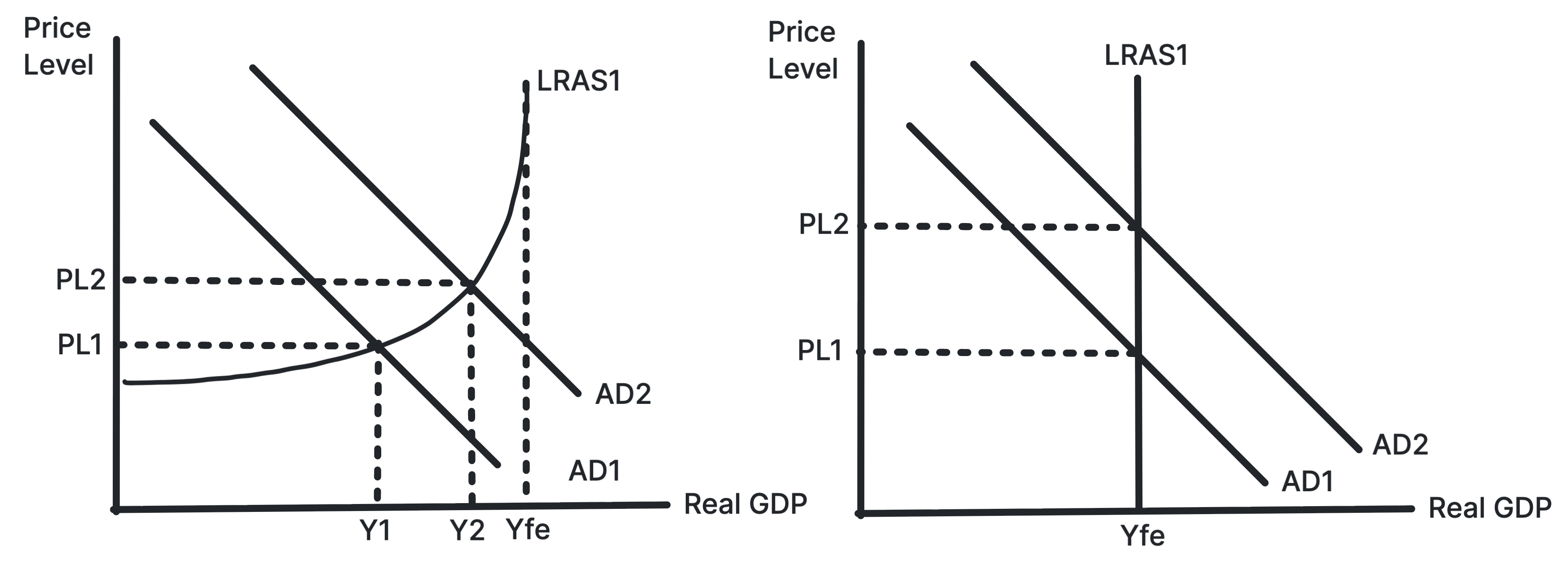
Aggregate Demand shifts right from AD1 to AD2, resulting in a higher level of output/real GDP of Y2 and a higher price level of PL2. The impacts on the macroeconomic objectives are as follows:
- Economic growth: Increases since real GDP increases from Y1 to Y2.
- Inflation: Increases since the price level rises from PL1 to PL2.
- Employment: Increases since there is a higher demand for goods and services. Therefore the derived demand for labour rises, so unemployment falls.
- Balance of Payments: This may increase or decrease depending on the type of expansionary fiscal policy implemented. If income tax is decreased, the balance of payments worsens, but if indirect taxes are decreased, then the balance of payment improves.
- Income/wealth distribution: Typically, expansionary fiscal policy leads to an improvement in equality. Government spending tends to be aimed at providing services that lower income households would otherwise be unable to afford e.g. education/healthcare. Additionally, income tax is progressive meaning higher income households pay a greater proportion of their income in tax.
- Environmental sustainability: Higher consumption and investment can increase resource use and pollution, which may worsen environmental sustainability.
- Government budget: Expansionary fiscal policy increases the size of the government budget deficit, and increases the national debt.
Evaluations of Government Spending and Taxes
Increasing Government Spending
- Crowding-out effect: Since the UK government consistently runs a government budget deficit, when they decide to increase spending further they must increase their borrowings. This acts as a significant increase in demand in the money market, and hence causes interest rates across the economy to rise. This increases the cost of borrowing for firms and therefore investment falls, offsetting the rise in AD.
- Opportunity Cost: Any spending by the government reduces the ability for this money to be spent elsewhere. Therefore if the government expenditure is not spent effectively, it creates a significant opportunity cost.
- Budget Deficit and National Debt: A rise in spending increases the budget deficit and the national debt. Unsustainable rises in national debt can lead to more expensive borrowing in the future, and a larger taxation burden for future generations. It can also reduce confidence in the economy and reduce inward FDI.
- Multiplier/Confidence: The effectiveness of government spending depends on the size of the multiplier. When confidence is high, the size of the multiplier is likely to be greater and thus government spending will generate greater economic growth.
- Time Lags: Some government spending policies have significant time lags and therefore the effects will not be seen in the short term. For example, education reforms may take 10+ years to have a substantial impact on the labour force.
Lowering Taxes
- Confidence: The impact of lower taxes depends on consumer and business confidence. If income tax/corporation tax falls, the proportion of additional disposable income spending/retained profits invested depends on the state of the economy and the outlook that consumers/firms have for the future of the economy.
- Budget Deficit and National Debt: A fall in taxes increases the budget deficit and the national debt. Unsustainable rises in national debt can lead to more expensive borrowing in the future, and a larger taxation burden for future generations. It can also reduce confidence in the economy and reduce inward FDI.
- Ricardian Equivalence: This is a theory that suggests consumers/firms anticipate future tax raises following a reduction in taxes. Consequently, firms and consumers do not react to lower taxes by increases consumption/investment, but instead save their additional income for the higher future taxes.
- Laffer Curve: This is a very strong evaluation for taxation changes.
The Laffer Curve and Tax Revenue
The Laffer Curve shows the theoretical relationship between tax rates and total tax revenue.
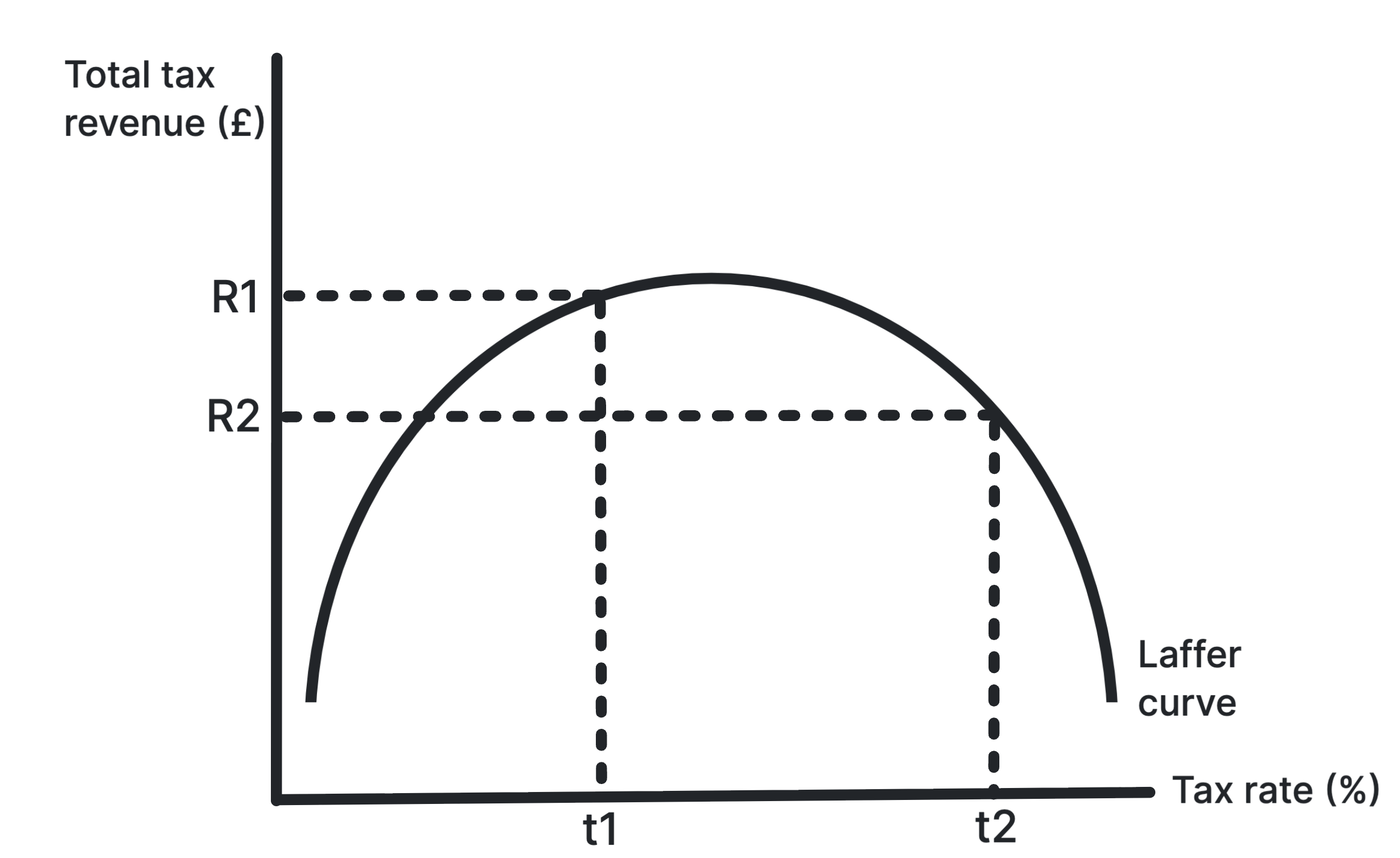
The Laffer Curve suggests that there is an optimal tax rate that maximises revenue. Tax rates above this point can lead to decreased revenue due to:
- Reduced incentives to work and invest: Higher tax rates can discourage individuals from working or investing, leading to lower economic activity and reduced tax revenue.
- Increased tax avoidance and evasion: Higher tax rates can incentivise individuals and businesses to find ways to avoid or evade taxes, reducing the overall tax base.
- Brain drain and capital flight: High tax rates can encourage skilled workers and businesses to relocate to countries with lower tax rates, reducing the domestic tax base and overall revenue.
As shown on the diagram, increasing the tax rate from t1 to t2 leads to a decrease in tax revenue from R1 to R2, as the higher tax rate reduces incentives to work and invest, leading to lower economic activity and tax revenue.
Types of Government Spending
Current Expenditure
Current expenditure is day-to-day spending on public sector wages, such as payments to teachers and nurses, and on the consumption of goods and services such as medicines and utilities.
Capital Expenditure
Capital expenditure is long-term investment in infrastructure and assets such as roads, hospitals, and schools.
This can increase the economy's productive potential.
Transfer Payments
Transfer payments are payments where no good or service is received in return, such as pensions, unemployment benefits, and subsidies.
They help redistribute income but do not directly add to GDP.
Reasons for Changes in Size and Composition
- Economic growth can increase tax revenue and reduce the need for transfer payments, allowing more spending on public services.
- Demographic changes such as an ageing population can increase spending on pensions and healthcare.
- Political priorities can shift spending towards certain sectors, such as education or defence.
- External shocks such as recessions or pandemics can increase transfer payments and require stimulus spending.
- Technological change can alter the cost and nature of public services, such as the need for digital infrastructure.
Types of Taxes
Direct Taxes vs Indirect Taxes
Direct taxes are levied on income or profits, such as income tax, corporation tax, and National Insurance.
These often tend to be progressive.
Indirect taxes are levied on spending, such as VAT and excise duties.
These often tend to be regressive.
Economic Effects of Changes in Tax Rates
| Economic Variable | Explanation |
|---|---|
| Incentives to Work | Higher income taxes can reduce the incentive to work, as individuals retain a smaller proportion of their earnings. This can lead to a decrease in labour supply and potentially lower productive capacity in the economy. |
| Income Distribution | Progressive taxes (e.g. income tax) can help reduce income inequality by redistributing wealth from higher-income individuals to fund public services and welfare programmes. Conversely, regressive taxes (e.g. VAT) can exacerbate income inequality, as lower-income households spend a larger proportion of their income on taxed goods and services. |
| Real Output and Employment | Changes in tax rates can influence aggregate demand and supply, thereby affecting real output and employment. Higher taxes can reduce disposable income and consumption, potentially leading to lower demand for goods and services and a decrease in employment. |
| Price Level | Changes in tax rates can influence the overall price level in the economy. Higher indirect taxes, such as VAT, can increase the cost of goods and services, decreasing SRAS leading to higher cost-push inflation. |
| Trade Balance | Changes in tax rates can affect the trade balance by influencing domestic consumption and production. Higher taxes can reduce disposable income and consumption, potentially leading to lower imports. However, if higher taxes reduce domestic production, it may lead to increased imports to meet demand, worsening the trade balance. |
| FDI | Changes in tax rates can influence foreign direct investment (FDI) by affecting the after-tax returns on investment. Higher corporate taxes can reduce the attractiveness of a country for foreign investors, potentially leading to lower FDI inflows. Conversely, lower corporate taxes can attract more FDI, boosting economic growth and employment. |
Types of Tax Systems
Progressive Tax: A tax where the percentage of income paid in tax rises as income rises. Examples include income tax and inheritance tax.
Proportional Tax: A tax where the percentage of income paid in tax remains constant regardless of income level. There are few examples of purely proportional taxes, but some flat-rate taxes can be considered proportional.
Regressive Tax: A tax where where the percentage of income paid in tax falls as income rises. Examples include VAT and demerit good taxes e.g. tobacco and alcohol duties.
The Government Budget and National Debt
The Government Budget shows the planned levels of government spending and taxation for a given period. It is calculated as follows:
\[ \text{Government Budget} = \text{Taxation Revenue} - \text{Government Spending} \]
Fiscal deficit: The amount by which government spending exceeds taxation revenue in a given period. This resets each year.
\[ \text{Fiscal Deficit} : \text{Government Spending} > \text{Tax Revenue} \]
National debt: The total amount of money that a government owes to creditors. This is the accumulation of past deficits and surpluses over time.
Cyclical and Structural Deficits
Cyclical deficit: A deficit that occurs due to the economic cycle, typically widening during recessions and narrowing during booms, as tax revenue and government spending fluctuate with economic activity.
Structural deficit: A deficit that exists even when the economy is operating at its potential output, indicating a fundamental imbalance between government spending and taxation that is not related to the economic cycle.
Factors Influencing the Size of Deficits and Debt
- Economic Growth: Strong growth increases tax revenue and reduces welfare spending, helping to reduce deficits and debt.
- Interest Rates: Higher interest rates increase the cost of servicing debt, potentially leading to larger deficits.
- Government Spending Priorities: Decisions on public services, infrastructure, and welfare can influence the size of deficits and debt.
- Taxation Policy: Changes in tax rates and structures can affect revenue collection and the fiscal balance.
- Demographic Changes: An ageing population can increase welfare spending and healthcare costs, contributing to higher deficits and debt.
- External Shocks: Events such as financial crises, pandemics, or natural disasters can lead to increased government spending and reduced tax revenue, affecting deficits and debt levels.
Significance of Fiscal Deficits and Debt
- Economic Stability: Large deficits and debt can undermine confidence in the government's ability to manage public finances, potentially leading to higher borrowing costs and reduced investment.
- Intergenerational Equity: High levels of debt may place a financial burden on future generations, who will be responsible for repaying it.
- Inflationary Pressures: Financing deficits by printing money can lead to inflation, eroding the value of money and savings.
- Policy Flexibility: High debt levels may limit the government's ability to implement fiscal policy, reducing its capacity to respond to economic shocks or crises.
- Credit Ratings: Persistent deficits and high debt levels can lead to downgrades in a country's credit rating, increasing borrowing costs and potentially leading to a debt crisis.
The Office for Budget Responsibility (OBR)
The Office for Budget Responsibility (OBR) is an independent body that provides economic and fiscal forecasts to the UK government. It was established in 2010 to improve the transparency and credibility of fiscal policy.
The OBR's main functions include:
- Economic Forecasting: The OBR produces independent forecasts of the UK economy, including GDP growth, inflation, employment, and other key economic indicators.
- Fiscal Forecasting: The OBR provides forecasts of government revenue, spending, and the budget balance, helping to inform fiscal policy decisions.
- Monitoring Fiscal Policy: The OBR assesses the government's fiscal policy and its impact on the economy, providing analysis and recommendations to ensure sustainable public finances.
- Accountability and Transparency: The OBR publishes reports and analysis on the government's fiscal performance, promoting transparency and accountability in public finances.
Stuck on this topic? Work through it with an online A-Level Economics tutor in a free 15-minute intro call, or send an essay on it for A-Level Economics essay marking.