Central Banks and Monetary Policy
The Functions of Central Banks
Central bank: A national bank that provides financial and banking services for a country's government and commercial banks. It is responsible for managing the country's currency, money supply, and interest rates. The central bank in the UK is the Bank of England.
The main functions of a central bank are:
- Issuing currency: The central bank has the sole authority to issue the national currency, which helps maintain the stability and integrity of the monetary system.
- Managing the money supply: The central bank controls the supply of money in the economy through monetary policy, which can influence inflation, interest rates, and economic growth.
- Setting interest rates: The central bank sets the base interest rate, which influences borrowing and lending rates throughout the economy. This helps control inflation and stabilise the economy.
- Acting as a lender of last resort: In times of financial crisis, the central bank can provide emergency funding to commercial banks and other financial institutions to prevent their collapse and maintain stability in the financial system.
- Regulating and supervising banks: The central bank oversees the banking system to ensure that banks operate safely and soundly, protecting depositors and maintaining confidence in the financial system.
Monetary Policy
Monetary policy: Managed by the Bank of England, which is independent. It is the manipulation of interest rates and the money supply to meet a desired macroeconomic objective.
Expansionary monetary policy: aims to increase AD.
- Lower the base interest rate set by the Bank of England
- Increase the money supply through quantitative easing (QE).
Contractionary monetary policy: Aims to reduce AD.
- Raise the base interest rate set by the Bank of England
- Reduce the money supply through quantitative tightening (QT).
How Interest Rates Affect AD
Interest rates: the cost of borrowing and the reward for saving.
They impact aggregate demand through the transmission mechanism:
- Consumption: Lower interest rates decrease the cost of borrowing and reduce the reward for saving. This incentivises consumers to increase consumption (MPC rises). Additionally, lower interest rates increase disposable income for consumers with a variable rate loan e.g. a mortgage, so consumption rises further.
- Investment: Lower interest rates decrease the cost of borrowing for firms, so investment rises.
- Net exports (X-M): Lower interest rates reduce the return on savings in the UK, so foreign investors may sell their pounds to invest elsewhere. This is known as hot flows of money leaving the UK. This increases the supply of pounds in the foreign exchange market, causing the pound to depreciate. A weaker pound makes UK exports cheaper and imports more expensive, so net exports rise.
Therefore, Aggregate Demand (AD) rises when interest rates fall, and AD falls when interest rates rise.
Impacts of Monetary Policy
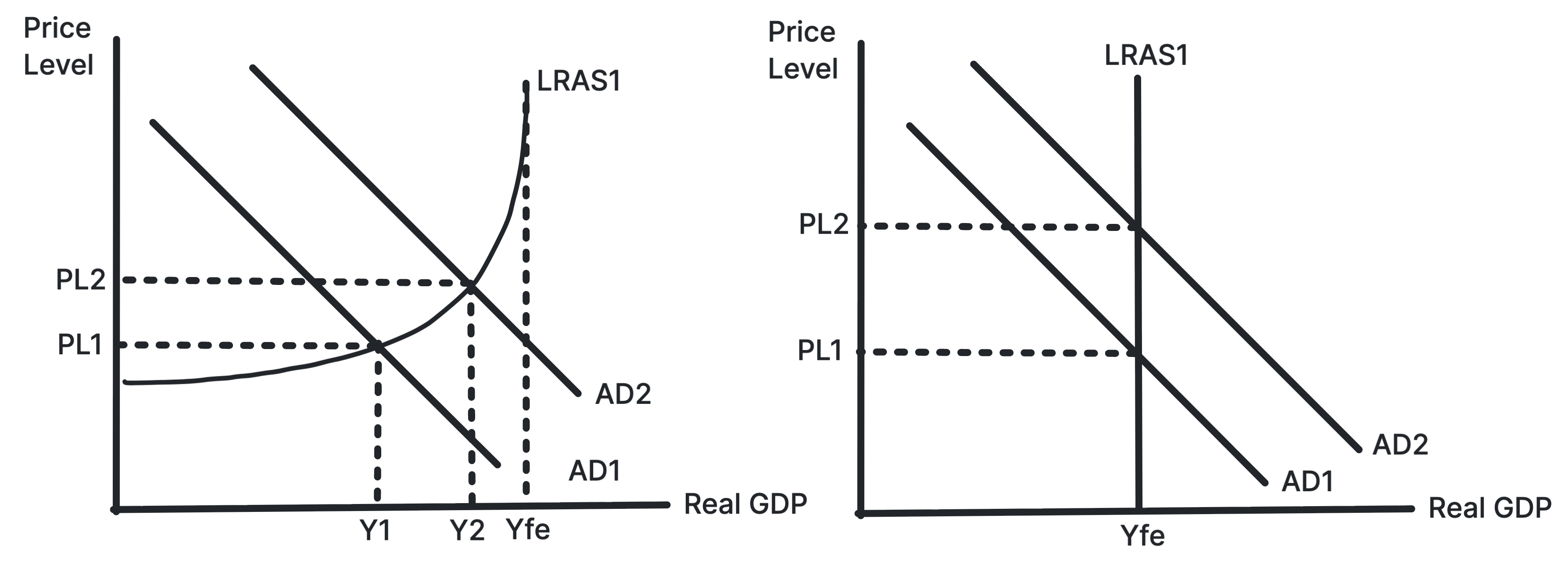
Aggregate Demand shifts right from AD1 to AD2, resulting in a higher level of output/real GDP of Y2 and a higher price level of PL2. The impacts on the macroeconomic objectives are as follows:
- Economic growth: Increases since real GDP increases from Y1 to Y2.
- Inflation: Increases since the price level rises from PL1 to PL2.
- Employment: Increases since there is a higher demand for goods and services. Therefore the derived demand for labour rises, so unemployment falls.
- Balance of Payments: Improves since the weaker pound makes UK exports cheaper and imports more expensive, so net exports rise.
- Income/wealth distribution: Lower interest rates can inflate asset prices, which benefits the wealthy who own more assets. This can worsen income and wealth inequality. For example, lower interest rates make mortgages cheaper, increasing the demand for housing and driving up house prices, which benefits homeowners but makes it harder for first-time buyers to enter the market.
- Environmental sustainability: Higher consumption and investment can increase resource use and pollution, which may worsen environmental sustainability.
- Government budget: Lower interest rates reduce the cost of government borrowing, which can improve the government budget position.
How Quantitative Easing Works
- The central bank prints additional money. This can be physically printed or created digitally.
- The central bank uses this money to buy government bonds from financial institutions, such as commercial banks like Barclays or HSBC.
- This increases the liquidity of commercial banks (the amount of cash they hold), which increases incentive for banks to increase their supply of loans to maximise their profits.
- To increase the supply of loans, banks must lower the interest rate to incentivise firms and consumers to take out additional loans. Thus the commercial interest rate has fallen.
From this point, the lower commercial interest rates have an almost identical effect to the lower central bank interest rates. Consumption, investment, and net exports rise, which increases aggregate demand and shifts the AD curve to the right.
Evaluations to Interest Rates and Quantitative Easing
- Time lags: Monetary policy can take a long time to have an effect on the economy, sometimes up to two years. This is because it can take time for consumers and firms to respond to lower interest rates. For example, consumers that are on fixed rate mortgages may not be impacted by lower interest rates, and firms may take time to plan and implement new investment projects.
- Liquidity trap: This occurs when interest rates are already very low and close to their 0% lower bound, so further cuts have little effect on consumption and investment. In this case, monetary policy may be ineffective at stimulating aggregate demand and quantitative easing may be needed to increase the money supply and encourage lending.
- Asset price bubbles: Lower interest rates can inflate asset prices, which can create bubbles in markets such as housing or stocks. If these bubbles burst, it can lead to a financial crisis and economic downturn.
- Confidence: If consumer or business confidence is low, then lower interest rates may not lead to higher consumption or investment. For example, during a recession, consumers may choose to save rather than spend, and firms may delay investment due to uncertainty about future demand.
The Monetary Policy Transmission Mechanism
The monetary policy transmission mechanism is the process by which changes in monetary policy affect the economy and ultimately influence macroeconomic variables such as inflation, output, and employment.
- Interest rate channel: Lower interest rates reduce the cost of borrowing and increase the incentive to spend and invest, which can increase aggregate demand.
- Credit channel: Lower interest rates can increase the availability of credit, which can increase consumption and investment.
- Exchange rate channel: Lower interest rates reduce the relative attractiveness of saving in the domestic currency, which can lead to a depreciation of the currency as foreign investors sell their "hot money" to invest elsewhere. A weaker currency can increase exports and reduce imports, which can increase aggregate demand.
- Asset price channel: Lower interest rates can increase asset prices, such as stocks and real estate, which can increase household wealth and consumption.
Stuck on this topic? Work through it with an online A-Level Economics tutor in a free 15-minute intro call, or send an essay on it for A-Level Economics essay marking.