Research and Development (R&D) and Innovation
R&D and Innovation
Research and development (R&D): the work a business does to discover new knowledge and turn it into new products or new ways of making them.
Innovation: turning a new idea into a product or process that is actually sold or used.
An invention is the idea itself. It only becomes an innovation when it reaches the market or the factory floor, and many inventions never do.
Product and Process Innovation
Product innovation: a new or improved good or service, such as a bakery launching a gluten-free range.
Process innovation: a new or improved way of producing or delivering a product, such as the same bakery installing ovens that bake twice as many loaves an hour.
- Product innovation: something rivals do not offer → the product is differentiated and demand becomes less price elastic → the firm can charge a higher price → higher revenue and profit.
- Process innovation: output per worker or per machine rises → lower average cost → the firm can cut its price to win customers, or keep it and take a wider margin.
Competitive Advantage Through Innovation
Competitive advantage: something that lets a firm win customers from its rivals and earn more profit than they do (unit 1.3.6).
The first firm to launch gets a head start, building a brand and loyal customers before rivals arrive. Rivals left behind lose sales, which is creative destruction at work (unit 1.2.1).
Whether innovation pays depends on:
- How easily rivals can copy: a new flavour can be copied in weeks, while a complex technology or a patented design can take years.
- Cost and risk: R&D is expensive and many projects fail. A small firm may not be able to afford the losses, and the payoff can take years to arrive.
Innovation and Market Power
Patent: a legal right that lets an inventor take action against anyone who makes or sells their invention without permission. A UK patent lasts up to 20 years if it is renewed each year.
Patents are what link R&D to market power. Successful R&D → the firm patents the result → rivals cannot sell a copy → the firm is the only supplier and can set a high price → high profits for the life of the patent.
That prospect is the incentive to spend on risky R&D. Without protection, a rival could copy the product without paying any of the development cost.
For consumers there are two sides:
- Losers in the short run: one supplier → higher prices while the patent lasts.
- Winners in the long run: the profit pays for more R&D → new products that might not exist otherwise. When the patent ends, rivals enter and prices fall, as with cheaper copies of a medicine.
Patents are one barrier to entry among several (unit 4.1.2).
The Role of State Funding
Left to the market, firms spend less on R&D than is best for society, for two reasons:
- Spillovers: new knowledge spreads to other firms and to consumers, who gain without paying. This is a positive externality (unit 1.5.1), so the firm that pays for the research does not get all the benefit.
- Risk: basic research, such as into new materials or medicines, may take decades to pay off, or never pay off at all.
The UK government supports R&D in two main ways:
- Tax relief: companies that pay corporation tax can claim R&D tax relief on qualifying projects in science and technology.
- Grants: Innovate UK, part of UK Research and Innovation, gives grants and loans to businesses for innovation projects.
State funding → R&D costs firms less → more projects are worth doing → more innovation → higher productivity and economic growth.
How well it works depends on:
- Choosing well: officials may back projects that fail, and have less at stake than an investor using their own money.
- Paying for what would have happened anyway: if a firm would have done the research without help, the subsidy just adds to its profit.
The Product Life Cycle
Product life cycle: the stages a product's sales pass through over time, from launch to withdrawal.
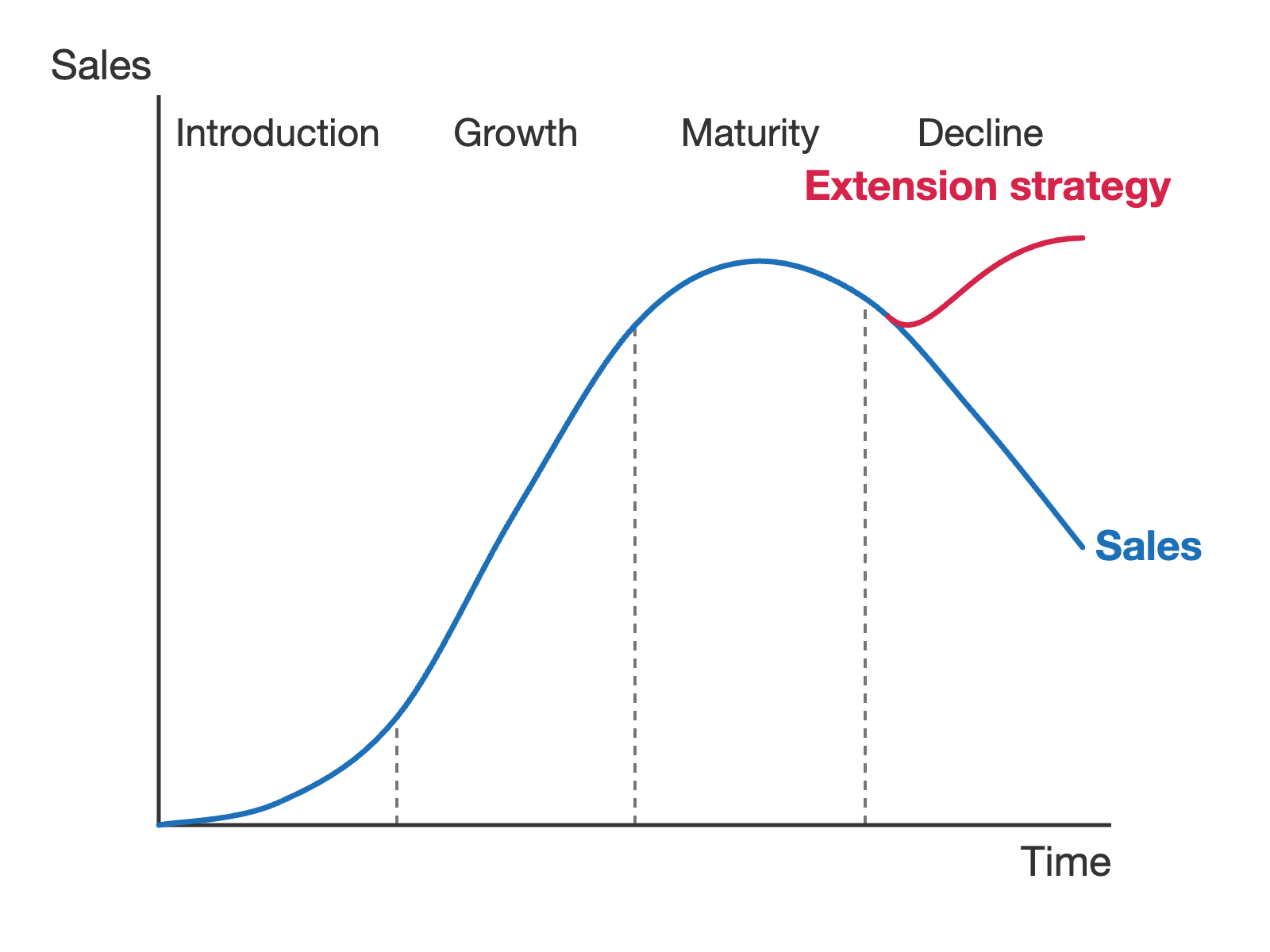
| Stage | Sales | Profit and cash flow | What the firm does |
|---|---|---|---|
| Introduction | Low, as few customers know the product | Usually a loss: R&D and launch costs are still being paid | Heavy promotion; a high or low launch price |
| Growth | Rising fast | Profit appears, and cash flow turns positive | Widens distribution; rivals start to enter |
| Maturity | High, but levelling off | Highest profit, as costs are spread over high sales | Defends market share; considers extension |
| Decline | Falling, as tastes change or better products arrive | Profit falls | Cuts spending, extends the product or withdraws it |
Firms try to hold a balanced portfolio: mature products earn the cash that pays for launching new ones. A firm whose products all reach decline at once has nothing to replace them.
Extension Strategies
Extension strategy: action taken to lengthen a product's life by lifting sales when they level off or start to fall.
- New markets: selling abroad or to a new type of customer, such as a children's drink relaunched for adults.
- Repackaging or redesign: a new look, size or version that makes the product feel new.
- New uses: finding another reason to buy it, such as a cleaning product marketed for a second job.
- Price changes: a price cut or promotion to win back price-sensitive buyers.
An extension → sales rise again → more revenue from a product whose development is already paid for → cash to fund the next new product.
Whether it is worth it depends on:
- Why sales are falling: a new pack will not save a product that newer technology has replaced.
- Cost against reward: a relaunch costs money, and the same budget might earn more spent on a new product.
Say which kind of innovation it is. Product innovation wins through differentiation and a higher price; process innovation wins through lower average cost. "It makes the firm more competitive" earns little until you name the route and take the chain through to profit.
Stuck on this topic? Work through it with an online A-Level Economics tutor in a free 15-minute intro call, or send an essay on it for A-Level Economics essay marking.