Barriers to Entry
Contestability and Ease of Entry
Barriers to entry: anything that makes it hard or costly for a new firm to start selling in a market.
Contestable market: a market where barriers to entry and exit are low, meaning firms can easily and cheaply enter and leave the market.
Contestability is about the threat of new rivals, not the number of firms already there. A market with two firms can still be contestable if others could join quickly. That threat is enough to change how the two behave.
What makes leaving costly is sunk costs: money spent on entering that cannot be got back on exit, such as advertising or equipment with no resale value. Low sunk costs make hit-and-run entry possible, where a firm joins to take a share of high profits and leaves when they fall.
In a contestable market, existing firms respond to the threat:
- Prices: high profits would attract entrants → firms keep prices close to average cost, a tactic called limit pricing → consumers pay less and firms earn close to normal profit.
- Quality and costs: an entrant could win customers with a better or cheaper product → firms keep costs down and service up → consumers gain even with few firms in the market.
Types of Barrier to Entry
Product Differentiation
Product differentiation means making a product different from rivals', through design, quality or features customers value. The more customers see a product as unique, the fewer substitutes a new firm can offer them, so it has to spend heavily to win anyone over.
Branding
A strong brand builds loyalty, so customers keep buying even when a newcomer is cheaper. An entrant has to spend large sums on advertising just to be noticed, and that spending is a sunk cost if it fails. Think of a new cola trying to take customers from Coca-Cola.
Start-Up Costs
Some markets need huge spending before the first sale: a factory, a fleet of aircraft or a network of phone masts. Few firms can raise that money, and lenders see a newcomer as risky. A market stall or a dog-walking business, by contrast, costs very little to start.
Intellectual Property Rights
Intellectual property rights: legal rights over ideas and creative work, such as patents, trademarks and copyright.
A UK patent lets the inventor stop others making or selling an invention for up to 20 years, renewed each year. A drug company with a patent on a new medicine is a monopoly supplier of it until the patent runs out and cheaper copies can enter.
R&D and Technology Change
Firms that spend heavily on research and development (R&D) build up know-how and products that newcomers cannot match quickly. But technology change can also knock barriers down. Online selling let small retailers reach customers without a high-street shop, and streaming let new firms compete with TV channels without a broadcast licence.
Legal Barriers
Some markets need permission to trade. A taxi firm needs a licence from the local licensing authority, and a bank must be authorised before it can take deposits. Licences limit the number of firms, or make entry slow and costly.
Anti-Competitive Practices
Established firms can also raise barriers on purpose. Predatory pricing means cutting prices below cost until a newcomer gives up, then raising them again. Exclusive dealing ties retailers to one supplier, and a dominant firm may refuse to supply shops that stock a rival. Competition law bans these when a dominant firm uses them (unit 4.2.2).
How Barriers Shape Market Structure
The height of the barriers decides how many firms a market can hold, and so where it sits on the spectrum of competition (unit 4.1.1):
- High barriers: new firms are kept out → a few firms or one firm supplies the market → oligopoly or monopoly → firms keep supernormal profit in the long run and can charge consumers more.
- Low barriers: new firms enter whenever profits are high → many firms compete → monopolistic or near-perfect competition → profit is competed down to normal and prices fall towards average cost.
How much a barrier protects existing firms depends on:
- How long it lasts: patents expire and brands can fade, so supernormal profit may only be temporary.
- Technology: new ways of producing or selling can make an old barrier irrelevant.
- The size of the entrant: a large firm from another market can afford start-up costs and advertising that would stop a small business.
- Regulation: competition authorities can block mergers or practices that raise barriers on purpose (unit 4.2.2).
Economies of Scale
Economies of scale: the fall in long-run average cost as a firm increases its scale of production.
As a firm grows, its long-run average cost falls until it reaches the minimum efficient scale (MES), the lowest output at which average cost is as low as it can go. Grow too large and diseconomies of scale, such as slow communication and poor coordination, push average cost back up.
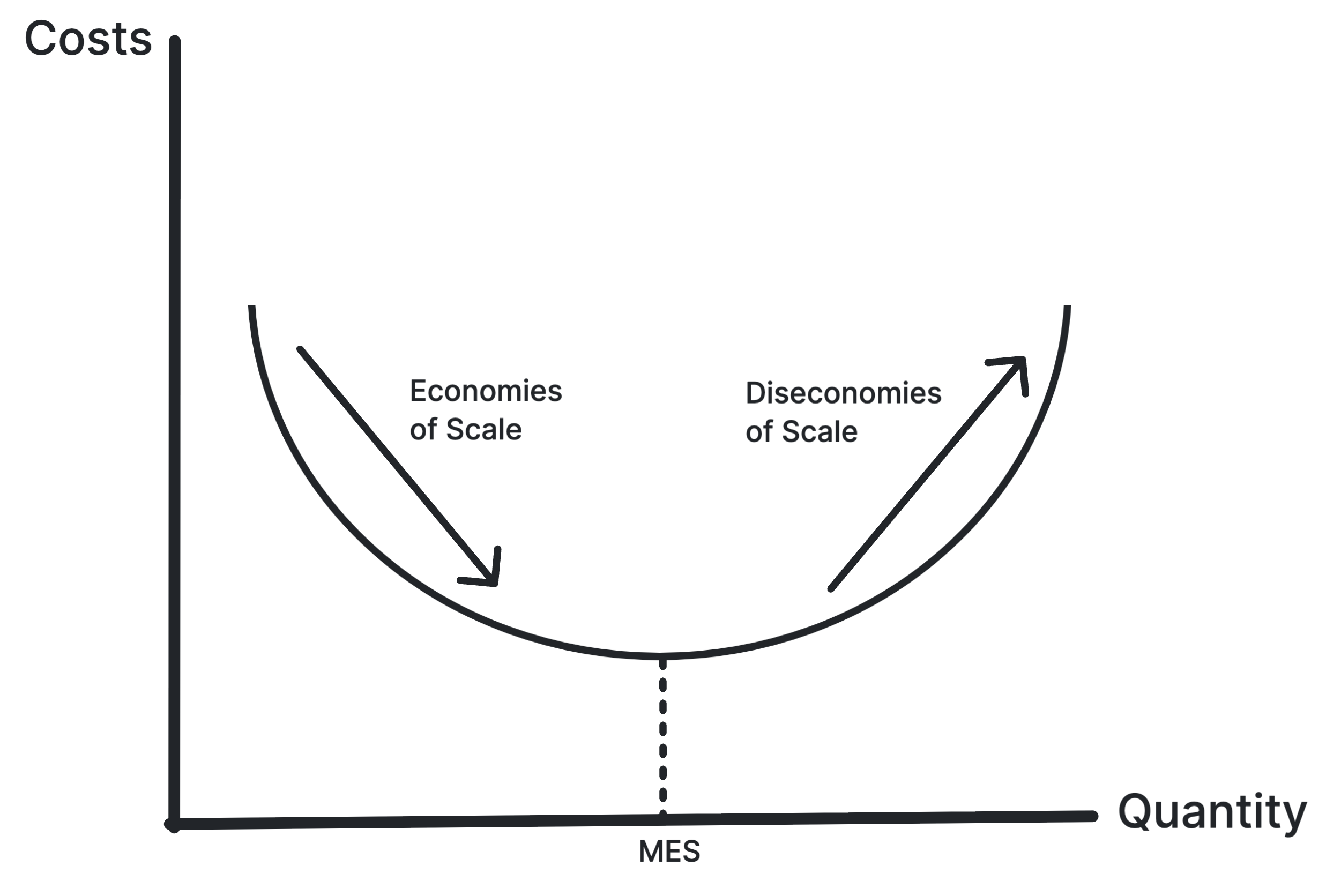
The main types are:
- Purchasing: large orders win bulk discounts from suppliers.
- Technical: a large firm can afford automated machinery that makes each unit more cheaply.
- Financial: banks see large firms as safer, so they borrow at lower interest rates.
- Marketing: an advertising campaign costs the same however many units it sells, so its cost per unit falls as sales rise.
Their impact on costs and prices:
- For the large firm: output rises → average cost falls → it can cut prices and still make a profit, or keep prices and earn a higher margin.
- For consumers: lower average cost is passed on → lower prices. The UK's large supermarket chains undercut small grocers this way.
- For new entrants: a newcomer starts small → its average cost is higher than established rivals' → it cannot match their prices without a loss, so economies of scale work as a barrier to entry.
Whether consumers gain depends on:
- Competition: a firm with rivals has to pass savings on as lower prices. A firm protected by barriers may keep them as profit.
- Diseconomies of scale: past the MES, further growth raises costs, so bigger is not always cheaper.
- The size of the market: where the MES is a large share of total demand, the market only has room for a few firms.
Don't confuse competition with contestability. A market with only two firms can still behave competitively if new firms could enter easily. When an extract describes a dominant firm, look for evidence on how easy entry is - start-up costs, patents, brand loyalty - before judging whether it can raise its prices.
Stuck on this topic? Work through it with an online A-Level Economics tutor in a free 15-minute intro call, or send an essay on it for A-Level Economics essay marking.