How the Digital Economy Affects Markets and Firms
What the Digital Economy Is
Digital economy: economic activity that runs on the internet and digital technology, such as online shopping, apps, streaming and social media.
It changes three things for a firm: what buyers know, how the firm sells and delivers, and who it can sell to.
Market Information
Price comparison site: a website that lists the prices of the same product from many sellers side by side, used for things such as energy, flights and broadband.
- For consumers: comparing prices takes seconds → buyers find the cheapest seller → lower prices paid and more chance of switching.
- For firms: demand becomes more price elastic → a small price rise loses many sales → firms must compete on price → margins are squeezed, and the lowest-cost firms win.
Viral marketing: marketing designed to be shared by the people who see it, so it spreads from person to person at little cost to the firm.
A video that goes viral reaches millions for the cost of making it, which lets a small firm compete with big advertising budgets. The catch is that nobody can be sure what will spread.
Social media lets firms talk directly to customers and target adverts at the people most likely to buy. It also gives customers a voice: good reviews bring in sales, but a complaint can be seen by thousands within hours.
The Supply Side
Micromarketing: targeting very small groups of customers, or individuals, with products and offers tailored to them, using data on what they search for and buy.
- Micromarketing: data shows what each customer wants → offers matched to them → more of them buy and less is wasted on adverts nobody needs → higher sales per pound spent on marketing.
- Online retailing: sell from a website instead of a shop → no shop rent, open all day every day → lower costs and more sales.
- Online distribution: digital products such as music, software and e-books are delivered as files → each extra copy costs almost nothing → very low average cost at high sales.
Selling online is not free. Firms pay for warehouses, delivery and returns, and for the website and its security. Customers who cannot see or try the product return more of it.
Firms also need staff with digital skills to run websites, analyse data and manage social media. Those skills are in demand everywhere → recruits are scarce → firms pay more or train their own staff → higher costs. This is the skills shortage of unit 2.1.1 in a digital setting.
The Demand Side
The Long Tail
Long tail: the large number of niche products that each sell only a few units, but together can make up a big share of sales.
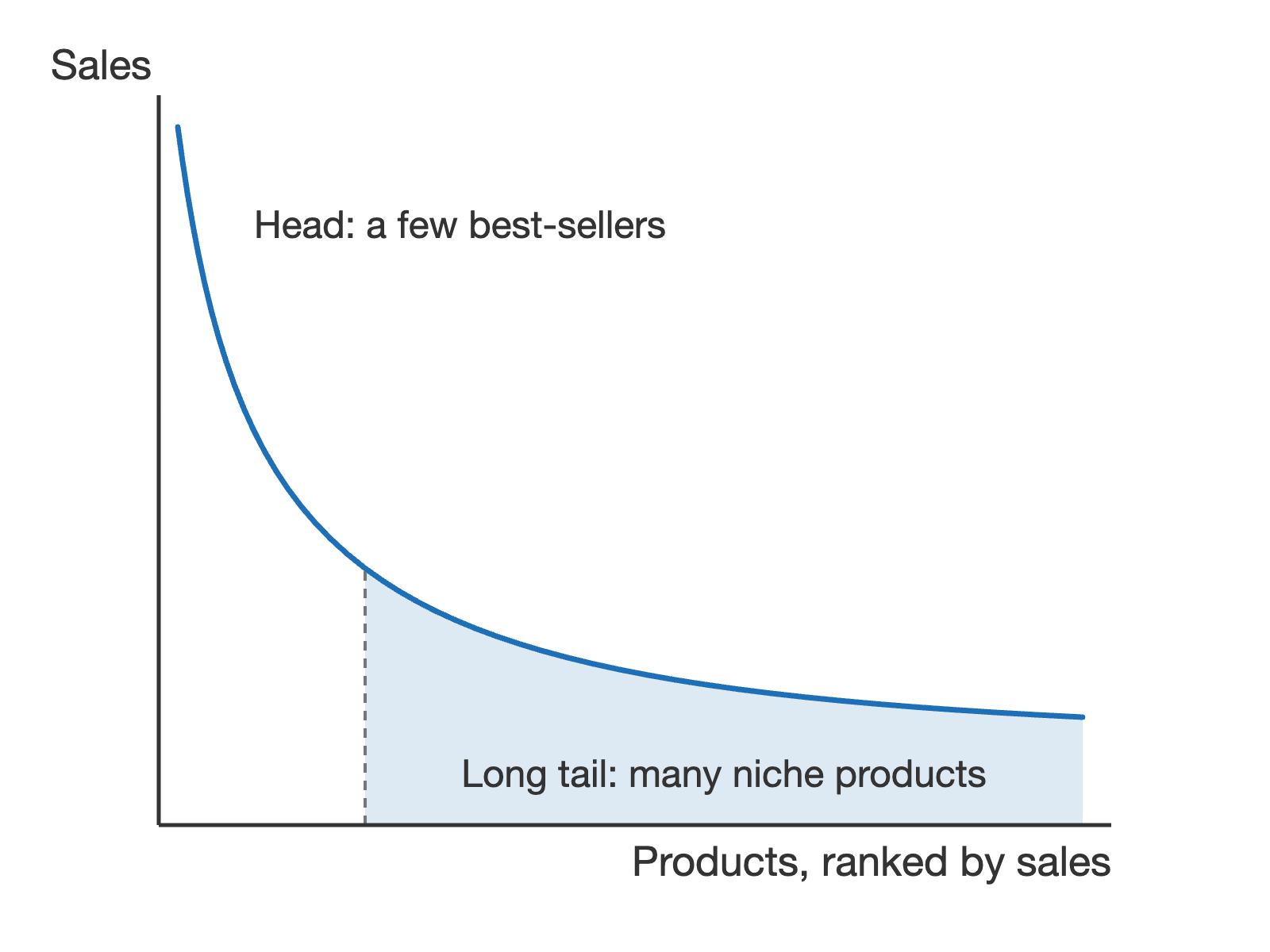
A bookshop has room for a few thousand titles, so it stocks the best-sellers. An online bookseller can list millions, because a listing costs almost nothing to keep. Each rare title sells a few copies a year, but together they add up, and customers with unusual tastes find what they want.
Wider Geographical Markets
A website can be seen anywhere. A small firm selling online → customers across the country or abroad → more sales → economies of scale that a local market could never support. The same is true in reverse: rivals from anywhere can now reach the firm's own customers.
Impact on Costs, Prices, Profit and Loss
Putting the changes together:
- Costs: no shops, cheaper marketing and near-free digital distribution → lower average cost, though delivery, returns and digital staff add some back.
- Prices: price comparison and more rivals → more price-elastic demand → lower prices for consumers.
- Profit and loss: costs and prices both fall → profit rises for firms whose costs fall faster than their prices, and turns to loss for those whose prices fall faster.
Which way it goes for a firm depends on:
- Whether its product can be sold online: a hairdresser or a builder is barely affected, while a seller of books, music or insurance is transformed.
- How differentiated it is: a standard product on a price comparison site is judged on price alone, while a strong brand or a niche product keeps some pricing power.
Firm Creation and Destruction
The digital economy is creative destruction at speed (unit 1.2.1):
- Creation: start-up costs are low → a laptop and a website can be enough to start trading → many new firms enter, from online shops to app developers → more choice for consumers and new jobs.
- Destruction: customers move online → high-street shops, travel agents and bank branches lose custom → closures and job losses, worst for staff whose skills do not transfer.
In a new business environment like this, barriers to entry are lower, but a few online platforms can grow very large because of network effects.
Network effects: when a product becomes more useful to each user as more people use it.
A marketplace with more sellers attracts more buyers → more buyers attract more sellers → the platform keeps growing → it can come to dominate its market, and a new rival struggles to attract either side.
Don't assume the internet helps every firm. Lower costs and wider markets are only half the story: the same technology brings in rivals and makes prices easy to compare. Use the extract to decide whether this firm's costs fall by more than its prices, and say which kind of firm gains and which loses.
Stuck on this topic? Work through it with an online A-Level Economics tutor in a free 15-minute intro call, or send an essay on it for A-Level Economics essay marking.