The Competition
Market Positioning and Market Maps
Market positioning: where a product sits in customers' minds compared with its rivals, for example cheap and basic, or expensive and high quality.
Market map: a diagram that plots the brands in a market against two features customers care about, such as price and quality.
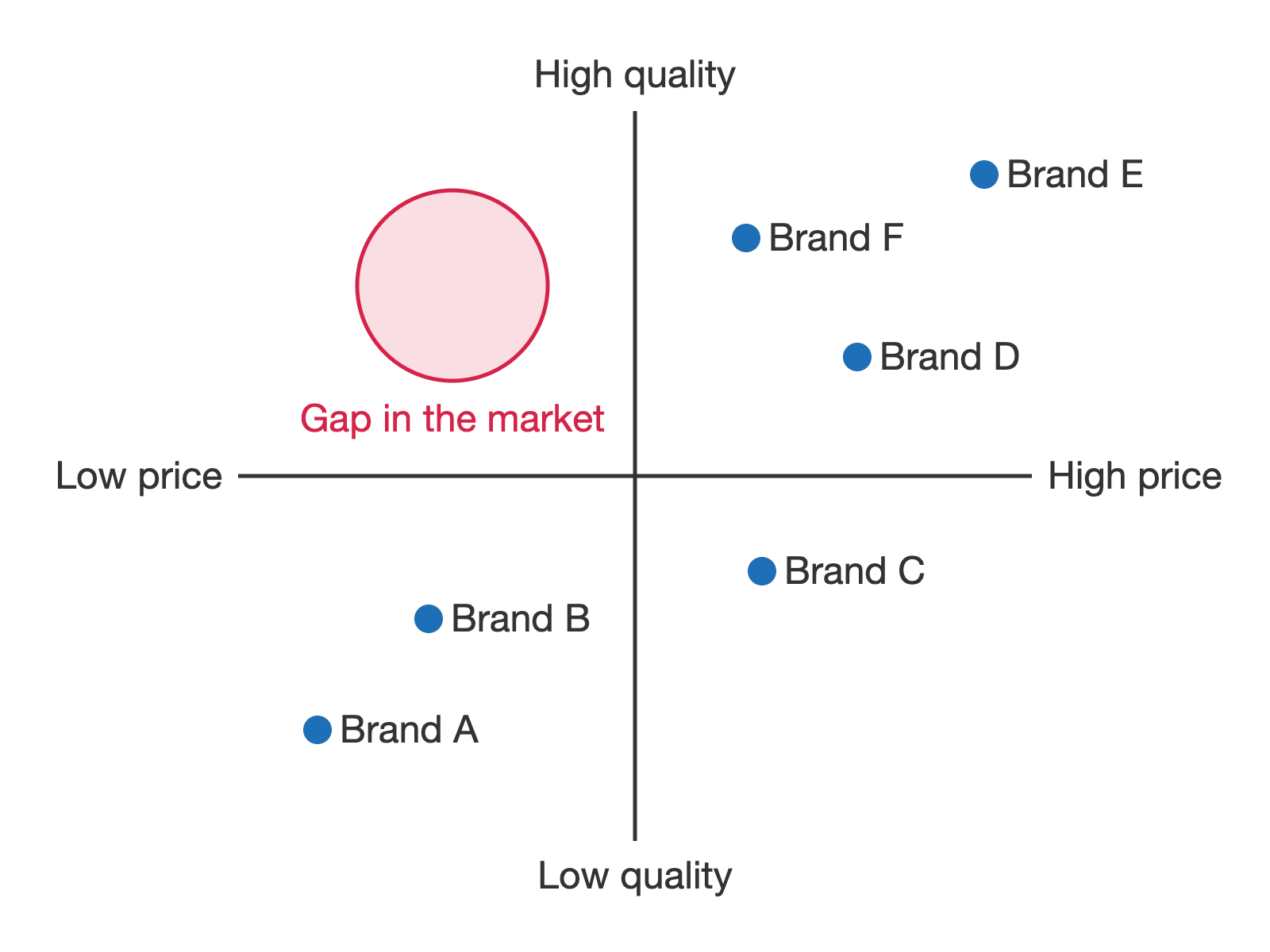
A market map helps a firm to:
- see which brands are its closest competitors
- spot a gap in the market, a position no brand fills
- decide where to place a new product, or whether to move an existing one.
Market maps have limits. Where each brand goes is often a judgement call. Two features cannot capture everything customers weigh up. And a gap only matters if there are enough customers who want a product in that position.
A gap in the market is not proof of demand. There may be no brand selling luxury quality at a budget price because no firm could cover its costs there. When a case study shows a gap, ask whether customers want it and whether the firm can serve it at a profit.
Competitive Advantage
Competitive advantage: something that lets a business attract customers away from its rivals and earn higher profits than they do.
There are two broad routes to it:
- Lower costs, so the firm can charge less than rivals and still make a profit, or charge the same and make more. Discount supermarkets such as Aldi and Lidl compete this way.
- A better product, or one customers see as better, so they will pay more for it.
The advantage is worth most when it is hard to copy. A strong brand, a patent, a prime location or highly skilled staff take rivals years to match. A price cut can be matched the next day.
Product Differentiation
Product differentiation: making a product different from rival products in ways that customers value.
A firm can differentiate through design, features, quality, packaging, branding or after-sales service. The aim is often a unique selling point (USP), something no rival offers. A differentiated product has fewer close substitutes → customers are less likely to switch when its price goes up → the firm can charge more without losing many sales → higher profit margins.
Adding Value to Products and Services
Added value is the selling price of a product minus the cost of its inputs (see 1.2.1). A firm facing competition adds value so customers will pay more than the inputs cost, and more than they would pay a rival.
Coffee is a clear example: the beans, milk and cup in a latte cost a small part of its price. Customers are paying for the skill, the brand and the convenience, and each of these also differentiates the product.
How Firms Decide on Price and Level of Output
When setting a price, a firm looks at:
- Costs: in the long run the price must cover what each unit costs to make.
- Demand: what customers are willing to pay, found through market research (see 1.3.5).
- Competitors' prices: the closer the substitutes, the less room the firm has to charge more.
- Its market position: a premium brand that prices too low can damage its image.
- Its objectives: a firm aiming for the most profit picks the price with the biggest gap between revenue and costs, while one chasing market share may price lower to win customers.
How much freedom a firm has depends on competition. In a market with many firms selling near-identical products, a firm has to accept the market price set by demand and supply (see 1.3.3). A firm with a well-differentiated product can set its own price.
Output follows from the same evidence. The firm forecasts how many units it can sell at its chosen price, then checks that against its capacity and costs. Making too much leaves unsold stock. Making too little means lost sales and customers going to rivals.
Stable and Dynamic Markets
Stable market: a market where sales, products and customer tastes change little from year to year, such as bread, toilet roll or milk.
Dynamic market: a market that changes quickly, with new products, new technology and shifting tastes, such as smartphones, fashion or video games.
In a stable market firms know roughly what they will sell, so planning is easier. Growth is hard, though: a firm mostly gains sales by taking them from rivals, so it competes on cost, price and brand loyalty.
In a dynamic market there are more chances to grow, but more risk. Firms need to keep researching customers and developing products, because today's best seller can be overtaken within a year or two. A firm that is slow to adapt loses its competitive advantage.
Stuck on this topic? Work through it with an online A-Level Economics tutor in a free 15-minute intro call, or send an essay on it for A-Level Economics essay marking.