Growth
Why Firms Grow
A firm grows when it makes more output, sells more, takes on more staff or opens more sites. The spec gives four objectives of growth, and the last, higher profit, is usually the point of the other three.
Economies of Scale
Economies of scale: the fall in long-run average cost that comes from producing on a larger scale.
Average cost is the cost of each unit, total costs divided by output (unit 1.6.1). A bigger firm spends more in total, but if its output rises faster than its costs, each unit gets cheaper to make.
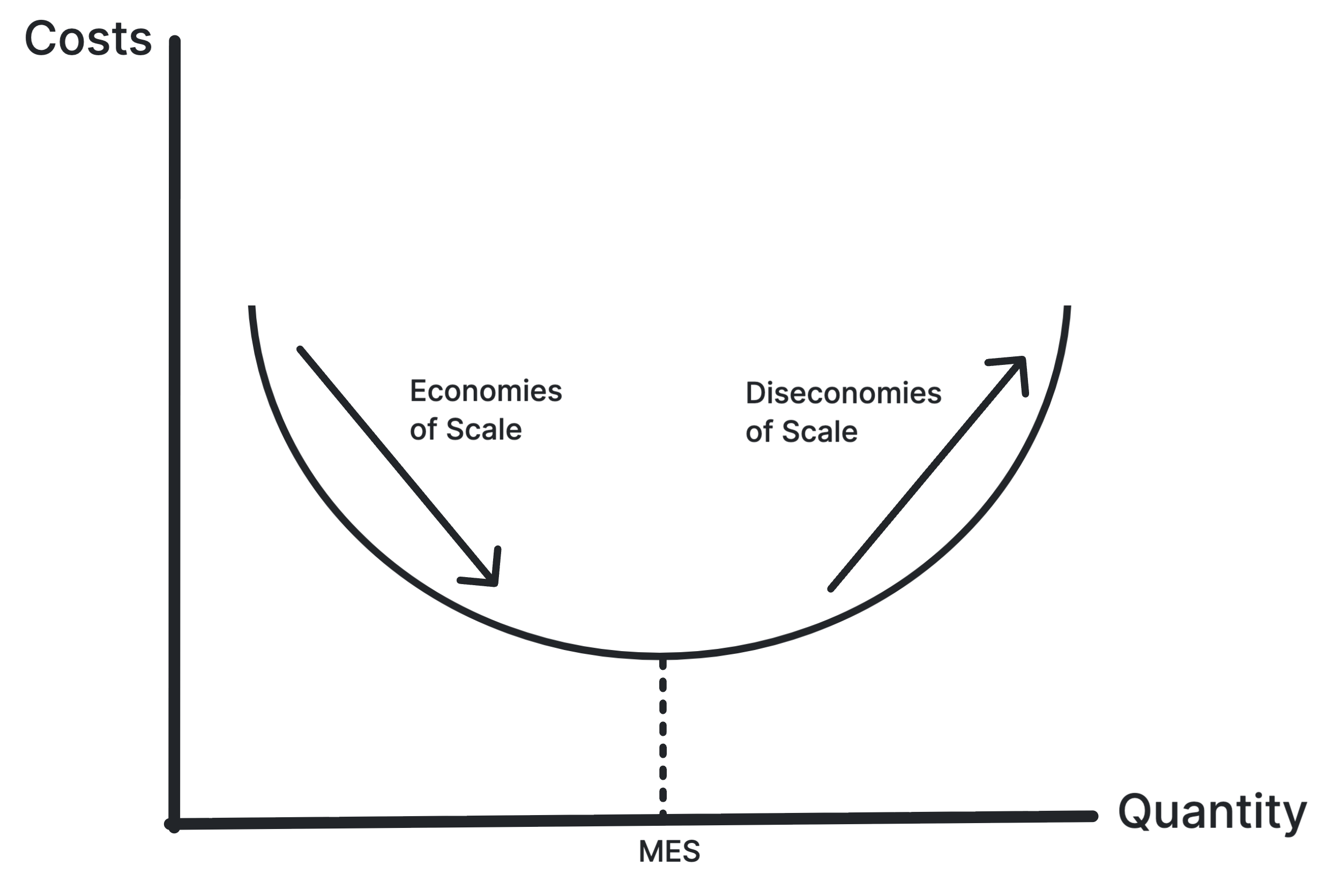
Minimum efficient scale (MES): the lowest output at which a firm reaches the lowest possible long-run average cost.
Internal Economies of Scale
Internal economies of scale: cost savings that come from the growth of the firm itself. The examples follow a bakery that grows from one shop to a chain of forty.
| Type | Why average cost falls | Example |
|---|---|---|
| Purchasing | Large orders win bulk discounts, because suppliers want to keep a big customer | The chain pays less per sack of flour than one shop |
| Technical | Large, automated machinery becomes affordable, and its cost is spread over far more units | One central bakery with industrial ovens supplies every shop |
| Financial | Lenders see a large firm as safer, so it borrows at lower interest rates | The chain gets a cheaper loan than a sole trader |
| Managerial | The firm can afford specialist managers, who make better decisions than one owner doing every job | It hires a buyer and a finance manager |
| Marketing | An advertising campaign costs the same whatever it sells, so its cost per unit falls as sales rise | One local radio advert promotes forty shops |
| Risk-bearing | Selling more products in more places means a loss in one can be covered by profit in another | A quiet month in one town does not sink the business |
External Economies of Scale
External economies of scale: cost savings a firm gets from the growth of its whole industry, often in one area, not from its own size.
When an industry clusters in one place:
- A skilled labour pool builds up: workers trained by other firms live nearby → easier and cheaper recruitment and less training → lower labour costs.
- Specialist suppliers move in: component makers and service firms locate close by → faster, cheaper deliveries → lower costs.
- Infrastructure improves: roads, broadband and college courses are built around the industry → every firm in it benefits.
Internal economies move a firm down its average cost curve. External economies shift the whole curve down, for large and small firms alike.
Market Power, Market Share and Brand Recognition
Market power: a firm's ability to influence the prices it charges customers or pays suppliers.
Growth gives a firm more power in two directions:
- Over consumers: the firm grows and rivals shrink or disappear → fewer close substitutes → demand becomes less price elastic → it can raise prices without losing many sales → higher profit, while consumers pay more and have less choice.
- Over suppliers: the firm becomes one of a supplier's biggest customers → the supplier cannot afford to lose the order → the firm negotiates lower prices or longer to pay → lower costs and better cash flow, while the supplier's margins are squeezed.
Market share: one firm's sales as a percentage of the total sales in its market.
A bigger market share usually brings brand recognition, as more shops and more customers mean more people know the name. Shoppers trust a brand they see often → they choose it first → higher sales from loyal customers whose demand is less sensitive to price.
Increased Profitability
The first three objectives feed the fourth. Growth → lower average cost and, with more market power, higher prices → a wider margin on each unit → more units sold at that margin → higher total profit. That pays for higher dividends for owners and more retained profit to reinvest.
Whether growth delivers these gains depends on:
- How close the firm is to its MES: a firm already at the bottom of its average cost curve gains no more cost savings, and may start to face diseconomies.
- The competition authorities: the CMA can block a merger or investigate a firm that uses its market power against consumers (unit 4.2.2).
Problems Arising From Growth
Bigger firms are harder to run. Each of the three problems the spec names can push average cost up.
Diseconomies of Scale
Diseconomies of scale: the rise in long-run average cost when a firm grows beyond its minimum efficient scale.
- Coordination: more sites, departments and products → harder to plan and control, and work gets duplicated → resources are wasted → higher average cost.
- Motivation: each worker feels like a small part of a big organisation → less effort, more absence and more staff leaving → lower productivity and higher recruitment costs → higher average cost.
Internal Communication
A growing firm adds layers of management. More layers → each message passes through more people → it arrives late, changed or not at all → slow decisions and costly mistakes → higher costs and lost sales. A recipe change that reaches some of the bakery's shops a week late means wasted stock.
Potential Skills Shortages
A growing firm needs more skilled people, often faster than it can find them. If the skills are scarce:
- Wages: the firm has to outbid other employers → higher pay to attract staff → higher labour costs.
- Output and quality: vacancies stay unfilled, or less-skilled staff are hired → slower output and more mistakes → lost orders and a weaker reputation.
The owner can be short of skills too. Someone who ran one shop well may not know how to run forty.
How serious these problems are depends on:
- The speed of growth: a takeover can double a firm overnight, while slow growth from within leaves time to recruit and train.
- How the firm is organised: splitting it into regions or divisions with their own managers keeps chains of command short.
The Role of Corporate Culture
Corporate culture: the shared values, attitudes and habits that shape how people in a business behave, often summed up as "the way we do things here".
For a growing firm:
- It can hold a bigger firm together: staff share the same goals → fewer rules and checks are needed → decisions can be made lower down → faster, cheaper decisions and fewer communication problems.
- It affects motivation: staff feel trusted and valued → they work harder and stay longer → lower recruitment and training costs and better customer service.
- Growth can weaken it: the founder can no longer know everyone, and hundreds of new staff join → the old values fade → motivation falls → the diseconomies above get worse.
- Takeovers can bring a culture clash: a cautious firm buys a fast-moving one, or the reverse → conflict and senior staff leaving → the cost savings the deal promised do not arrive.
Culture is slow to change, because it follows how leaders behave and what gets rewarded, not what a mission statement says.
Economies of scale cut average cost, not total cost. A firm that grows spends more in total; what falls is the cost of each unit. Write "lower average cost", name the economy of scale (purchasing, say), then take the chain on to price, margin or profit.
Stuck on this topic? Work through it with an online A-Level Economics tutor in a free 15-minute intro call, or send an essay on it for A-Level Economics essay marking.