Policies to Deal with Market Failure
Provision of Public and Merit Goods
The free market provides little or no public goods, and too little of merit goods (unit 4.3.1). So the government provides them itself, paid for through taxes. Councils light streets and the state builds flood defences. The NHS and state schools are free at the point of use, so cost does not stop anyone using them.
- Consumers: a zero price → consumption rises towards the social optimum → a healthier, better-educated population.
- The government: provision has to be paid for → higher taxes or borrowing, or less spent on something else.
Indirect Taxation of Demerit Goods
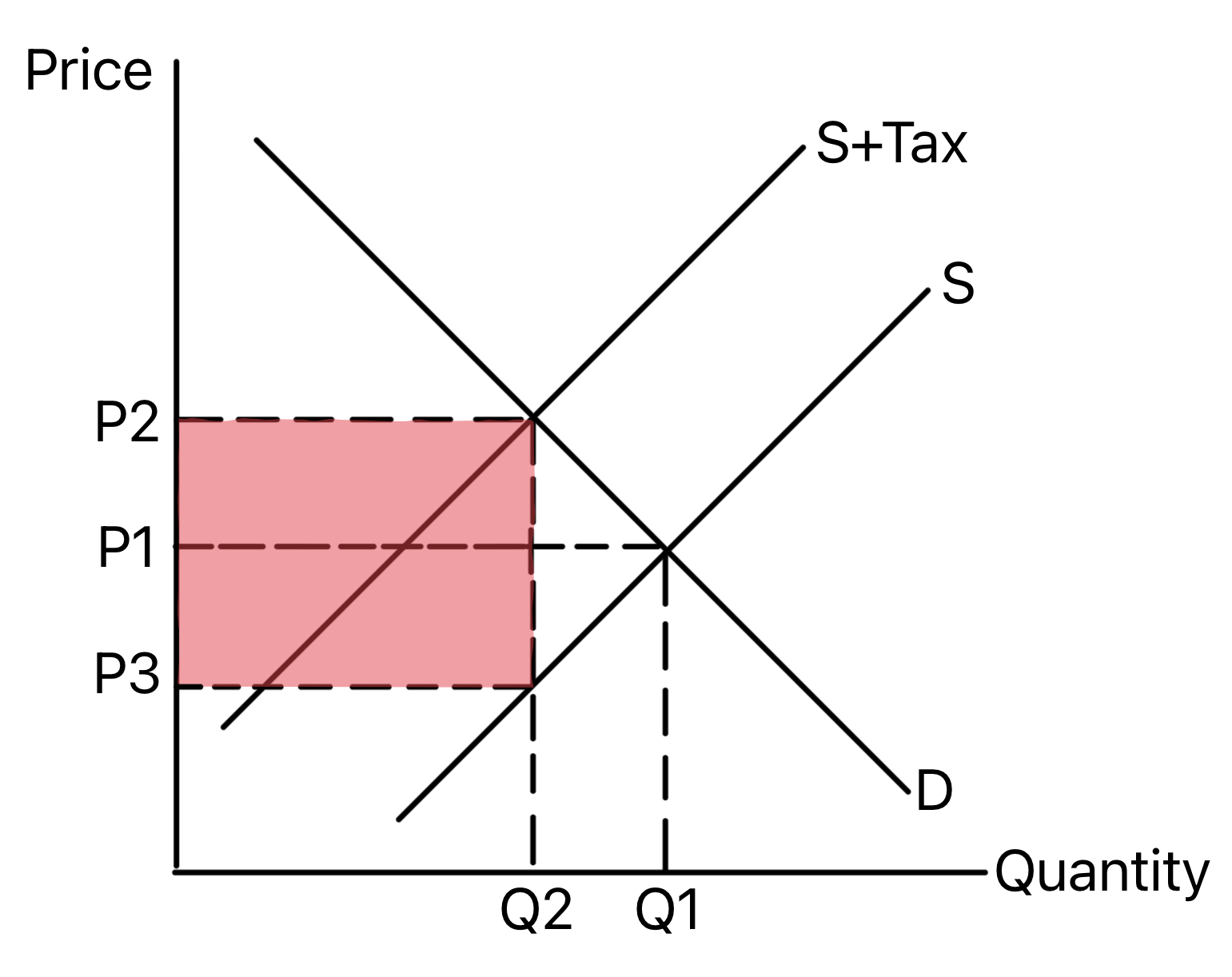
A tax on each unit raises the price of a demerit good, so less is bought. Set equal to the external cost, the tax makes the buyer pay the full social cost (unit 1.5.2 has the diagram in full). Taxes on tobacco, alcohol and sugary drinks work this way.
Subsidies for Merit Goods
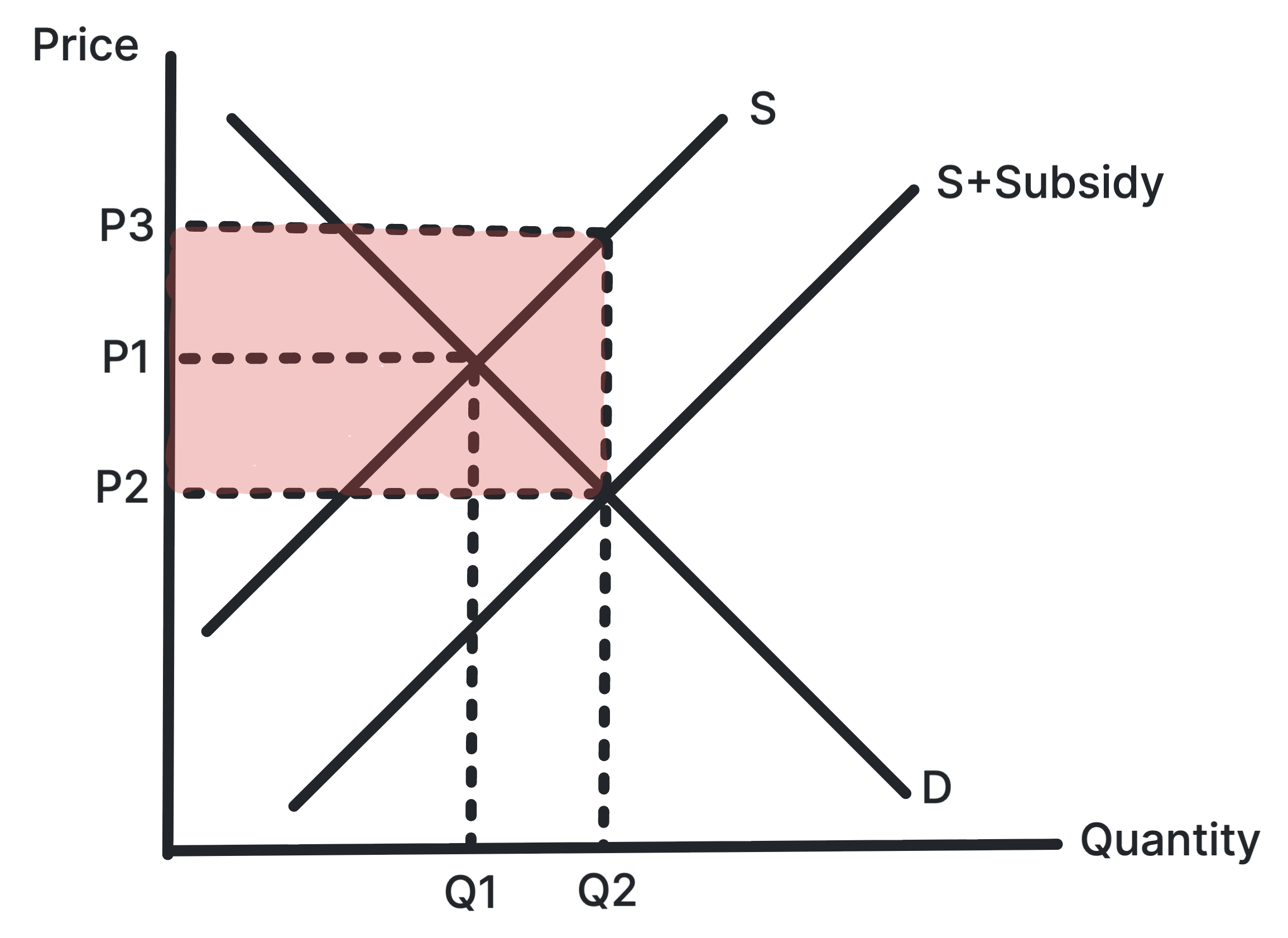
A subsidy works the other way. A payment to producers for each unit lowers their costs, so the price falls and more is bought. Set equal to the external benefit, it moves consumption towards the social optimum (unit 1.5.2). Subsidies for home insulation, heat pumps and public transport are examples.
- Consumers: a lower price → more of the merit good is consumed → the external benefits spread.
- The government: it pays for every unit → higher spending, funded by taxes or borrowing.
Tradable Pollution Permits
Tradable pollution permits: permits, each allowing a set amount of pollution, that firms must hold to cover their emissions and can buy and sell.
The government sets a cap on total pollution and issues that many permits. A firm that cuts its emissions cheaply can sell its spare permits, and a firm that cannot must buy more. The cap is lowered over time. The UK Emissions Trading Scheme has worked this way since 2021 for power stations, heavy industry and aviation.
- Polluting firms: pollution now has a price → higher costs → an incentive to invest in cleaner methods.
- The environment: the cap fixes total emissions → pollution falls as the cap tightens.
- Consumers: firms pass on the cost → higher prices for energy and goods made with it.
Provision of Information
Many market failures come from people not knowing the full costs or benefits of what they buy (unit 4.3.1). The government can fill the gap with health warnings on cigarette packets, campaigns on healthy eating, or rules making firms publish information. Since April 2022, large cafés, restaurants and takeaways in England have had to show calories on their menus.
Better information → consumers make choices closer to the social optimum → less over-consumption of demerit goods and more use of merit goods. It is cheap, but people may ignore it, especially if a habit or addiction is involved.
Legislation and Regulation
Laws can ban or limit a harmful activity outright, and regulators set and enforce standards, such as limits on factory emissions (unit 1.5.2). These work quickly and with certainty where the harm is serious. Their cost is enforcement, and firms face higher compliance costs.
Short-Term and Long-Term Impacts
Many policies have a different effect in the short term from the long term, and this is where most evaluation marks come from.
| Policy | Short term | Long term |
|---|---|---|
| Provision | Higher government spending and taxes | A healthier, more skilled workforce; higher productivity and tax revenue |
| Indirect tax | Higher prices; habits barely change where demand is inelastic; hits poorer households hardest | People quit or switch; firms change products, such as cutting sugar |
| Subsidy | Higher government spending; more of the good bought | Firms may come to rely on it; the habit, such as better insulated homes, can last after it ends |
| Tradable permits | Higher costs and prices for energy users | Investment in clean technology; emissions fall as the cap tightens |
| Information | Little change in behaviour | Attitudes shift slowly, as with smoking |
| Legislation and regulation | Harm cut quickly; compliance costs for firms | Can push firms to innovate, or drive trade to an illegal market |
Whether a policy works depends on:
- PED: a tax cuts consumption only if demand is price elastic enough to respond.
- Information: the government rarely knows the exact external cost, so taxes and caps may be set at the wrong level.
- Time lags: new technology, skills and habits take years to change.
- Who bears the cost: taxes on necessities, such as energy, take a larger share of poorer households' income.
- Government failure: poorly designed policy can leave things worse than before (unit 1.5.2).
Use the time frame to evaluate. Ask what a policy does in the first year and after ten. A carbon price raises bills now but pays for cleaner energy later. Say which effect matters more in the case given.
Stuck on this topic? Work through it with an online A-Level Economics tutor in a free 15-minute intro call, or send an essay on it for A-Level Economics essay marking.