Externalities
Private, External and Social Costs and Benefits
The definitions are in unit 1.5.1. In short:
- Social cost = private cost + external cost
- Social benefit = private benefit + external benefit
A gas-fired power station is the example used on this page. Its private costs are gas, staff and equipment. Burning gas also releases carbon dioxide, which adds to climate change. That damage is an external cost: the people affected are not part of the deal between the power station and its customers, and are not compensated.
When Prices Leave Out External Costs
Internalising an externality: making the producer or consumer pay for the external cost, so it becomes part of their private cost and the price.
If the power station's price covers only its private costs, electricity sells for less than its full cost to society. Buyers respond to that low price, so more is produced than is best for society.
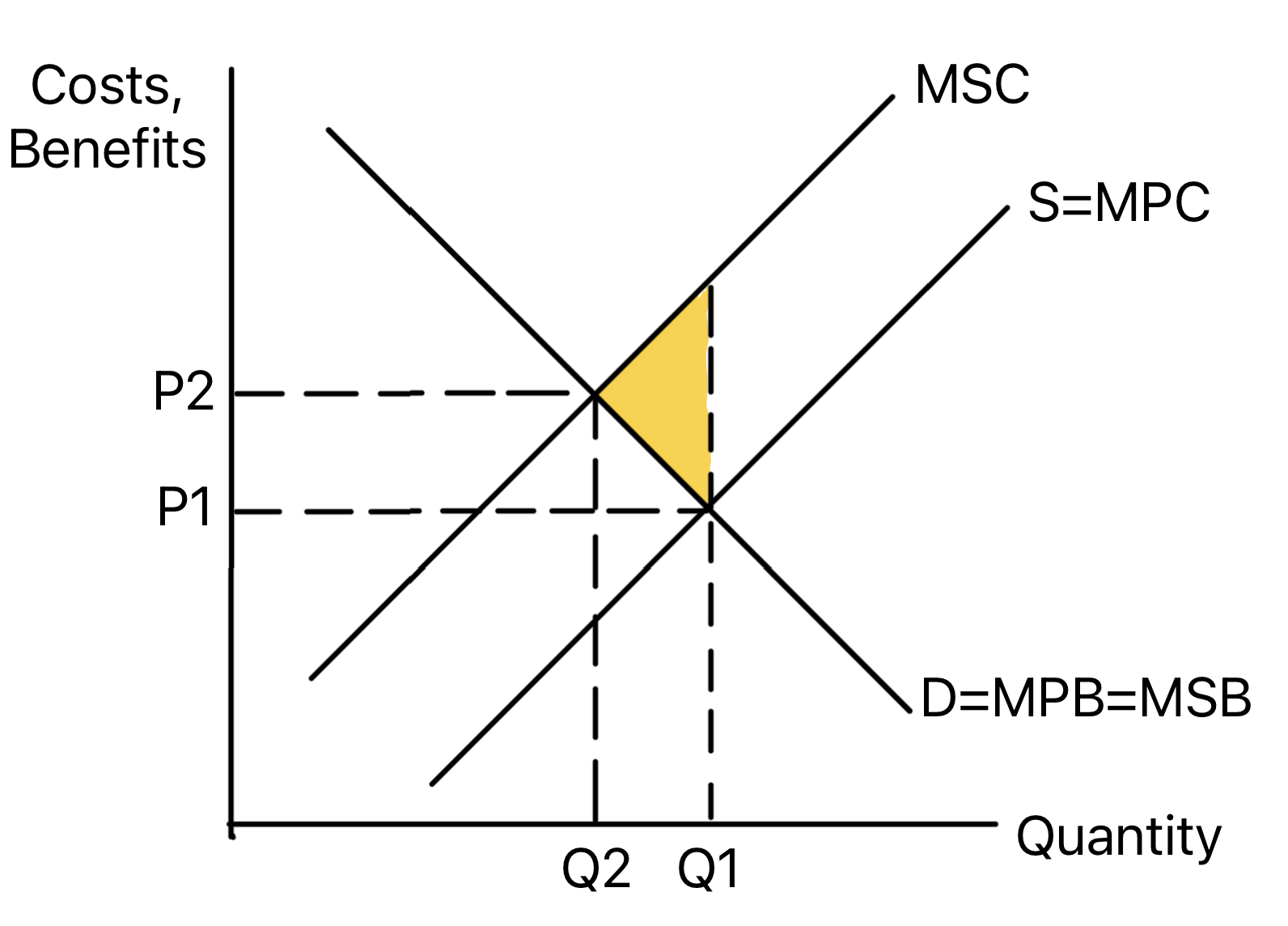
When prices do not reflect the full cost:
- Over-production: the price is too low → demand is higher than it should be → output reaches Q1, above the social optimum Q2 → a welfare loss to society.
- Third parties pay: the cost of the damage falls on people outside the market → through worse health, flood damage or clean-up bills → lower real incomes for people who gained nothing from the sale.
- Clean firms lose out: a polluting firm's costs look lower than a clean rival's → it can charge less → the clean firm loses sales and has less reason to invest.
- Wrong signals for investment: polluting methods stay cheap → firms keep using them → too little is spent on cleaner technology.
The same happens in reverse with external benefits. If buyers only pay for their private benefit, goods such as home insulation are under-consumed, and society misses out on gains it would value.
Environmental Externalities
Environmental externality: an external cost or benefit that affects the natural environment, such as air, water, land or the climate.
Air pollution, carbon emissions, sewage in rivers and waste in landfill are external costs. Planting trees, restoring wetlands and insulating homes create external benefits.
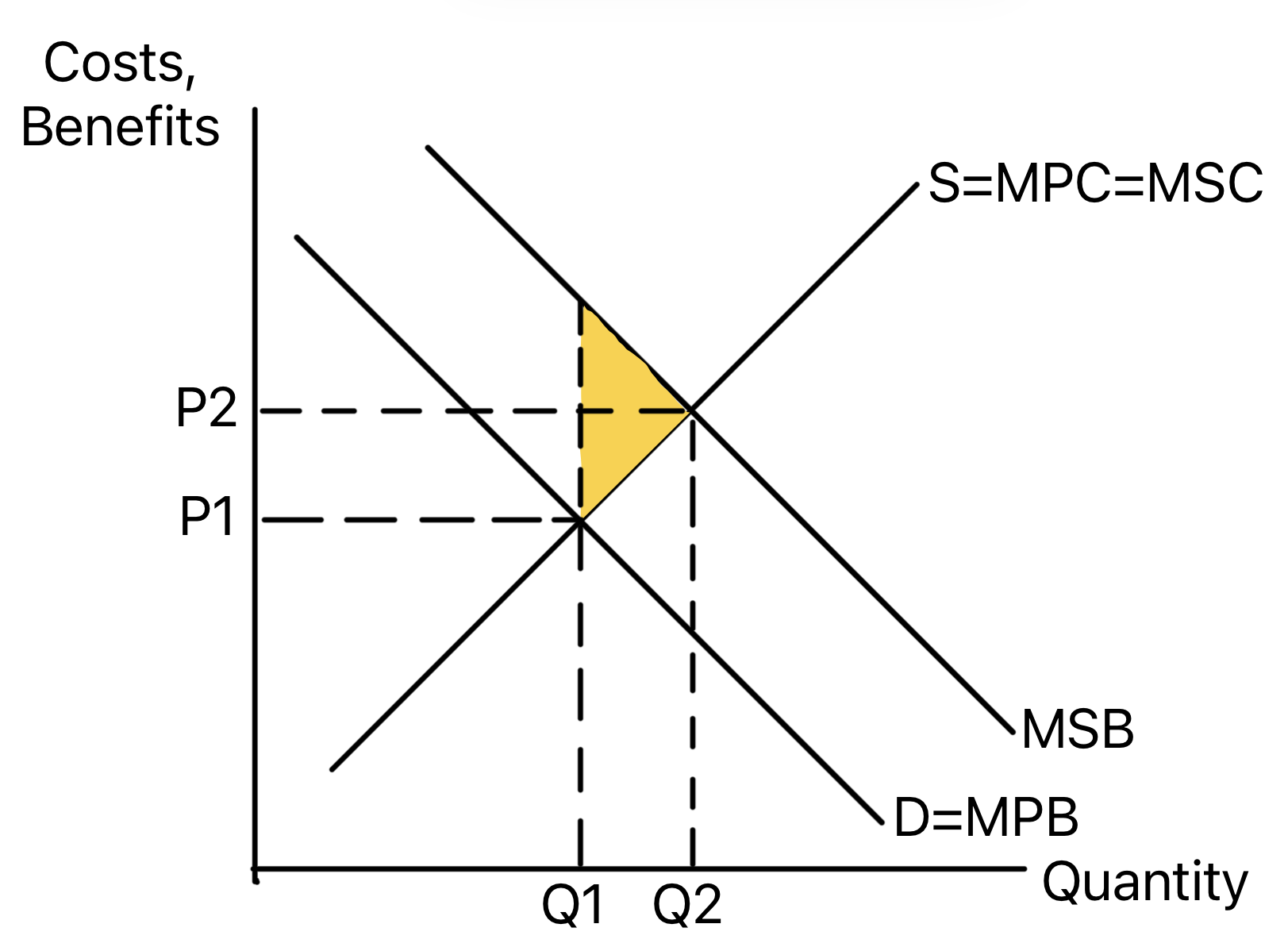
Environmental externalities are harder to correct because:
- They are hard to measure: putting a money value on a damaged river or a warmer climate involves a lot of guesswork.
- They cross borders: carbon emitted in one country warms the whole planet, so no single government can fix it.
- They build up over time: much of the cost falls on future generations, who have no say in today's market.
- Nobody owns the environment: with no owner to charge for its use, firms treat clean air and water as free.
The policies that try to internalise these costs, such as taxes and tradable pollution permits, are covered in unit 4.3.3.
Say who pays. The strongest answers on externalities name the third party who bears the external cost - residents near a factory, future generations - and explain why the price does not include it. Then use the diagram: the gap between MPC and MSC is the external cost of each unit, and the triangle is the welfare loss.
Stuck on this topic? Work through it with an online A-Level Economics tutor in a free 15-minute intro call, or send an essay on it for A-Level Economics essay marking.