Government Intervention and Failure
Why Governments Intervene
Unit 1.5.1 showed that a free market produces too much of a good with external costs and too little of a good with external benefits. The main purpose of intervention is to move the market closer to the social optimum, where the full costs and benefits to society are counted.
That means two jobs, depending on the market:
- Cutting output or consumption where there are external costs. Examples are pollution from factories and power stations, litter from disposable products, and the cost to the NHS of illness linked to smoking or sugary food.
- Raising output or consumption where there are external benefits. Examples are vaccination, training, home insulation and low-carbon heating.
Governments also intervene for reasons that have little to do with externalities, such as raising tax revenue or protecting consumers. In an answer on this topic, tie the intervention back to the market failure it is meant to fix.
Methods of Government Intervention
The spec names five methods.
Legislation: laws passed by Parliament that ban or require something. Since 1 June 2025 it has been illegal for shops in England to sell single-use vapes, which were being thrown away as litter in large numbers.
Regulation: rules that control how firms operate, set and enforced by government bodies, usually under powers that legislation gives them. Emission limits on factories, food hygiene inspections and safety standards are all regulation. A firm that breaks the rules can be fined or shut down.
Indirect tax: a tax on spending, paid to the government by the seller and added to the cost of each unit. It raises the price and cuts the quantity bought.
Subsidy: a payment from the government to producers that lowers their cost of each unit, so they supply more at a lower price. A grant is a one-off payment for a set purpose, such as the Boiler Upgrade Scheme's £7,500 towards a heat pump for homes in England and Wales.
Voluntary agreement: a promise by firms in an industry to change what they do, agreed with the government with no law forcing them. In 2016 the food industry was asked to cut sugar in foods such as cereals, yoghurts and biscuits by 20% by 2020, on a voluntary basis.
| Method | Strength | Main drawback |
|---|---|---|
| Legislation | Clear and quick to understand; can stop a harmful product outright | Needs enforcing, and a ban can push sales to an illegal market |
| Regulation | Can be set for each industry and updated as technology changes | Inspecting and enforcing costs money; firms face paperwork and compliance costs |
| Indirect taxation | Makes the polluter pay and raises revenue; buyers and firms still choose for themselves | Hard to set at the right level; little effect if buyers keep buying; takes more of a poorer household's income |
| Grants and subsidies | Lowers the price of goods with external benefits, so more people buy them | Costs the government money that could be spent elsewhere; firms can come to rely on it |
| Voluntary agreements | Cheap to run, and firms can choose the cheapest way to meet the target | Nothing happens to firms that ignore the target |
Indirect Taxation
A tax of a set amount per unit adds to the seller's costs, so the supply curve shifts up and to the left, from S to S+Tax (see 1.3.2 Supply). The price buyers pay rises from P1 to P2 and the quantity falls from Q1 to Q2.
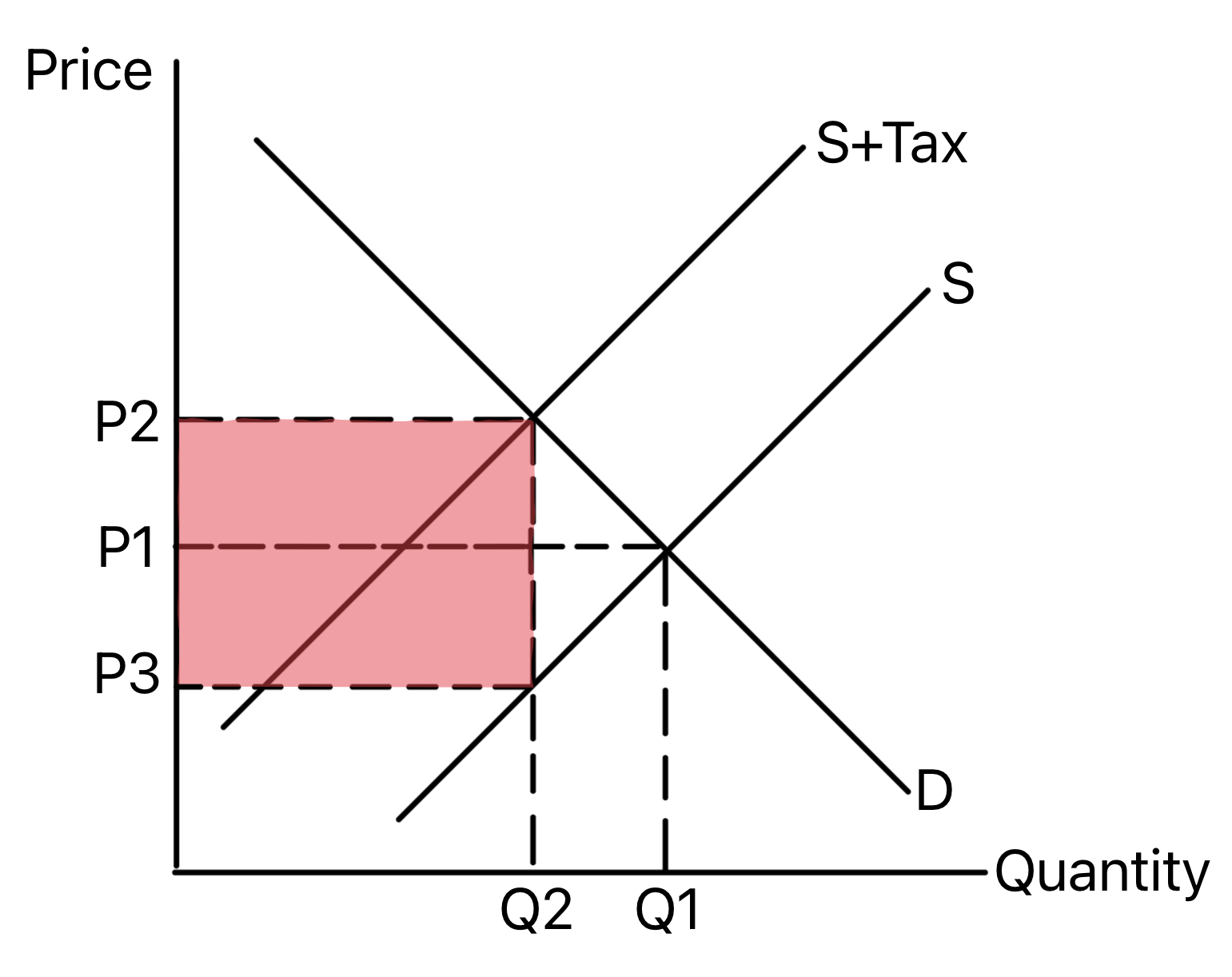
The tax per unit is the vertical gap between P2 and P3. Buyers pay part of it through the higher price (P1 to P2), and producers pay the rest through the lower amount they keep (P1 to P3). The revenue is the tax per unit times Q2.
Measure the tax at Q2, between the two supply curves. The tax per unit is the full vertical gap from P3 to P2. A common slip is to mark P1 to P2 as the tax, but that is only the part buyers pay. Shade the revenue rectangle from P3 up to P2 and across to Q2, then say how much of it falls on buyers and how much on producers.
If the tax equals the external cost of each unit, overproduction is corrected. The UK's Soft Drinks Industry Levy has worked this way since April 2018: producers pay it on soft drinks with 5g or more of sugar per 100ml, and many brands cut the sugar to pay less or none.
How far a tax cuts consumption depends on how much buyers react to the higher price. Smokers keep buying cigarettes when the price rises, so a tobacco tax raises a lot of revenue but cuts smoking less than it might. You will measure this as price elasticity of demand in Theme 2.
Grants and Subsidies
A subsidy works the other way round. It lowers each unit's cost, so supply shifts down and to the right, from S to S+Subsidy. The price buyers pay falls from P1 to P2 and the quantity rises from Q1 to Q2.
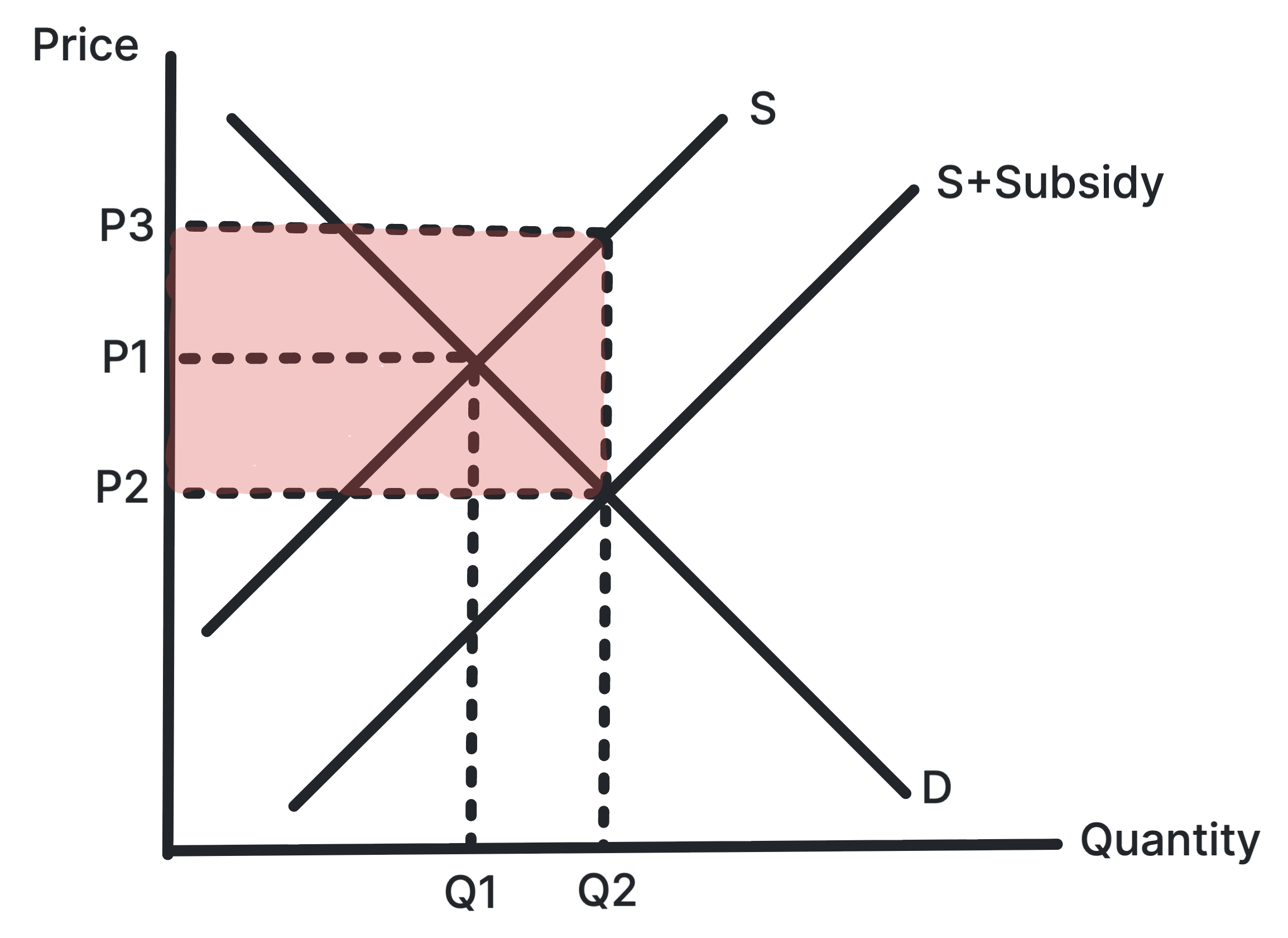
The subsidy per unit is the gap between P3 and P2, and the cost to the government is that gap times Q2. If the subsidy matches the external benefit of each unit, output rises towards the social optimum and underconsumption is corrected.
The government has to fund that rectangle from taxes or borrowing, so every subsidy has an opportunity cost: the money could have gone to schools or hospitals. A firm that has been subsidised for years may also feel less pressure to cut its costs.
Causes of Government Failure
Government failure: when government intervention makes the allocation of resources worse than it was before, or costs more than the benefit it brings.
Intervention is meant to fix a market failure, but it can fail too. The spec gives four reasons.
Distortion of Price Signals
Prices tell firms what consumers want. A tax or subsidy changes the price, so the signal can point the wrong way. Suppose the government pays farmers £50 for every tonne of a crop they grow → farmers respond to the subsidy as well as to demand → they plant more of the crop than people want to buy → the surplus has to be stored or wasted.
Unintended Consequences
People and firms respond to a policy in ways the government did not plan for. A high tax on cigarettes → criminals smuggle them in and sell them cheaply → illegal tobacco pays no tax and is sold without age checks → some of the harm the tax was meant to cut comes back in another form.
Excessive Administrative Costs
Designing, running and enforcing a policy costs money. If those costs are high compared with what the policy achieves, society can end up worse off. A grant scheme with complicated forms needs staff to check every application, and a regulation needs inspectors to visit every firm.
Information Gaps
To set a tax equal to the external cost, the government needs to know what the external cost is. It rarely knows for sure. If the damage from each unit is 20p but the tax is set at 50p, output is cut by too much and society loses goods that were worth making. Set the tax too low and overproduction carries on.
Government Failure in Various Markets
Exam questions give you a market and ask whether intervention worked. Three UK cases show the range.
Home energy efficiency. The Green Homes Grant (2020 to 2021) aimed to help 600,000 households pay for insulation and low-carbon heating. The National Audit Office found it would upgrade only about 47,500 homes, and £50.5 million of its £314 million cost went on running it. It was too complicated: a clear case of excessive administrative costs.
Tobacco. Cigarettes carry heavy duty to discourage smoking, and some of the market has moved underground. HMRC estimates that 12% of the duty due on cigarettes in 2024 to 2025 was never paid. This is the unintended consequence above, and it limits how high the tax can usefully go.
Sugar. Here the two methods can be compared. The voluntary programme cut the sugar in the foods it covered by far less than its target. Over the same years, brands cut the sugar in soft drinks much further to pay less of the levy. The voluntary agreement fell well short, while the tax changed what firms made.
Stuck on this topic? Work through it with an online A-Level Economics tutor in a free 15-minute intro call, or send an essay on it for A-Level Economics essay marking.