Spectrum of Competition
Market Structures
Markets sit on a spectrum. At one end, many small firms sell identical products and none can set its own price. At the other, a single firm supplies the whole market. The further a market sits towards monopoly, the more market power each firm has: the ability to raise its price without losing all its customers.
Imperfect competition: any market that is not perfectly competitive, so firms have some power over their price. Monopolistic competition, oligopoly and monopoly are all forms of imperfect competition.
| Structure | Number of firms | Barriers to entry | Product | Power over price |
|---|---|---|---|---|
| Perfect competition | Very many, all small | None | Identical | None - price takers |
| Monopolistic competition | Many | Low | Slightly different | A little |
| Oligopoly | A few large firms dominate | High | Identical or branded | Considerable, but each firm watches its rivals |
| Monopoly | One | Very high | No close substitutes | High - a price maker |
Monopolistic competition: a market with many firms and low barriers to entry, where each firm sells a slightly different product. Hairdressers, cafés and takeaways in a town are typical examples. Where the spec lists "imperfect competition" alongside monopoly and oligopoly, this is the structure it means.
In an oligopoly, a handful of firms supply most of the market, as with UK supermarkets or mobile networks (unit 4.1.3). In a monopoly, one firm supplies the whole market, as a regional water company does for the homes it serves. What keeps rivals out is covered in unit 4.1.2.
Perfect Competition: How Markets Work
Perfect competition: a market with very many small firms selling homogeneous products, with perfect information and no barriers to entry or exit.
Homogeneous products are identical whichever firm makes them, so buyers have no reason to prefer one seller over another. One farm's wheat of a given grade is the same as any other farm's, so no farmer can build up loyal customers or charge more for its brand.
No real market fits exactly, but the model shows how a market behaves when competition is at its strongest. With identical products and fully informed buyers, a firm charging a penny more would sell nothing. Each firm is a price taker: it accepts the market price and can sell all it wants at that price.
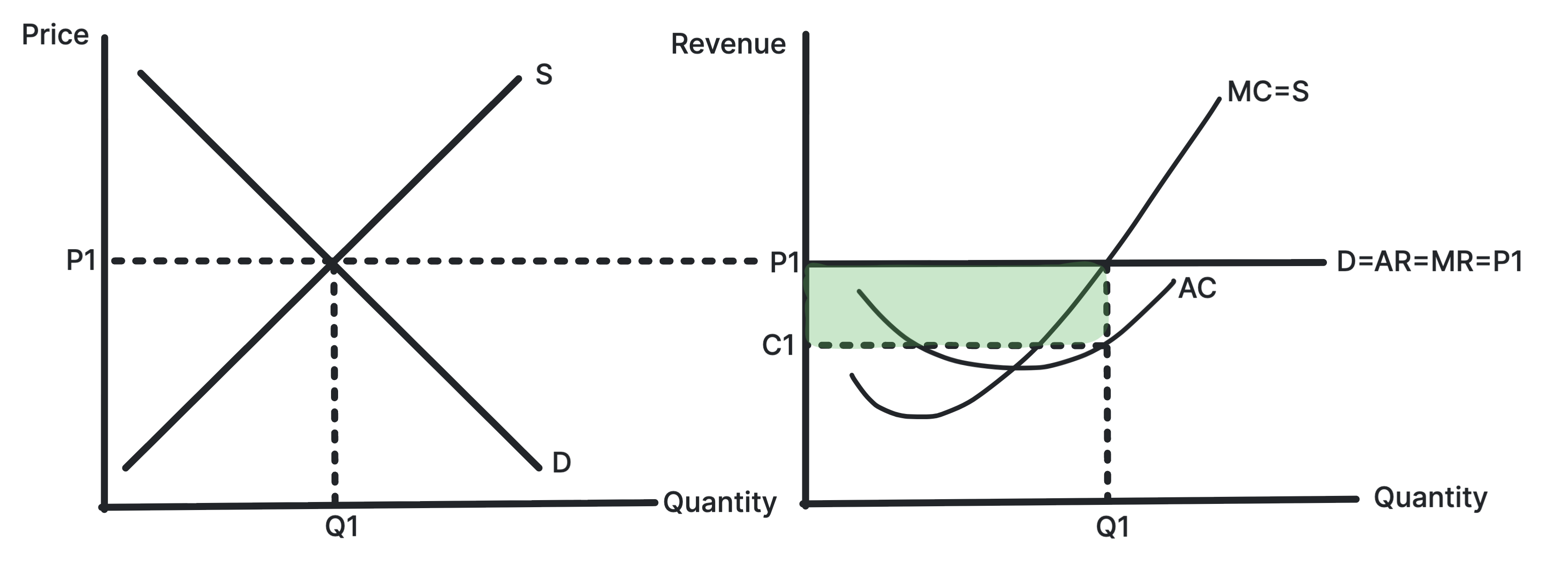
The model explains how profit moves resources around an economy:
- Short run: demand rises → the market price rises above average cost → firms make supernormal profit, meaning profit above the minimum needed to keep them in the market (Figure 1).
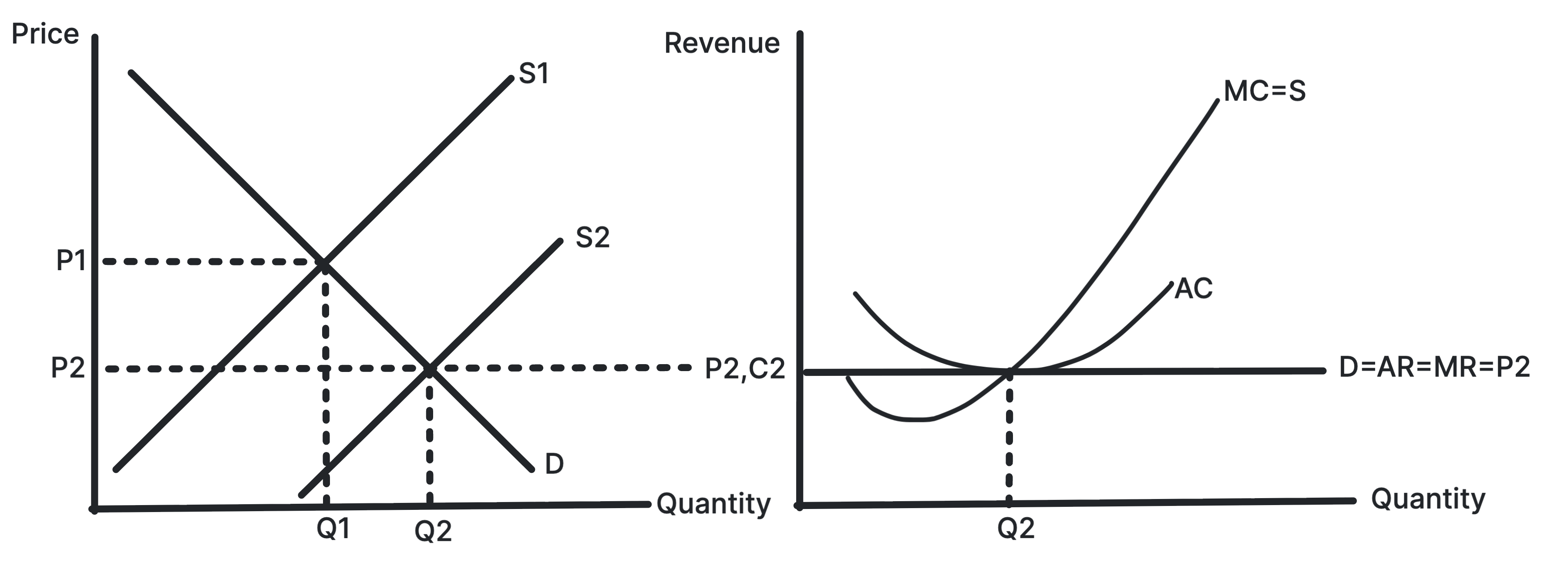
- Entry: the profit signals an opportunity → new firms join, which is easy with no barriers → market supply rises → the price falls.
- Long run: entry continues until the price equals average cost → firms make only normal profit, just enough to stay in the market (Figure 2).
A fall in demand works in reverse: losses push some firms out, supply falls and the price rises until normal profit returns. This is the price mechanism from unit 1.3.4 at work, and in the long run consumers pay a price equal to the lowest average cost.
Limitations of the Model of Perfect Competition
The model is a benchmark, not a description of real markets. Its assumptions rarely hold:
- Products are rarely identical. Most firms brand or change their products so customers stop treating them as the same.
- Information is not perfect. Buyers rarely compare every price, and firms keep their costs and plans to themselves.
- Entry is rarely free. Start-up costs, licences and established brands make joining a market costly and slow.
- Firms are not all small. Economies of scale let large firms produce more cheaply, so markets tend to end up with fewer, bigger firms.
The model also leaves little reason to innovate. Any idea is copied at once and supernormal profit is competed away, so firms have neither the profit to fund research nor the reward for doing it. Some markets come close, such as foreign currency or farm produce like wheat, but most sit further along the spectrum.
Market Structure, Pricing and Consumers
How much say a firm has over its price depends on where its market sits on the spectrum:
- Perfect competition: firms take the market price, so there is no pricing strategy to choose.
- Monopolistic competition: a loyal customer base → the firm can charge a little more than rivals without losing every sale → but a large gap sends customers elsewhere, so prices stay close to rivals'.
- Oligopoly: each firm's sales depend on what its rivals charge → a price cut is likely to be matched → firms avoid price wars and keep prices stable, often competing in other ways instead.
- Monopoly: no close substitutes → the firm sets its own price → it can raise prices above cost and keep supernormal profit, because barriers stop rivals entering.
Structure also limits which pricing strategies from unit 2.2.2 a firm can use. Competitive pricing, close to rivals', is the norm where products are similar. Price skimming only works while a product has no close rivals. Predatory pricing, cutting prices below cost to force rivals out, needs a large firm that can afford losses for a while.
For consumers, less competition usually means:
- Higher prices: fewer rivals → less pressure to cut prices → consumers pay more and buy less.
- Less choice: fewer firms → fewer products to choose between → consumers lose out if the one on offer doesn't suit them.
- Weaker pressure on quality: customers have nowhere else to go → less need to improve service or products → quality can slip.
The effect depends on:
- Economies of scale: a large firm may have such low costs that it charges less than many small firms could, even with market power.
- Use of profit: supernormal profit can pay for research and new products, so consumers may gain in the long run.
- Contestability: if new firms could enter easily, even a dominant firm keeps its prices down to stop them (unit 4.1.2).
- Regulation: regulators can cap prices or block mergers where market power harms consumers (unit 4.2.2).
Non-Price Competition
Non-price competition: ways of winning customers other than charging a lower price.
It matters most in monopolistic competition and oligopoly, where firms have products to set apart and, in oligopoly, a price cut would simply be matched. Common methods are:
- Branding and advertising, so customers see the product as different and better.
- Quality and design, such as better ingredients or new features.
- Customer service, such as free delivery, long warranties or easy returns.
- Loyalty schemes, such as supermarket reward cards, which give customers a reason to come back.
- Convenience, such as location, opening hours or a good app.
Successful non-price competition → customers see fewer close substitutes → demand becomes more price inelastic → the firm can charge more without losing many sales → higher profit. The catch is cost: advertising and loyalty schemes are expensive, and rivals copy anything that works.
Name the market structure before you analyse pricing. Use the extract's clues - the number of firms, their market shares, branding - to place the market on the spectrum, then explain what that means for the firm's freedom to set prices. "Supermarkets are an oligopoly, so a price cut is likely to be matched" earns analysis marks that a general point about competition does not.
Stuck on this topic? Work through it with an online A-Level Economics tutor in a free 15-minute intro call, or send an essay on it for A-Level Economics essay marking.