Price Mechanism
What the Price Mechanism Is
Price mechanism: the way changes in price, set by demand and supply, decide how a market's scarce resources are used.
No one tells farmers how much wheat to grow. Prices rise and fall, buyers and sellers respond, and resources move to where they are wanted with nobody in charge. This is the "invisible hand".
Rationing, Incentives and Signalling
A price change does three jobs at once, known as the three functions of the price mechanism.
| Function | What the price does | Example |
|---|---|---|
| Rationing | When something is scarce, a higher price limits who gets it to those willing and able to pay the most. A lower price spreads a plentiful good among more buyers. | Hotel rooms near a big festival cost far more that weekend, so only the keenest visitors book them |
| Incentive | A higher price means more profit, which encourages firms to produce more. A lower price encourages them to produce less or move into something else. | High festival-weekend prices encourage locals to let out rooms |
| Signalling | A price change tells buyers and sellers that conditions have changed. A rising price shows demand is outrunning supply. A falling price shows the reverse. | Rising rents in a city tell builders that more homes are wanted there |
Keep signalling and incentive separate. The signal is the information: the price has risen, so demand is up. The incentive is the reason to act on it: higher prices mean more profit. Students often write one and call it the other, which loses the mark for whichever is missing.
How Firms Respond to a Change in Demand
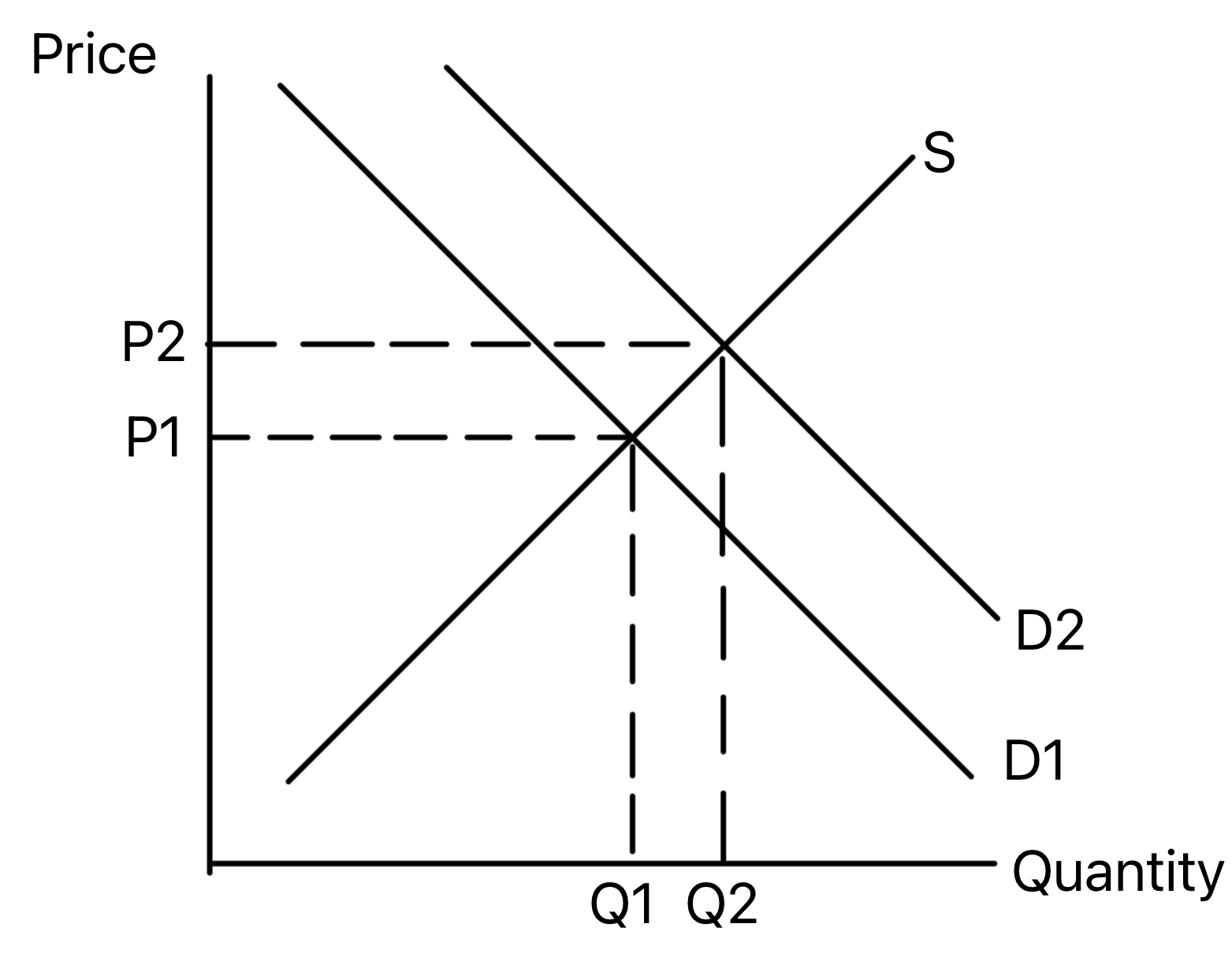
When demand rises, as in Figure 1, a firm has three options:
- Raise its price: stock runs short → the firm raises its price → the higher price rations what it has → more profit on each sale.
- Produce more with what it has: spare capacity, overtime or stock → supply extends from Q1 to Q2 → higher revenue, and more hours for staff.
- Invest in more capacity: the rise looks set to last → the firm takes on staff, buys machinery or opens new premises → higher output and new jobs.
In the longer run, higher profits attract new firms → supply shifts right → the price is pushed back down. A fall in demand works the other way. Firms cut prices to clear stock, reduce output and staff hours, and some leave the market.
Which response a firm chooses depends on:
- Whether the rise will last: no firm builds new capacity for a one-off spike, such as fans and ice cream in a heatwave.
- Spare capacity: a firm with idle machines and staff can raise output quickly and cheaply. One already at full capacity can only raise its price until it invests.
- What rivals do: if competitors hold their prices, a firm that raises its own risks losing customers.
Mass Markets and Niche Markets
Mass market: a large market where similar products are sold to most types of customer, such as toothpaste, crisps or smartphones.
Niche market: a small, specialised part of a larger market, with customers who want something particular, such as gluten-free bread or kit for left-handed golfers.
In a mass market there are many buyers and usually several large sellers. Competition keeps prices close to each other, so profit on each unit is small and firms rely on selling high volumes at low cost. A rise in demand is met mainly by producing more.
In a niche market there are fewer competitors, and customers will often pay more for a product that suits them. Profit on each unit can be high, but sales are small. If the niche grows, its high profits draw in bigger firms and prices fall.
Potential Market Growth
Before entering or expanding in a market, a firm wants to know whether it is growing. A growing market lets a firm raise sales without taking customers from rivals.
Market growth: the percentage change in the size of a market over a period, measured by sales value or volume.
Market growth (%) = change in market size ÷ original market size × 100. If a market's sales rise from £40m to £46m in a year, it has grown by £6m ÷ £40m × 100 = 15%.
Signs that a market has room to grow include:
- prices and profits rising, a signal that demand is outrunning supply
- changing tastes, or growth in the age group that buys the product
- rising real incomes, for normal goods
- new technology that creates a product or makes it cheaper.
Growth attracts new firms, so a fast-growing market often becomes more competitive. In a flat or falling market, a firm can only grow by winning customers from rivals.
Stuck on this topic? Work through it with an online A-Level Economics tutor in a free 15-minute intro call, or send an essay on it for A-Level Economics essay marking.