Wage Rates
How Wage Rates Are Set
Wage rate: the price of labour, paid per hour, week or year of work.
In a competitive labour market, the wage is set where firms' demand for labour meets workers' supply of it: W1 and Q1 in Figure 1.
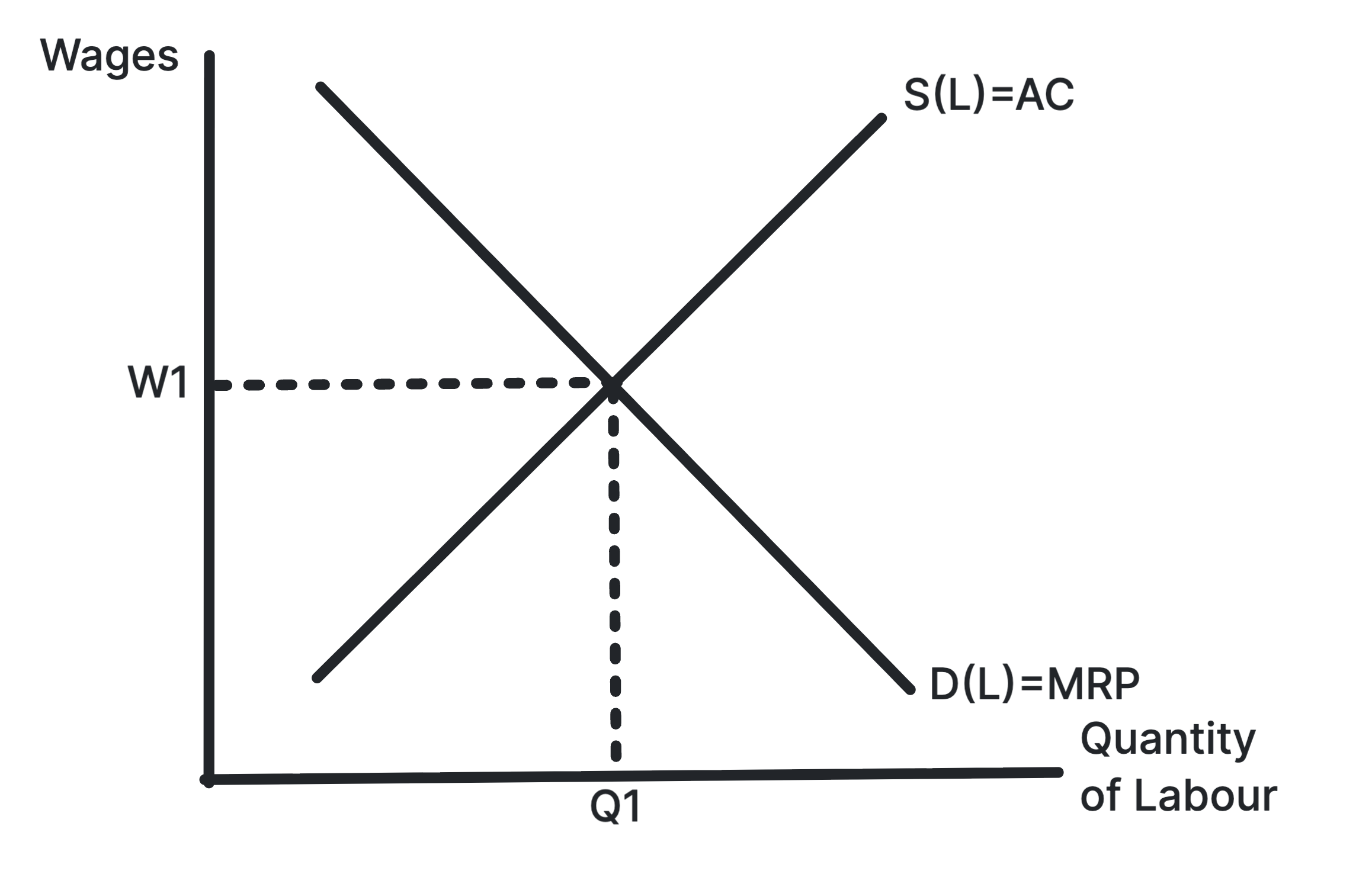
A wage rises when demand for labour rises or supply falls. That is why pay differs so much between jobs: few people have a surgeon's training and hospitals need surgeons badly, while almost anyone can start work in a shop.
The Demand for Labour
Derived demand: demand for something because of the demand for what it helps to produce. Firms want workers for the goods and services they make, not for their own sake.
The demand for labour depends on:
- Demand for the product: more people eat out → restaurants need more staff → demand for chefs and waiting staff rises.
- Productivity: each worker produces more → each adds more to revenue → firms will employ more people, or pay more (unit 2.3.1).
- The cost of machines: machines get cheaper or better → firms swap workers for them, as with self-service checkouts → demand for labour falls.
- Other employment costs: employer National Insurance rises → each worker costs more to employ → firms want fewer of them at any wage.
The Supply of Labour
The supply of labour to a job is the number of people willing and able to do it at each wage. It rises when:
- Pay in similar jobs falls: the job looks better by comparison, so more people apply.
- Non-wage benefits improve: flexible hours, job security or a good pension make a job more attractive at the same pay.
- Fewer qualifications are needed: a job anyone can start tomorrow has more applicants than one that takes seven years to train for.
- The working-age population grows: through higher birth rates in the past, or migration (unit 3.5.3).
- Work pays more than not working: lower income tax, cheaper childcare or less generous out-of-work benefits draw more people into jobs.
Skills, Training and Education
Skills raise pay from both sides of the market. A skilled worker produces more, so firms' demand for them is higher. Skills take years to gain, so fewer people can supply them. Higher demand and lower supply give a higher wage.
- Workers: train or study → become more productive and harder to replace → higher wages and less risk of losing their job.
- Firms: train staff → higher productivity and better quality → lower unit costs and higher profit. The risk is that a rival poaches the trained worker by paying more.
- The economy: a better-educated workforce → firms can make higher-value products and compete on quality → higher real incomes.
The pay-off depends on:
- Whether the skills are in demand: training for a declining industry does little for pay.
- Who pays for training: firms train less when trained staff can easily leave, which is why governments fund apprenticeships and education (unit 4.4.3).
Global Competition, Recession and Redundancies
Redundancy: when an employer dismisses a worker because their job is no longer needed, not because of how they did it.
Each of these holds wages down:
- Global competition: foreign rivals sell for less → UK firms must cut costs to keep customers → they hold down pay, automate or move work abroad → slower wage growth for workers whose jobs could be done elsewhere.
- Recession: spending on goods and services falls → firms need fewer workers, as labour is a derived demand → they freeze pay and stop hiring → wage growth slows across the economy.
- Redundancies: firms cut jobs → more people apply for each vacancy → employers can fill jobs without raising pay → lower wages for new starters. Workers who keep their jobs often accept smaller pay rises.
How far wages fall depends on:
- Whether pay can be cut: firms rarely cut pay in pounds, as it hurts morale, and the minimum wage sets a floor. They cut hours, bonuses or jobs instead, and real wages fall if pay rises more slowly than prices.
- How long it lasts: a short recession may only delay pay rises; lasting competition from abroad can lower pay for good.
Trade Unions and Professional Bodies
Trade union: an organisation of workers that negotiates with employers, as a group, over pay and working conditions (unit 4.2.1).
Professional body: an organisation that sets the qualifications and standards for a profession. Accountants, for example, must pass a professional body's exams before they can call themselves chartered.
Both can push wages up:
- Collective bargaining: a union negotiates for all its members and can threaten a strike → the employer risks lost output → it agrees higher pay than it would offer one worker alone.
- Entry requirements: a professional body requires long training and hard exams → fewer people qualify → the supply of labour is limited → higher wages for those who do.
- The cost to firms: pay rises → labour costs rise → the firm raises prices, accepts lower profit or employs fewer people.
Firms can gain too. A union gives staff a voice, which can cut staff turnover and raise productivity.
A union's power to raise pay depends on:
- Membership: the more of the workforce it represents, the more a strike would cost the employer.
- The employer's position: a profitable firm in a growing market can afford more than one fighting off cheaper foreign rivals.
- Whether the work can be replaced: if the firm can automate or move production abroad, a union that pushes too hard costs its members their jobs.
Explain pay with demand and supply, not with how useful a job is. Nurses do essential work, but the NHS employs most of them, which gives it the power to hold pay down. A Premier League footballer earns far more because each top player brings a club huge revenue and very few people have the talent.
Stuck on this topic? Work through it with an online A-Level Economics tutor in a free 15-minute intro call, or send an essay on it for A-Level Economics essay marking.