Minimum Wage Legislation
What a Minimum Wage Does
Minimum wage: the lowest hourly pay an employer can legally give a worker.
In the UK the National Living Wage is the minimum for workers aged 21 and over, and the National Minimum Wage sets lower rates for younger workers, whose lack of experience could otherwise price them out of jobs. The rates change every April. From April 2026 the National Living Wage is £12.71 an hour.
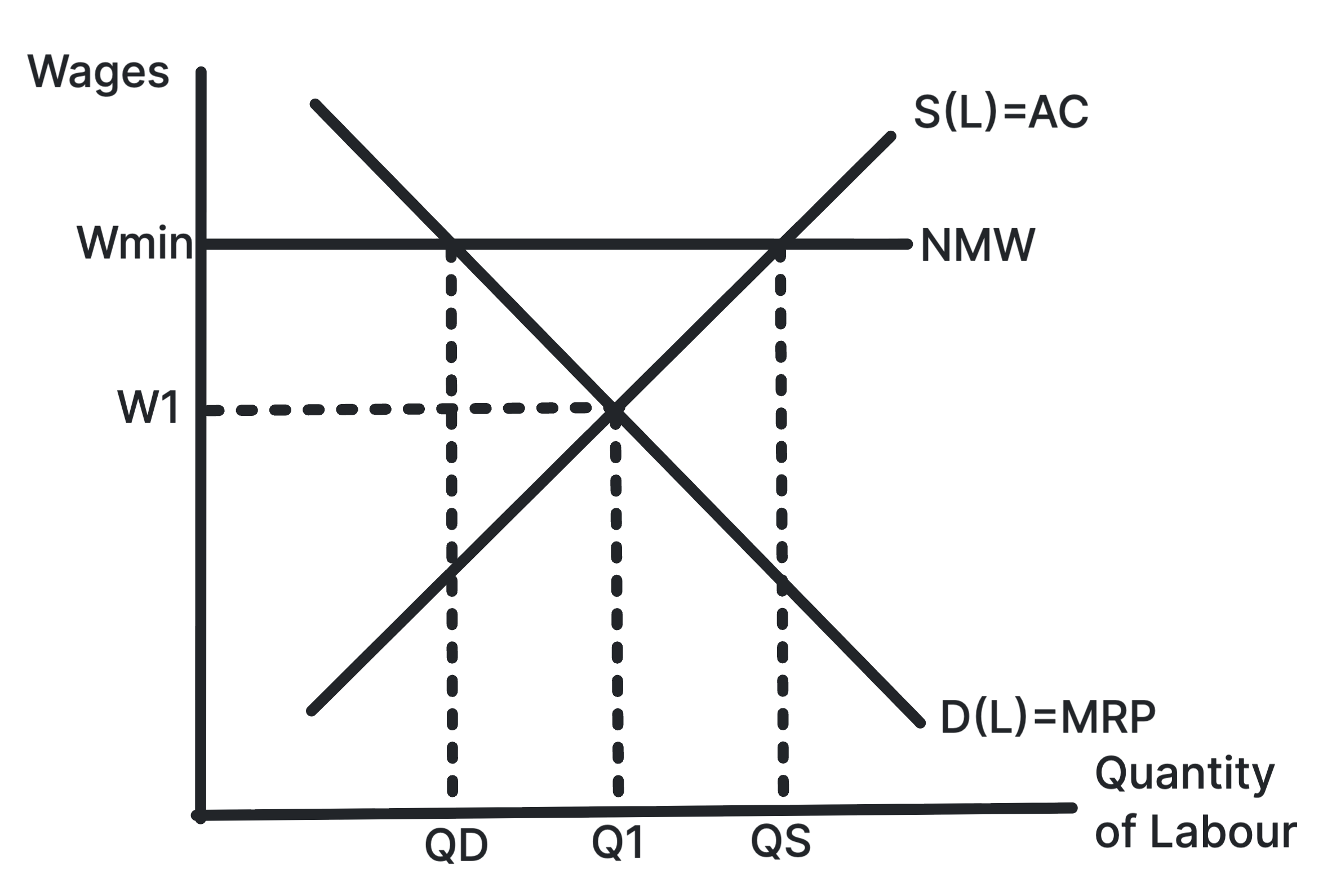
If a minimum wage is above the market wage, as Wmin is above W1 in Figure 1, workers who keep their jobs earn more. But firms now want only QD workers, while QS want to work. Employment falls from Q1 to QD, and the gap from QD to QS is unemployment.
Minimum Wages in Developed and Developing Countries
Most countries have a minimum wage, but it works differently depending on how developed the economy is.
| Feature | Developed countries | Developing countries |
|---|---|---|
| Level | Higher in money terms | Much lower in money terms, as productivity and prices are lower |
| Who it covers | Most workers, as most jobs are formal and registered | Fewer, as many work in the informal economy, in unregistered jobs the law rarely reaches |
| Enforcement | Inspections and fines | Often weak, with few inspectors |
| How it is set | Often one national rate, with age bands in the UK | Often varies by region or industry |
When a developing country raises its minimum wage:
- Workers gain: higher pay → families can afford better food, housing and schooling → higher living standards.
- Exporters' costs rise: factories making goods for global brands pay more → unit costs rise → the country's goods become less price competitive.
- Jobs can move: MNCs compare costs between countries → some move orders to a cheaper one → job losses in the first country (unit 3.5.1).
- The informal economy grows: small firms can't afford the new rate → they hire off the books → workers lose legal protection.
The effect depends on:
- Enforcement: a minimum wage that nobody checks changes little.
- Productivity: if output per worker rises as well, unit costs need not rise.
Skill Shortages and International Competitiveness
Skill shortage: when employers can't find enough workers with the skills they need at the going wage.
A skill shortage weakens a country's international competitiveness, its ability to sell abroad on price and quality:
- Higher costs: firms compete for scarce staff → wages rise → unit labour costs rise → higher prices → fewer exports.
- Lost orders: jobs go unfilled → orders are turned down or delivered late → overseas customers buy from rivals.
- Less investment: MNCs invest where they can find the workers they need → they choose other countries → fewer jobs and slower growth (unit 3.4.1).
How much damage a shortage does depends on:
- How long training takes: more lorry drivers can be trained in months, but a doctor takes years.
- Migration rules: firms that can recruit from abroad fill gaps faster.
Migration
Migration: people moving from one place to another to live, usually to find work or higher pay.
- Within economies: people move from poorer regions to better-off ones, or from the countryside to cities. In China, well over 100 million rural workers have left their home towns to work in cities.
- Between economies: people move to countries with more jobs or higher pay. A minimum wage in a developed country can be many times the pay on offer at home.
When workers move to another country:
- The host economy: labour supply rises → skill shortages ease and firms can expand → more output, spending and tax. Wage growth may slow in jobs where migrants and local workers compete.
- The country they leave: skilled workers go → fewer doctors, engineers and teachers at home (a brain drain) → slower growth. Against this, migrants send money home, called remittances → families spend more → higher incomes.
The effect depends on:
- Migrants' skills: filling shortages raises output; competing for the same jobs as low-paid local workers can hold their pay down.
- Time: in the short run, more people put pressure on housing and public services; over time, the extra tax can pay for more of both.
Inequality and Incentives
A minimum wage aims to reduce inequality by raising pay at the bottom. Its effects:
- Lower inequality: the lowest earners get a pay rise → the gap between low and average pay narrows → fewer working households in poverty.
- A stronger incentive to work: a job pays more compared with benefits → more people want to work → the supply of labour rises.
- An incentive for firms to raise productivity: labour costs rise → firms invest in training or machines → each worker produces more. Better-paid staff may also work harder and leave less often.
- Fewer jobs or hours: labour costs rise → firms cut hours, hire fewer people or automate → some low-paid workers lose income, as at QD in Figure 1.
The overall effect depends on:
- How high it is set: close to the market wage, few jobs are lost; far above it, many more.
- Who the low paid live with: many minimum-wage workers share a home with a better-paid partner or parent, so some of the gain goes to households that are not poor. Benefits target poverty more precisely.
- Employer power: where one employer dominates a local labour market, a minimum wage can raise pay and jobs together (unit 4.2.1).
Figure 1 shows the worst case. It assumes the minimum is above the market wage and that firms cut jobs rather than prices or profit. Research on the UK since the minimum wage began in 1999 has found very small effects on jobs. Draw the diagram, then evaluate it using the factors above.
Stuck on this topic? Work through it with an online A-Level Economics tutor in a free 15-minute intro call, or send an essay on it for A-Level Economics essay marking.