Market Power and Market Failure
Why Market Power Causes Market Failure
Market failure: when a free market allocates resources inefficiently, resulting in a social welfare loss (unit 1.5.1).
Market power is one cause. A firm that faces little competition can raise its price above marginal cost and supply less than consumers want at a fair price. Resources are under-allocated to that good, which is allocative inefficiency (unit 4.1.5). The rest of this page looks at the forms that power takes.
Cartels, Collusion and Tacit Agreement
Collusion: firms cooperating instead of competing, for example to fix prices, share out customers or limit output.
Cartel: a group of firms with a formal agreement to collude. Cartels are illegal in the UK, and people found guilty of cartel activity can go to prison.
Collusion is most likely in an oligopoly, where a few firms can watch each other. It takes two forms:
- Overt collusion: firms openly agree to fix prices, share out the market or limit output, through meetings, messages or contracts. A cartel is overt collusion. The agreement leaves evidence, so it can be proven in court and punished.
- Tacit collusion (tacit agreement): firms coordinate without ever communicating or agreeing anything, for example by following a price leader or never starting a price war (unit 4.1.3). The result can be the same as a cartel's, but with no agreement to point to it is much harder to prove.
Either form has the same effects:
- Consumers: firms act together like one monopoly → prices rise and output falls → consumers pay more and some are priced out.
- The colluding firms: no price competition → higher margins → supernormal profit, but a risk of heavy fines if caught.
Restrictive Practices
Restrictive practices: actions by a firm that limit competition, either against rivals or against the firms it trades with.
Common examples are:
- Predatory pricing: pricing below cost until a rival leaves, then raising prices.
- Exclusive dealing: making retailers stock only the firm's products.
- Tying: only selling one product to customers who also buy another.
- Refusal to supply: cutting off shops that also stock a rival's goods.
Each one keeps rivals out or pushes them out → fewer firms compete → the dominant firm can raise prices later → consumers pay more and have less choice. Competition law bans these practices when a dominant firm uses them (unit 4.2.2).
Monopsony Power
Monopsony: a market with a single buyer, or one dominant buyer, of a good, service or factor of production.
Large supermarkets have monopsony power over the farmers and food producers who supply them. A farmer who loses a supermarket contract may have nowhere else to sell, so the supermarket can drive a hard bargain.
- Suppliers: the buyer pushes down the price it pays → suppliers' margins shrink → smaller suppliers may go out of business or cut investment.
- Consumers: the buyer's costs fall → it may pass some saving on as lower prices, or keep it as profit.
Natural Monopolies
Natural monopoly: a market where one firm can supply the whole market at a lower average cost than two or more firms could.
This happens where fixed costs are huge and the cost of serving one more customer is small, such as water pipes, rail track or the electricity grid. Two firms laying pipes down every street would double the cost for no gain. Average cost keeps falling across the whole market, so one firm is the efficient outcome.
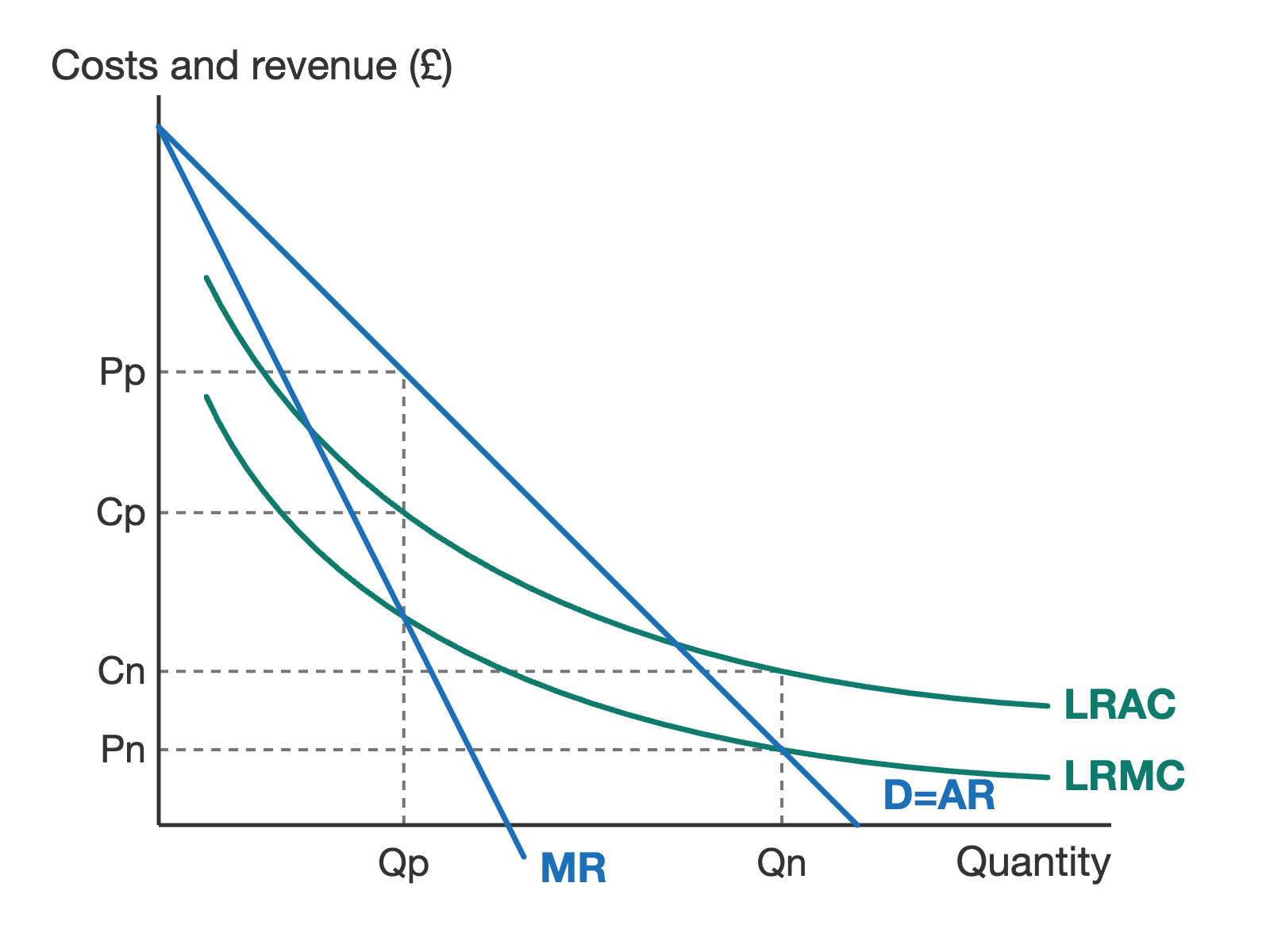
The market failure is that the one firm faces no competition. Left alone, it could charge high prices and let its service slip, so natural monopolies are regulated or publicly owned (unit 4.2.2).
Power in the Labour Market
Power can sit on either side of the labour market: with a dominant employer, or with workers organised in a trade union.
Monopsony Employers
In a town with one large employer, workers have few other jobs to go to, so they have to accept the wage on offer. The employer can pay less than a competitive market would → lower wages → fewer people take the jobs, so employment is lower too.
Trade Unions
Trade union: an organisation of workers that bargains with employers over pay and conditions.
A union can push wages above the competitive level by threatening strikes → labour costs rise → firms may hire fewer workers or raise prices. Against a monopsony employer, though, a union can push the wage back up towards the competitive level, raising pay and jobs together.
Implications for Economic Agents and Governments
When market power leads to market failure:
- Consumers: higher prices and less choice → lower real incomes and less consumer surplus.
- Workers: a monopsony employer pays less → lower wages → lower living standards and less spending in the local economy.
- Suppliers and small firms: squeezed by a dominant buyer or kept out by restrictive practices → lower profits, less investment and some closures.
- Firms with power: supernormal profit → higher returns for owners, and funds for investment.
- The government: market power goes unchecked → it has to fund competition authorities and regulators → less to spend elsewhere. It may also pay more for services it buys from a dominant supplier.
How serious the failure is depends on:
- Economies of scale: a large firm may have costs low enough that prices are no higher than with many small firms. This is the case for a natural monopoly.
- Use of profit: supernormal profit spent on research and new products can benefit consumers over time.
- Contestability: the threat of new entrants limits how far a dominant firm can raise prices.
- Regulation: effective competition law and regulators can correct much of the failure, though at a cost (unit 4.2.3).
Name the type of market power before you analyse it. A cartel, a monopsony buyer and a natural monopoly all cause market failure, but with different fixes. Say which one the extract describes, then judge the fix: breaking up a natural monopoly would raise costs, while breaking up a cartel would not.
Stuck on this topic? Work through it with an online A-Level Economics tutor in a free 15-minute intro call, or send an essay on it for A-Level Economics essay marking.