Supply-Side Policies
What Supply-Side Policies Do
Supply-side policies: policies that aim to increase an economy's productive capacity, shifting long-run aggregate supply (LRAS) to the right.
Demand-side policies change how much is spent. Supply-side policies change how much the economy can produce, by raising the quantity or productivity of labour and capital. Many also cut firms' costs, which shifts short-run aggregate supply (SRAS) right as well.
Market-Based and Interventionist Methods
Market-based policies: supply-side policies that reduce the government's role, so markets work more freely and incentives are stronger.
Interventionist policies: supply-side policies in which the government spends, provides or directs resources to raise productive capacity.
Market-based policies, such as tax cuts and deregulation, rely on firms and workers responding to incentives. Interventionist policies, such as spending on training or roads, fill gaps the market leaves because firms would provide too little of them.
Policies for Each Aim
| Aim | Market-based | Interventionist |
|---|---|---|
| Increase incentives | Lower income tax, so work pays more; lower corporation tax, so firms keep more profit to invest | Tax relief or grants for research and development, and for investment in new equipment |
| Promote competition | Deregulation and privatisation, lowering barriers to entry | Competition law enforced by the Competition and Markets Authority (unit 4.2.2) |
| Reform the labour market | Limit trade union power; make it easier to hire on flexible contracts; tighter rules on who can claim benefits | Job centres matching people to vacancies; funded childcare so parents can return to work |
| Improve skills and quality of labour | Student loans, so people invest in their own skills; universities competing for students | State spending on schools, apprenticeships and adult training; healthcare that keeps people fit to work |
| Improve infrastructure | Faster planning approval; private investment in privatised networks such as energy and water | Government spending on roads, rail, broadband and power grids |
Each aim raises capacity in a different way:
- Incentives: lower tax on income → work pays more → more people join the labour force or work longer hours → more labour, so higher output.
- Competition: lower barriers → new firms enter → existing firms must cut costs and innovate → lower prices and higher productivity.
- Labour market: wages and hiring respond more easily to demand → firms take on staff more readily → lower unemployment.
- Skills: better training → workers produce more per hour → firms' unit costs fall and workers can earn higher wages.
- Infrastructure: faster transport and broadband → lower costs of moving goods and people → firms can reach more customers and invest where they could not before.
Showing Supply-Side Policies on a Diagram
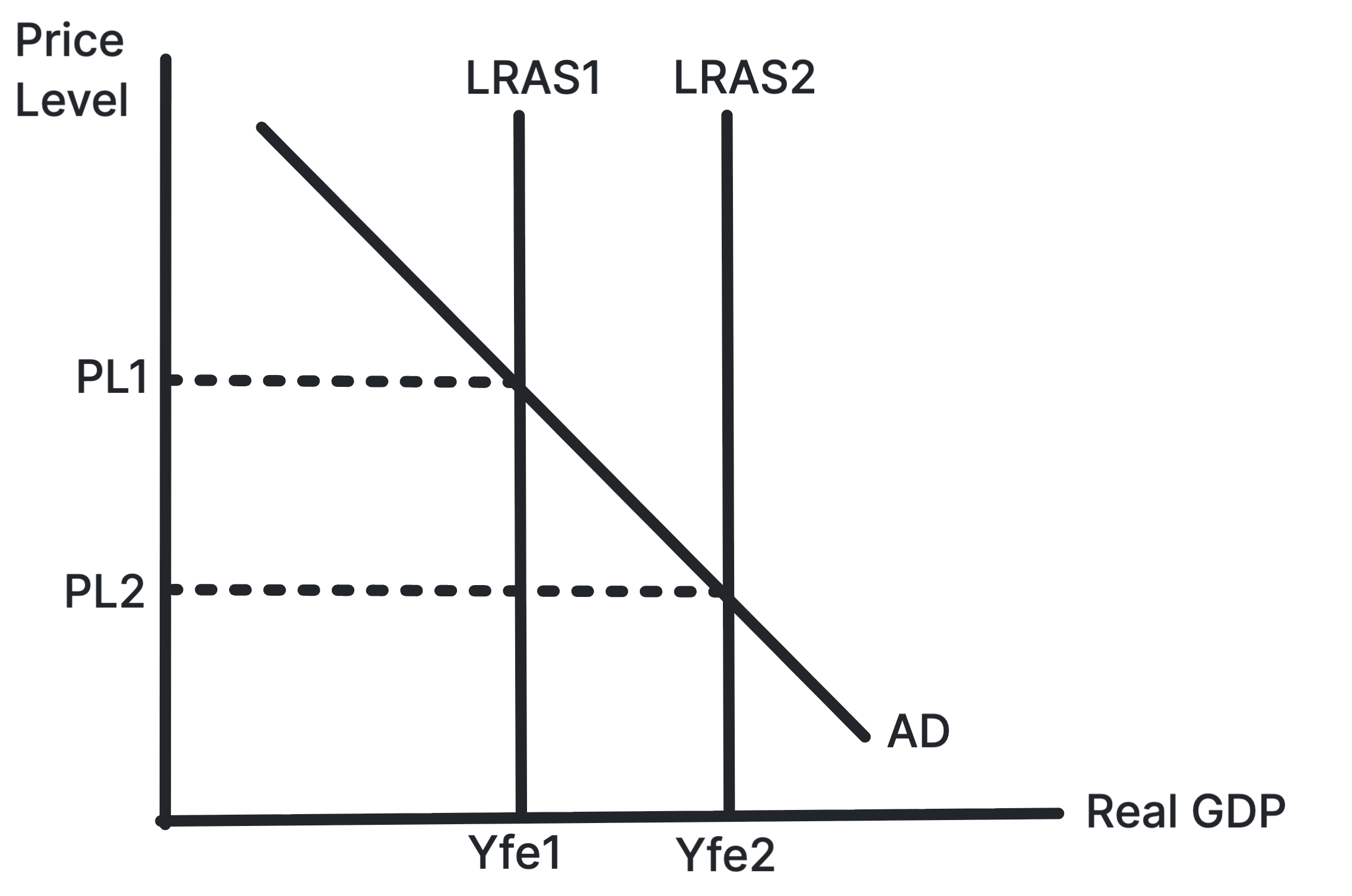
A successful supply-side policy shifts LRAS to the right. Real GDP rises and, with AD unchanged, the price level falls. On the classical diagram, full capacity output itself moves, from Yfe1 to Yfe2.
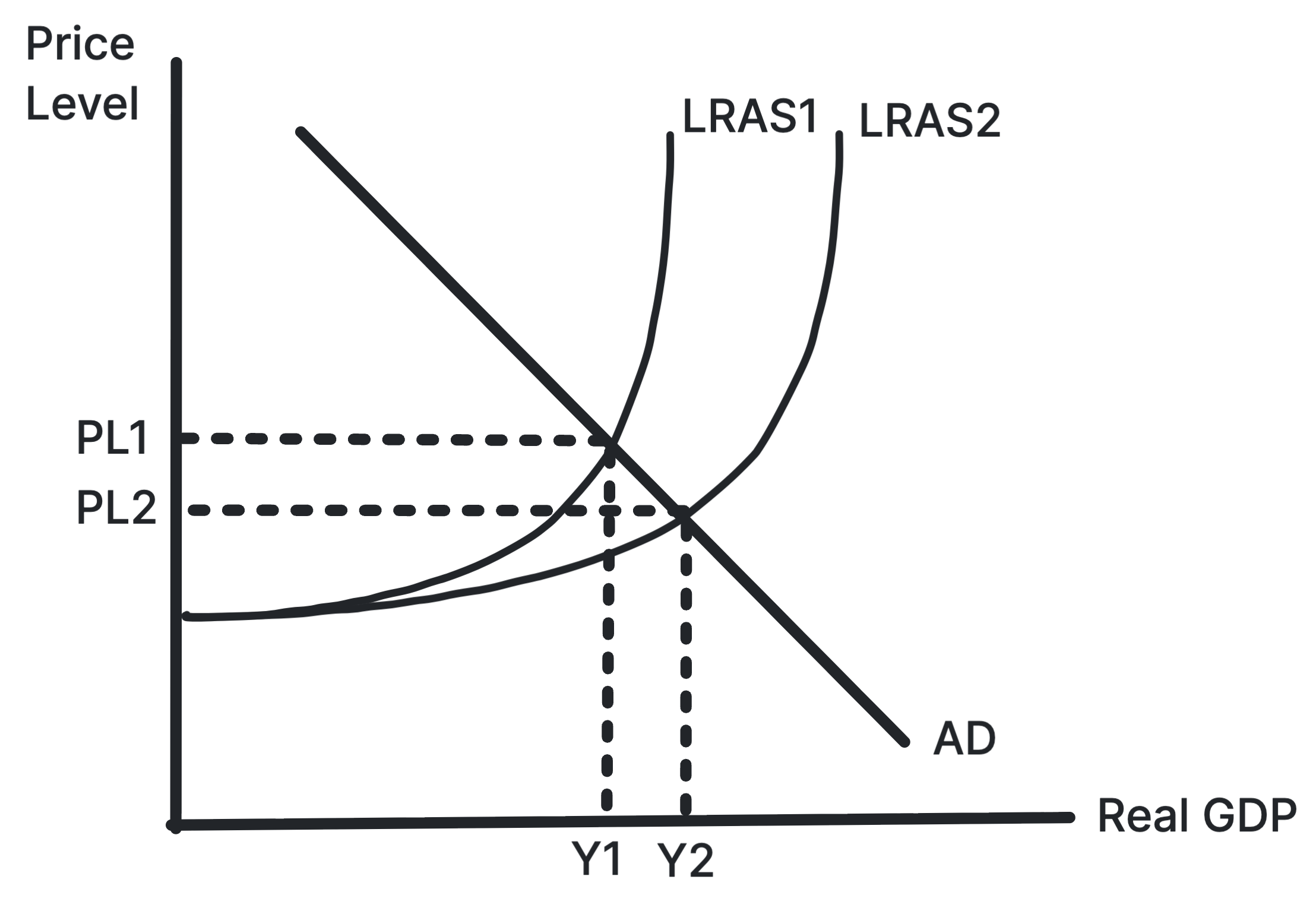
On the Keynesian diagram the whole curve moves right, so the economy reaches full capacity at a higher output.
Strengths and Weaknesses
When supply-side policies work:
- Growth without inflation: capacity rises → output can grow without firms running short of workers and materials → less pressure on costs and prices.
- Lower unemployment: better skills and job matching → people fit the vacancies on offer → structural unemployment falls, which demand-side policy cannot fix.
- Exporters: higher productivity → lower unit costs → UK goods compete better on price abroad → more export sales.
- The government: a larger, faster-growing economy → more tax revenue and fewer benefit claims → the budget deficit narrows over time.
Their weaknesses:
- Time lags: a new apprentice takes years to become fully skilled, and a rail line can take a decade or more to build.
- Cost: interventionist policies need government spending, with an opportunity cost in other services or higher borrowing.
- Uncertain results: an income tax cut may lead some people to work fewer hours for the same pay, and a firm may keep a tax cut as profit.
- No help in a recession: extra capacity is wasted if demand is weak and firms cannot sell what they already make.
How well they work depends on:
- The type of policy: market-based policies are often cheaper for the government; interventionist ones can reach problems markets ignore, such as training for workers who might leave for a rival firm.
- The cause of the problem: they help most where low output comes from a skills gap, poor transport or weak competition.
- How well they are run: money spent on the wrong projects, or deregulation that lets firms cut safety corners, is government failure.
Policy Conflicts and Trade-Offs
- Efficiency or equality: cuts to top tax rates, benefits and union power → stronger incentives → but the gains go mainly to higher earners and the low-paid can lose out.
- The budget now or growth later: spending on education and infrastructure → higher borrowing today → with the growth, if it comes, years away.
- Growth or the environment: new roads, runways and faster planning → more output → but more emissions and lost green space.
- Workers or firms: flexible contracts → firms hire more cheaply → but workers face less job security and less predictable pay.
Many supply-side policies shift AD first. Spending on a new railway adds to government spending, so AD rises straight away, while LRAS only moves once the line is open. Show both shifts, say which comes first, and use the gap between them as your time-lag evaluation.
Stuck on this topic? Work through it with an online A-Level Economics tutor in a free 15-minute intro call, or send an essay on it for A-Level Economics essay marking.