Exchange Rate Changes
Exchange Rates and the Wider Economy
Depreciation: a fall in the value of a currency against another, such as the pound falling from $1.30 to $1.20.
Appreciation: a rise in the value of a currency against another.
Unit 2.4.4 explains why exchange rates change and what a change means for one firm. The starting point for the whole economy is the same: a weaker pound makes UK exports cheaper abroad and imports dearer at home.
The Effects of a Depreciation
Current account: the part of the balance of payments that records trade in goods and services, plus income such as interest and profits flowing in and out of the country.
When the pound depreciates:
- Current account: UK exports are cheaper in foreign currency and imports dearer in pounds → export sales rise and imports fall → a current account deficit narrows, or a surplus grows.
- Economic growth: net exports rise → aggregate demand rises → firms raise output → higher real GDP, made larger by the multiplier.
- Firms: exporters and firms competing with imports win sales → higher revenue and profit. Firms that rely on imported materials face higher costs and lower margins (unit 2.4.4).
- Unemployment: firms producing more for export and home markets need more workers → they hire → unemployment falls, especially in manufacturing areas.
- Inflation: imported food, fuel and components cost more in pounds → firms pass the costs on → cost-push inflation. Higher demand for exports adds demand-pull pressure too (unit 2.5.3).
- FDI flows: UK land, factories and firms cost less in foreign currency → buying or building in the UK is cheaper for foreign firms → FDI into the UK can rise.
An appreciation runs each chain the other way: the current account worsens, growth slows, exporters lose sales and jobs, and cheaper imports bring inflation down.
Why the Effects Are Not Automatic
The Marshall-Lerner Condition
A depreciation means each import costs more in pounds. If the quantity of imports barely falls, the UK spends more on them, not less. Exports must also rise enough to make up for that.
Marshall-Lerner condition: a depreciation improves the current account only if the price elasticities of demand for exports and imports add up to more than 1: \[ \text{PED}_{\text{exports}} + \text{PED}_{\text{imports}} > 1 \]
The elasticities are taken as positive numbers. If demand for both is inelastic and the total is below 1, a depreciation makes the current account worse.
The J-Curve
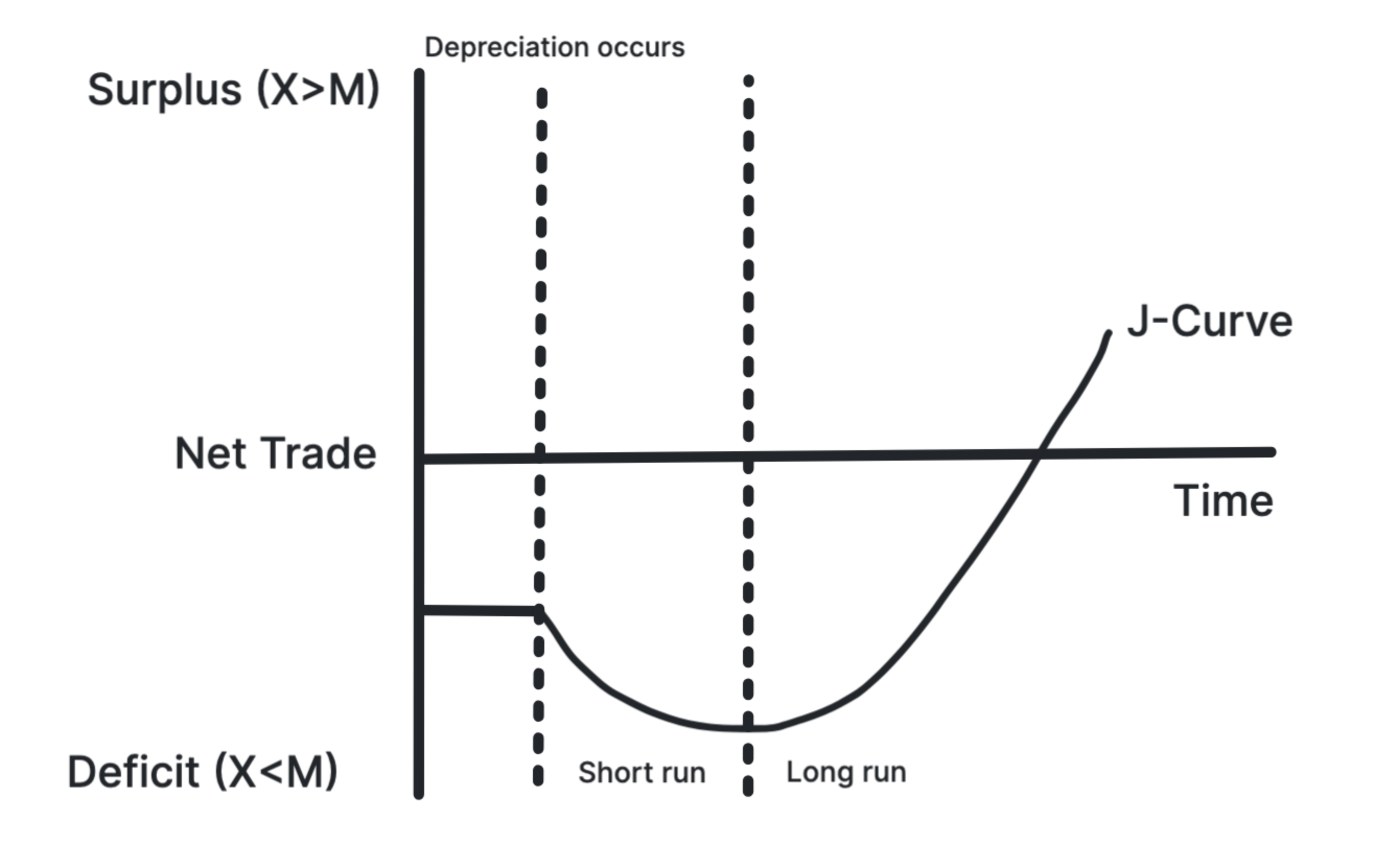
Even when the condition holds in the long run, it often fails at first. Prices are fixed in contracts, and buyers take time to find new suppliers, so demand is inelastic in the short run. The trade balance gets worse after a depreciation, then improves as buyers switch, tracing a J shape.
What Else Changes the Answer
The effect of a depreciation depends on:
- Spare capacity: with unemployed workers and idle factories, firms can raise output, so growth and jobs gain most. Near full capacity, the extra demand mainly raises prices.
- Import content of exports: many UK exports use imported parts. Their costs rise with the depreciation, so part of the price advantage is lost.
The Eurozone
Eurozone: the group of EU countries that use the euro as their currency, with interest rates set for all of them by the European Central Bank (ECB).
The euro was launched in 1999. Bulgaria became the 21st member in January 2026. The UK never joined, so UK firms trading with the Eurozone still face changes in the pound-euro rate.
For firms and countries inside the Eurozone:
- No exchange rate risk: a German firm selling to France is paid in euros → its revenue cannot be hit by a currency change, and it pays nothing to convert money → lower costs and easier planning → more trade between members.
- Clear prices: prices across 21 countries are in one currency → buyers compare them easily → firms face more competition → lower prices for consumers.
- More investment: a firm outside, such as a US carmaker, can build one factory and sell across the Eurozone without currency risk → more FDI into member countries.
The costs come from sharing one monetary policy:
- One interest rate for all: the ECB sets a single rate → it may be too high for a member in recession and too low for one with rising inflation → each country loses a tool to manage its own economy.
- No exchange rate to adjust: a member whose costs rise faster than its neighbours' cannot let its currency fall → its exports stay expensive → it can regain competitiveness only by cutting wages and prices, which means higher unemployment for years. Greece faced this in its debt crisis after 2010.
Whether the euro suits a country depends on:
- How closely its economy moves with the rest: if members boom and slump together, one interest rate suits them all.
- How easily workers and money move: if workers can move to where the jobs are, unemployment in one member falls without a currency change.
Add time and capacity to any depreciation answer. A weaker pound can improve the current account and raise growth, but only after a lag (the J-curve) and only if demand is elastic enough (Marshall-Lerner). If the economy is near full capacity, the main result may be inflation. Use the extract to say which applies.
Stuck on this topic? Work through it with an online A-Level Economics tutor in a free 15-minute intro call, or send an essay on it for A-Level Economics essay marking.