Trade Policy and Trade Negotiations
Protectionism
Protectionism: government policies that restrict imports to shield domestic producers from foreign competition.
Governments protect industries for four main reasons:
- Infant industries: a new industry may need time to grow and cut its costs before it can compete with established foreign firms.
- Jobs: protection can save jobs in an industry that cheaper imports would otherwise close.
- Dumping: foreign firms selling below cost to win a market can be met with extra tariffs.
- Strategic industries: a country may want its own supply of steel, energy or medicines in case trade is cut off.
Tariffs
Tariff: a tax on imported goods.
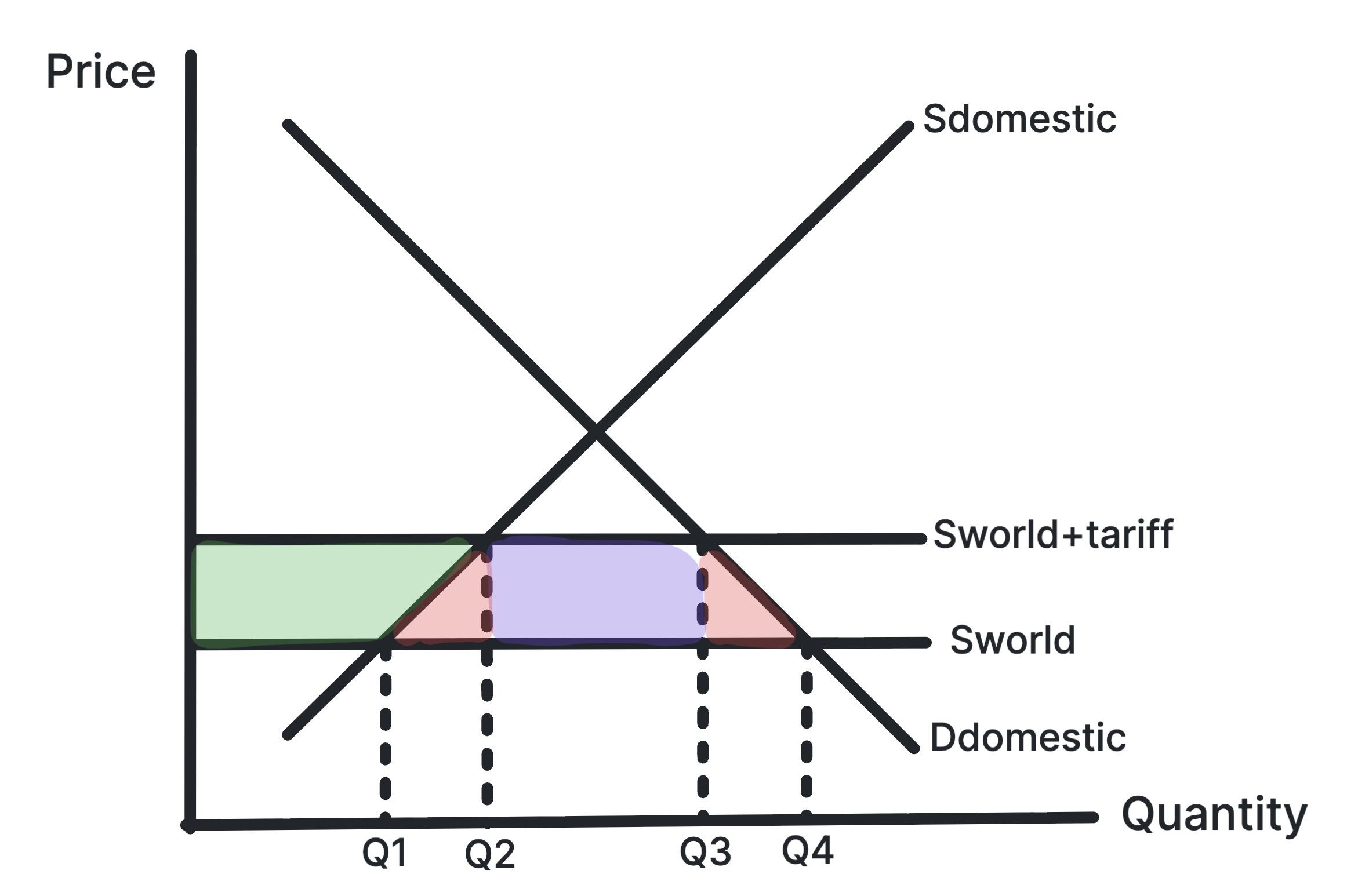
Without a tariff, the country can import as much as it wants at the world price, shown by the line Sworld. Home producers supply Q1, consumers buy Q4, and imports fill the gap. A tariff raises the price of imports to Sworld+tariff.
When the tariff is imposed:
- Home producers gain: the price they can charge rises → they expand output from Q1 to Q2 → higher revenue and profit (the green area), and more jobs.
- Consumers lose: they pay the higher price → they buy less, Q3 instead of Q4 → lower real incomes and less choice.
- The government gains: it collects the tariff on each of the Q2-Q3 units still imported (the purple area).
The two red triangles are a welfare loss. The left one is the cost of making goods at home that could be imported more cheaply. The right one is the lost benefit to consumers who no longer buy at all.
Import Quotas
Import quota: a limit on the quantity of a good that can be imported in a period.
Once imports reach the quota, any extra demand must be met by home producers, who need a higher price to supply more. The price rises above the world price → home producers expand output → consumers pay more and buy less.
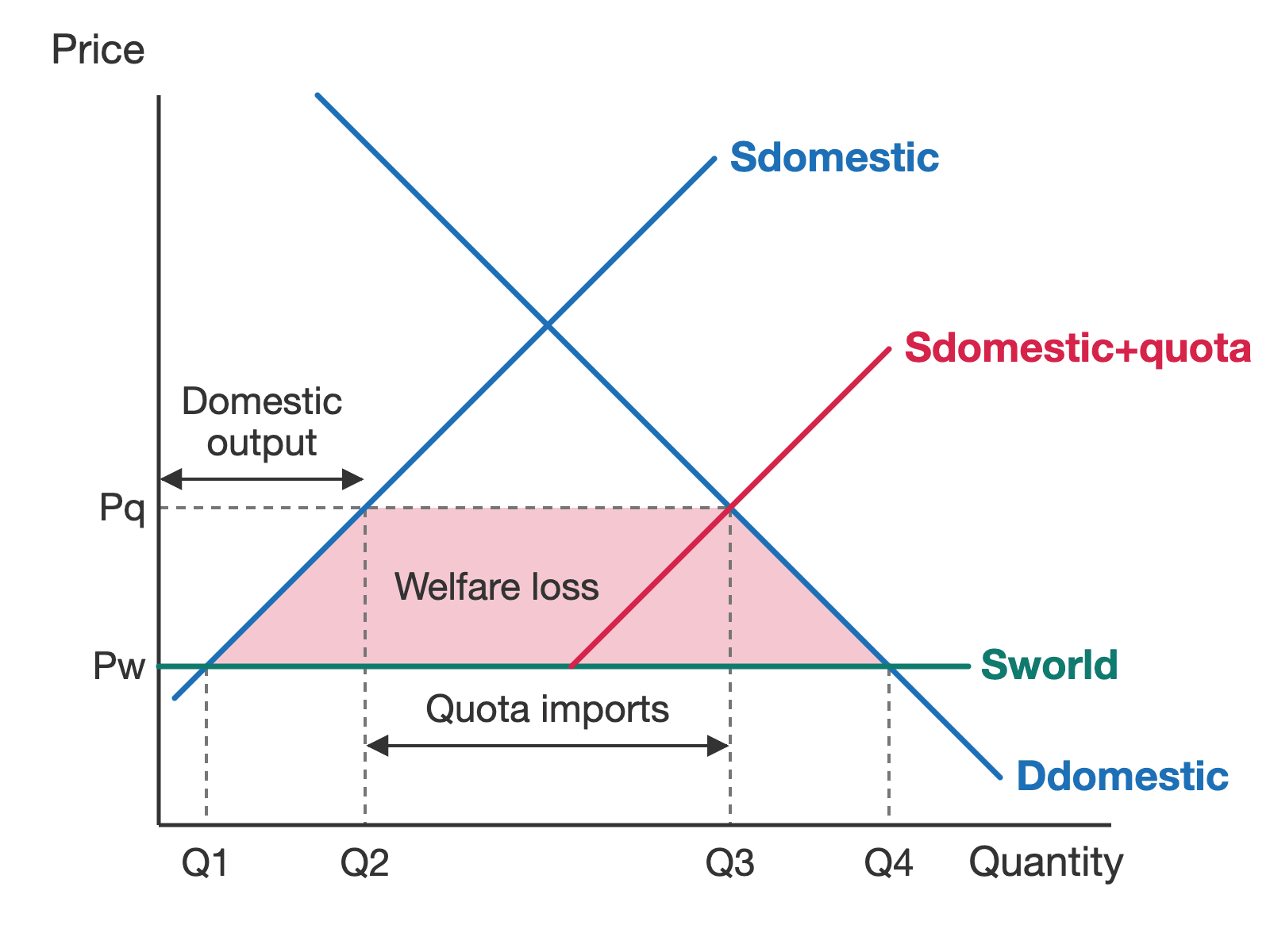
The effects on producers and consumers are like a tariff's, with one difference: the government collects no revenue. The gap between the world price and the higher home price goes instead to the foreign firms allowed to sell within the quota.
Other Trade Barriers
Non-tariff barrier: any restriction on imports other than a tariff or a quota.
- Government legislation: laws on product safety, labelling or how food is produced. The EU bans beef from cattle given growth hormones, which keeps out much US beef.
- Paperwork and checks: customs forms, licences and inspections at the border add cost and delay, and hit small exporters hardest.
- Voluntary export restraints: the exporting country agrees to limit how much it sells, usually to head off a tighter barrier.
- Embargoes: a complete ban on trade with a country, usually for political reasons.
Rules like these often have genuine aims, such as safety. They count as protectionism when their main effect is to keep foreign goods out.
Domestic Subsidies
Subsidy: a payment from the government to producers that lowers their costs.
- Home producers: the subsidy lowers their unit costs → they can match the price of imports → they win back sales at home and abroad.
- Consumers and taxpayers: prices don't rise, unlike with a tariff → but the subsidy has to be paid for through taxes or borrowing, or by spending less elsewhere.
How well protection works depends on:
- Retaliation: trading partners may put tariffs on the country's exports in return, so exporters lose what the protected industry gains.
- Whether the industry becomes competitive: protection that never ends removes the pressure to cut costs, and consumers keep paying more.
- Price elasticity of demand for imports: if demand is inelastic, a tariff barely cuts imports and mainly raises prices.
International Trade Negotiations
Trade rules are agreed in talks between governments, either between many countries at once or between two.
| Body | Purpose | One criticism |
|---|---|---|
| G20 | Leaders of 19 large economies, the EU and the African Union meet each year to coordinate policy on growth, trade and finance, as they did in the 2008 financial crisis | It has no power to enforce what it agrees, and most low-income countries are not members |
| WTO | Sets the rules of world trade, hosts talks to cut barriers and settles disputes between members | Talks are slow: the Doha round, launched in 2001, was never completed. Appeals in disputes have stalled since 2019, when the US blocked new appointments |
| IMF | The International Monetary Fund lends to countries in financial crisis or with balance of payments problems, and monitors their economies | Its loans come with conditions, such as spending cuts, that can deepen a recession and hit the poorest hardest |
| World Bank | Lends to and funds developing countries for long-term projects, such as roads, power and schools, to reduce poverty | Voting power depends on how much each country pays in, so high-income countries have the most say |
Two WTO rules shape trade policy. Members must charge every other member the same tariff on a good, unless they are in a trade agreement together. And a member that breaks the rules can face tariffs from the country it harmed.
Bilateral Trading Agreements
Bilateral trade agreement: a deal between two countries to reduce barriers to trade between them.
Since leaving the EU, the UK has signed several. Its agreement with Australia came into force in 2023, and its agreement with India in July 2026.
Two countries can agree far faster than the WTO's members, and can tailor the deal to the goods they trade. But each deal has its own rules, which adds paperwork for firms trading with many countries, and a small economy has little bargaining power against a large one.
Say who gets the extra money. A tariff and a quota both raise the home price, but a tariff gives the government revenue, while a quota hands that gain to the foreign firms allowed to sell. When you draw either diagram, label the world price, the new price and the change in imports, then explain who gains and who loses.
Stuck on this topic? Work through it with an online A-Level Economics tutor in a free 15-minute intro call, or send an essay on it for A-Level Economics essay marking.