Exchange Rates
Changes in Exchange Rates
Exchange rate: the value of one currency expressed in another, for example £1 = $1.30.
The pound has a floating exchange rate: its value is set by the demand for and supply of pounds on the foreign exchange market, where currencies are bought and sold.
Appreciation: a rise in the value of a currency against another, such as the pound rising from $1.30 to $1.40.
Depreciation: a fall in the value of a currency against another, such as the pound falling from $1.30 to $1.20.
Pounds are demanded by anyone abroad who needs them: foreign buyers of UK goods and services, foreign firms investing in the UK, and savers moving money into UK banks. Pounds are supplied by UK households and firms changing them into other currencies to buy imports or invest abroad.
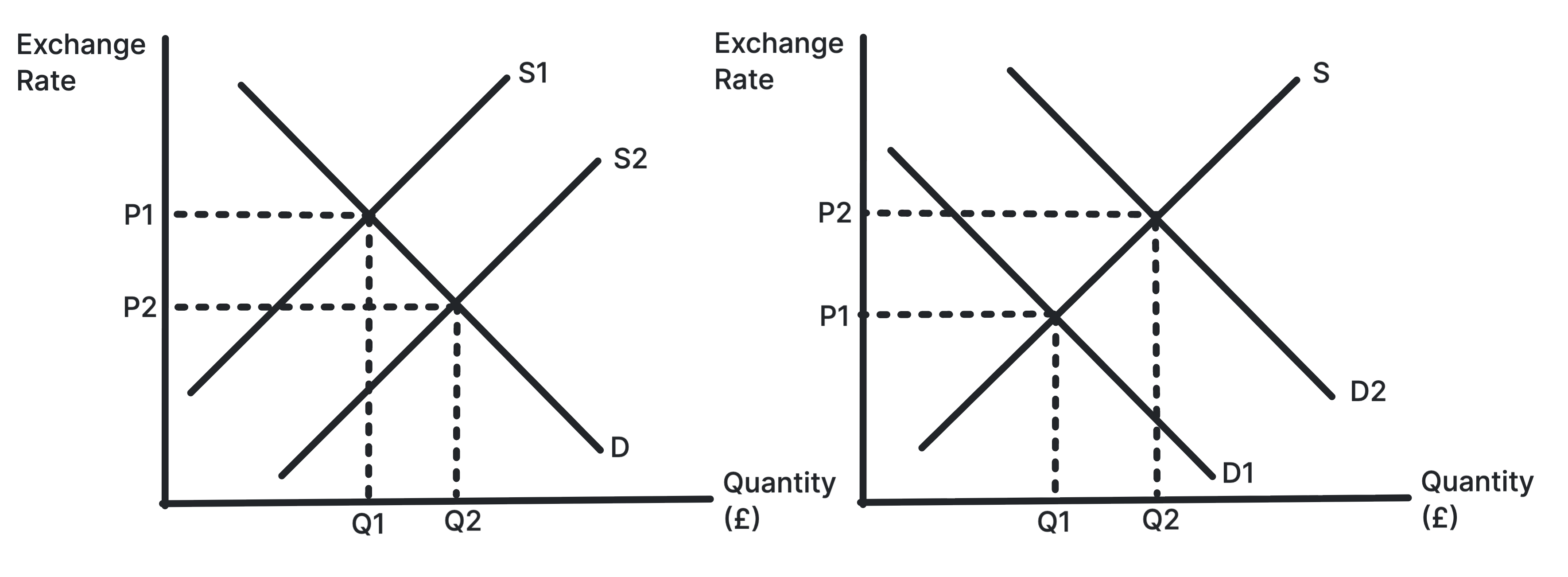
The main causes of a change are:
- Interest rates: UK rates rise compared with rates abroad → saving in the UK pays more → foreign savers buy pounds → demand for pounds rises → the pound appreciates.
- Demand for exports and imports: foreign demand for UK goods rises → buyers need more pounds to pay for them → the pound appreciates. If UK spending on imports rises instead, more pounds are sold and the pound depreciates.
- Speculation: traders expect the pound to rise → they buy it now to profit later → demand rises and the pound appreciates. Expecting a fall, they sell and it depreciates.
Impact of Changing Exchange Rates on Firms
A changing exchange rate alters a firm's prices abroad and its costs at home (see also unit 1.2.5). When the pound depreciates:
- Exporters gain: the pound falls → each UK product costs less in foreign currency → the firm can cut its foreign price and win more sales, or keep the price and earn more pounds on each one → higher revenue and profit.
- Importers lose: the pound falls → materials and components priced in dollars or euros cost more pounds → higher unit costs → the firm raises its prices and loses some sales, or keeps them and accepts a lower margin.
- Firms competing with imports gain: the pound falls → imported rivals cost more in UK shops → customers switch to UK-made products → higher sales for UK producers.
When the pound appreciates, each chain runs the other way: exporters lose price competitiveness, importers' costs fall, and cheaper imports take sales from UK producers.
How much a firm is affected depends on:
- How much it imports as well as exports: many exporters buy parts from abroad, so a weaker pound raises their costs while it helps their sales. The net effect depends on which is larger.
- Price elasticity of demand: if foreign buyers are price-sensitive, a lower foreign price wins many extra sales. A strong brand sells on quality, so the exchange rate matters less (unit 2.2.1).
- Size and duration of the change: firms rarely switch suppliers or markets over a brief dip. A big fall that persists for a year or more can make them rethink where they source parts and which countries they target.
Interpreting Exchange Rate Data
An exchange rate written as £1 = $1.30 tells you how many dollars one pound buys, so the rate is the amount of foreign currency per pound. To convert a sterling (pound) price into the other currency, multiply by the rate:
\[ \text{Foreign price} = \text{Sterling price} \times \text{Rate} \]
To convert back into pounds, divide by the rate:
\[ \text{Sterling price} = \frac{\text{Foreign price}}{\text{Rate}} \]
When reading exchange rate data, look at the direction of the change, how big it is in percentage terms, and how quickly it happened. A sharp move is harder for firms to plan around than a gradual one.
Interpreting Effective Exchange Rates
Effective exchange rate: the value of a currency against a basket of other currencies, with each weighted by how much the country trades with it. It is also called the trade-weighted exchange rate.
The pound can rise against the dollar while falling against the euro, so no single exchange rate shows whether it is stronger overall. The effective rate does. The Bank of England publishes the sterling effective exchange rate as an index, with January 2005 = 100:
- A rise in the index means the pound has appreciated on average against the currencies of the UK's trading partners.
- A fall means it has depreciated on average.
- The level compares the pound with January 2005: an index of 80 means it is worth 20% less on average than then.
The effective rate shows what is happening to UK firms as a whole. A single firm still needs the rate for the currency it actually trades in: an exporter selling only to the US cares about the dollar.
Worked Example: The Pound After the 2016 EU Referendum
Bank of England data for the day of the vote, 23 June 2016, and for 17 October 2016:
| Measure | 23 June | 17 October | Percentage change |
|---|---|---|---|
| £1 in dollars | $1.48 | $1.22 | (1.22 − 1.48) ÷ 1.48 × 100 = −17.6% |
| £1 in euros | €1.30 | €1.11 | (1.11 − 1.30) ÷ 1.30 × 100 = −14.6% |
| Effective exchange rate | 87.9 | 73.8 | (73.8 − 87.9) ÷ 87.9 × 100 = −16.0% |
| A £60 jacket sold in the US | 60 × 1.48 = $88.80 | 60 × 1.22 = $73.20 | 17.6% cheaper for US buyers |
| A $1,000 part bought from the US | 1,000 ÷ 1.48 = £676 | 1,000 ÷ 1.22 = £820 | 21.3% dearer for the UK firm |
The pound depreciated against both currencies, but by more against the dollar. The effective rate fell by 16.0%, between the two, because it averages the pound's moves against all the UK's trading partners. A UK exporter selling to the US became much more price competitive, while a firm buying parts in dollars faced a cost rise of over a fifth.
Check which way round the rate is written. If the data says £1 = $1.30, a higher number means a stronger pound. If it says $1 = £0.77, a higher number means a weaker pound. Before you analyse the effect on a firm, state whether the pound has appreciated or depreciated.
Stuck on this topic? Work through it with an online A-Level Economics tutor in a free 15-minute intro call, or send an essay on it for A-Level Economics essay marking.