Potential Policy Conflicts and Trade-Offs
Inflation and Unemployment
Trade-off: a situation where getting more of one thing means accepting less of another.
In the short run, pushing inflation down tends to push unemployment up, and the reverse:
- Cutting unemployment: AD rises → firms hire more and spare workers become scarce → firms raise wages to recruit and pass the cost on in prices → inflation rises.
- Cutting inflation: Bank Rate rises → households and firms spend less → firms cut output and stop hiring → unemployment rises.
Short-run Phillips curve: a curve showing an inverse relationship between the rate of inflation and the rate of unemployment in the short run.
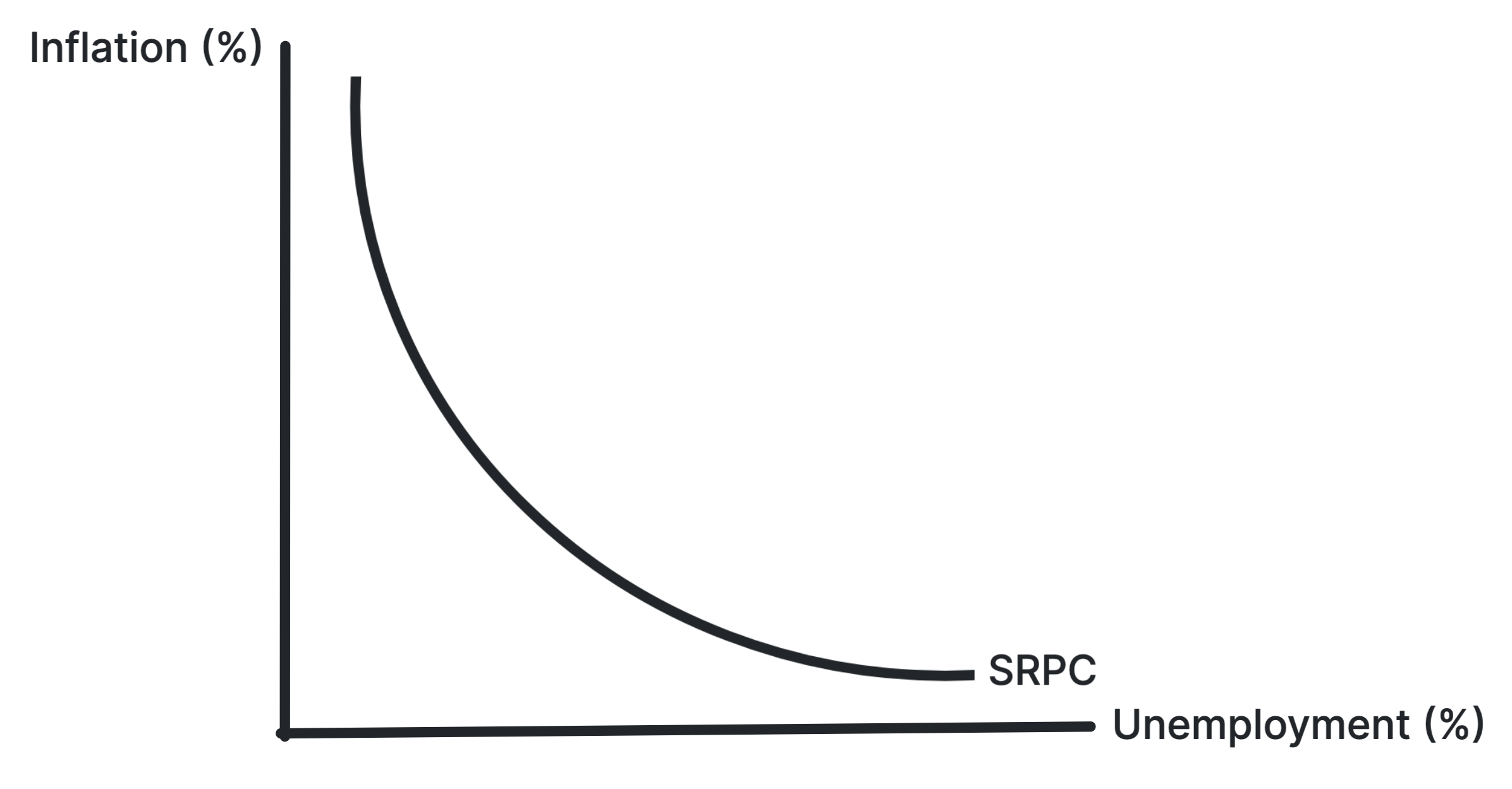
The trade-off is not fixed. It depends on:
- The cause of inflation: cost-push inflation, such as a jump in energy prices, can raise inflation and unemployment together, so the curve gives no guide.
- Spare capacity: in a deep recession, extra demand creates jobs with little effect on prices.
- The time period: supply-side policies that raise productivity can lower both over the long run.
Economic Growth and Negative Externalities
Negative externality: a cost of producing or consuming a good that falls on a third party, who is not paid for it, such as pollution from a factory.
Growth tends to raise these costs:
- Pollution: more output → more energy, transport and raw materials used → more emissions and waste → costs for people living nearby and for the climate.
- Congestion: more people commuting and more goods moved → busier roads → longer journeys and higher transport costs for firms.
Policies that cut externalities, such as carbon taxes or tighter regulation (unit 4.3.2), raise firms' costs. That can slow growth in the short run, so the conflict runs both ways.
How sharp the conflict is depends on:
- The kind of growth: growth in services, or in clean energy, adds far less pollution than growth in heavy industry.
- The time period: green investment costs firms money now but can create new industries and jobs later.
Issues in Managing the Economy
Even with a clear objective, running the economy is hard. Governments face several problems:
- Conflicting objectives: besides the two above, faster growth pulls in imports and widens the current account deficit, and cutting the budget deficit slows growth. The government has to choose which objective matters most at the time.
- Time lags: a change in Bank Rate can take up to two years to work in full. By then, the economy may have moved on.
- Late and uncertain data: GDP figures arrive weeks after the quarter ends and are often revised, so policy-makers can misjudge where the economy is.
- Shocks from abroad: a world recession or a rise in oil prices can hit the UK whatever its own policies.
- Limited money: extra spending or tax cuts have to be paid for, and a large national debt limits how much more the government can borrow.
- Politics: tax rises and spending cuts are unpopular, so they may be delayed, especially before an election.
How Different Macroeconomic Perspectives Influence Policy
Economists disagree about how the economy works, and that changes what they think the government should do. There are two main views.
| Keynesian | Free-market | |
|---|---|---|
| How the economy works | It can stay below full capacity for years if spending is weak | Left alone, markets return the economy to full capacity fairly quickly |
| Main worry | Unemployment and lost output in a recession | Inflation, high taxes and government debt |
| Role of government | Large: manage demand to keep output near capacity | Small: keep inflation low and let markets work |
| Favoured policies | Fiscal policy: more spending and borrowing in a recession; spending on training and infrastructure | Monetary policy for inflation; tax cuts, less regulation and lower benefits to make markets work better |
In a recession, a Keynesian economist would borrow to spend on projects such as house-building, to replace the missing demand. A free-market economist would avoid adding to debt and cut taxes and red tape so that firms expand. Unit 4.4.1 shows the two views as different shapes of the LRAS curve.
Policy Instruments, Specific Problems and Unintended Consequences
Unintended consequence: an effect of a policy that policy-makers did not aim for, often on another objective or another group.
Each instrument suits some problems better than others, and each has side effects:
| Problem | Likely instrument | Likely effect | Possible unintended consequence |
|---|---|---|---|
| Demand-pull inflation | Raise Bank Rate | Less borrowing and spending, so prices rise more slowly | Slower growth and job losses; a stronger pound hurts exporters |
| Recession and rising unemployment | More government spending or tax cuts | Higher AD, more output and jobs | More borrowing and debt; more spending on imports |
| Skills shortages | Education and training | Higher productivity and less structural unemployment | Firms cut their own training budgets and let the state pay |
| Low investment | Cut corporation tax | More profit kept to invest | Firms pay higher dividends instead; less tax revenue for public services |
| Pollution | Carbon tax or regulation | Firms cut emissions to avoid the cost | Higher prices; some production moves to countries with looser rules |
Whether an instrument works depends on:
- Getting the cause right: higher interest rates cut demand, so they do little against inflation caused by world energy prices, and extra spending does little for structural unemployment.
- How people respond: households and firms may save a tax cut, or change their behaviour in ways no one planned.
- Using instruments together: if the government loosens fiscal policy while the Bank is raising rates to fight inflation, the two pull against each other.
Match the instrument to the cause, not just the problem. If an extract shows inflation rising because of oil prices, a rate rise slows inflation only by cutting spending and jobs. Say what is causing the problem, pick the instrument that tackles that cause, then name one unintended consequence. That sequence gives you analysis and evaluation in one paragraph.
Stuck on this topic? Work through it with an online A-Level Economics tutor in a free 15-minute intro call, or send an essay on it for A-Level Economics essay marking.