The Economic Cycle
Understanding the Economic Cycle
Economic cycle: the repeated rise and fall in economic activity, measured by real GDP, around the economy's long-term trend. It is also called the trade cycle or business cycle.
Real GDP is the value of everything an economy produces, adjusted for inflation. A rise in real GDP is economic growth.
Trend rate of growth: the average rate at which real GDP grows over many years, as the economy's capacity to produce rises.
Actual growth rarely matches the trend. Some years it runs faster, some slower, and sometimes output falls. The cycle has four phases:
- Boom (or peak): output grows faster than the trend and the economy works close to its full capacity.
- Downturn (or slowdown): growth slows, and output drops back towards the trend.
- Recession (or slump): output falls, leaving the economy well below what it could produce. Its lowest point is called the trough.
- Recovery (or upturn, expansion): growth returns and output climbs back towards the trend.
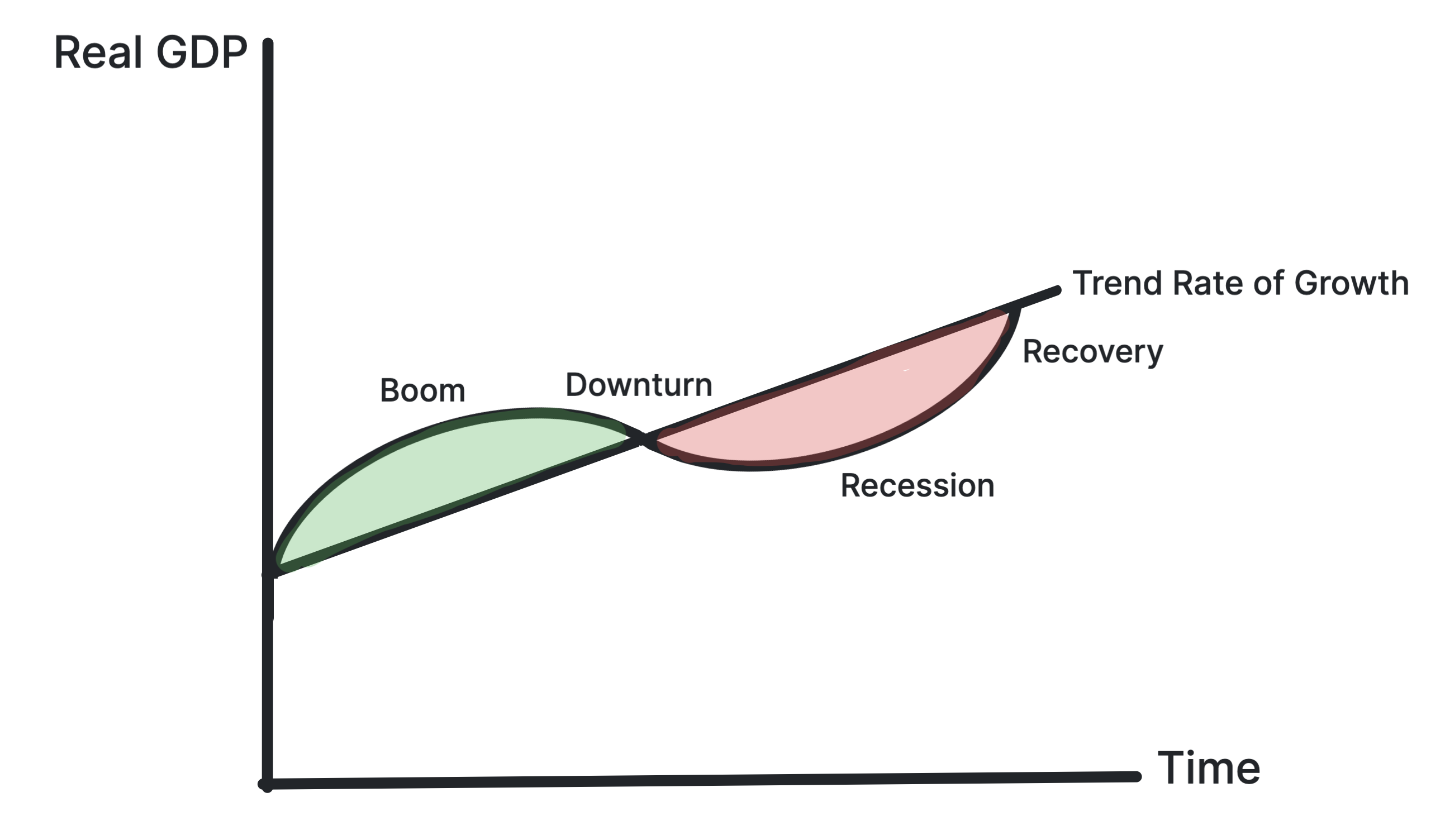
The cycle is driven mainly by changes in spending, and each change feeds on itself. Confidence rises → households and firms spend and invest more → firms raise output and hire → incomes rise → spending rises again.
A fall in confidence, a rise in interest rates or a sudden shock, such as a jump in energy prices, runs the same chain downwards (unit 2.5.2).
Characteristics of a Boom
Boom: a period when real GDP grows faster than its trend rate and the economy is working at or near full capacity.
In a boom you would expect to see:
- Fast growth: real GDP rising above its trend rate.
- Low unemployment: firms struggle to fill vacancies, and skills shortages appear.
- Rising inflation: spending outgrows what firms can supply, and wages rise as firms compete for staff.
- High confidence: households borrow and spend, and firms invest in extra capacity.
- More imports: higher incomes are partly spent on goods from abroad.
- Stronger government finances: tax revenue rises and less is spent on unemployment benefits.
A boom cannot last. Once the economy hits its capacity, extra spending mostly raises prices, and the Bank of England is likely to raise interest rates to slow it down.
Characteristics of a Recession
Recession: a fall in real GDP for two consecutive quarters, that is, six months of negative economic growth.
In a recession you would expect to see:
- Falling output: real GDP shrinks, and firms have spare capacity.
- Rising unemployment: firms cut jobs, and some close.
- Low inflation: weak demand stops firms raising prices, and prices can even fall.
- Low confidence: households save more, and firms put off investment.
- Fewer imports: lower incomes mean less spending on foreign goods.
- Weaker government finances: tax revenue falls while benefit spending rises, so government borrowing goes up.
Slower growth is not a recession. If growth falls from 3% to 1%, the economy is still growing: real GDP is higher than a year ago. A recession needs real GDP itself to fall. Read data carefully, because a falling growth rate on a chart can look like falling output.
Implications for Firms of Fluctuations in Economic Activity
In a boom:
- Sales and profit rise: incomes and confidence rise → customers spend more, especially on luxuries → higher sales → higher profit.
- Costs rise: firms compete for scarce staff and materials → wages and input prices go up → higher unit costs → margins shrink unless prices rise too.
- Capacity runs short: orders outgrow output → delivery times lengthen → customers go to rivals → lost sales unless the firm invests or hires.
In a recession:
- Most firms lose sales: unemployment rises and confidence falls → customers cut spending → lower sales and profit → redundancies, and closure for the weakest firms.
- Some firms gain: real incomes fall → shoppers trade down → discount retailers and budget brands win sales and market share (unit 2.2.4).
- Cash gets tight: customers pay later and banks lend more cautiously → less cash coming in → firms struggle to pay suppliers and staff → a risk of failure even for firms that were profitable (unit 1.6.4).
- Some costs fall: more people are looking for work → easier to recruit and less pressure on pay → lower labour costs. Rents and material prices may ease too.
Firms change what they do as the cycle turns:
| Decision | In a boom | In a recession |
|---|---|---|
| Prices | Raise prices to cover rising costs | Hold or cut prices, and run promotions |
| Output and stock | Add shifts and overtime, and hold more stock | Cut output and run stock down |
| Staff | Recruit, and raise pay to keep staff | Freeze hiring, cut hours or make redundancies |
| Investment | Expand capacity, new sites and machinery | Delay projects and close loss-making sites |
| Products | Launch premium lines | Push value ranges and smaller pack sizes |
The effect on a particular firm depends on:
- What it sells: sellers of luxuries feel each swing most, sellers of necessities least, and sellers of inferior goods move the opposite way (income elasticity of demand).
- How much it borrows: a firm with large debts struggles when sales fall and when rates rise; one with cash reserves can ride out a recession and even buy weaker rivals cheaply.
- How deep and long the phase is: a short, mild slowdown can be absorbed with stock and cash; a long recession forces job cuts and closures.
Stuck on this topic? Work through it with an online A-Level Economics tutor in a free 15-minute intro call, or send an essay on it for A-Level Economics essay marking.