Price Elasticity of Demand (PED)
PED and the Firm's Pricing Decision
Every firm that sets its own price faces the same question: if we raise the price, how many customers will we lose? Price elasticity of demand answers it.
Price elasticity of demand (PED): how much the quantity demanded of a product responds to a change in its own price.
If demand is price inelastic, customers keep buying when the price rises, so the firm can charge more. If it is price elastic, a small rise sends many of them to rivals.
Calculating PED
PED compares two percentage changes: \[ \text{PED} = \frac{\%\text{ change in quantity demanded}}{\%\text{ change in price}} \]
Work out each percentage change from the original figure (see unit 1.6.1), then divide. Because price and quantity demanded move in opposite directions, the answer is negative.
Worked Example: A Pizza Takeaway
A takeaway cuts the price of a large pizza from £12 to £10.80. Weekly sales rise from 300 to 360.
| Step | Working | Answer |
|---|---|---|
| % change in quantity demanded | (360 − 300) ÷ 300 × 100 | +20% |
| % change in price | (10.80 − 12) ÷ 12 × 100 | −10% |
| PED | +20 ÷ −10 | −2 |
| Total revenue before | £12 × 300 | £3,600 |
| Total revenue after | £10.80 × 360 | £3,888 |
A PED of −2 means sales rose by twice the percentage the price fell, so demand is price elastic. The extra pizzas more than make up for the lower price, and weekly revenue rises by £288.
Interpreting the Value of PED
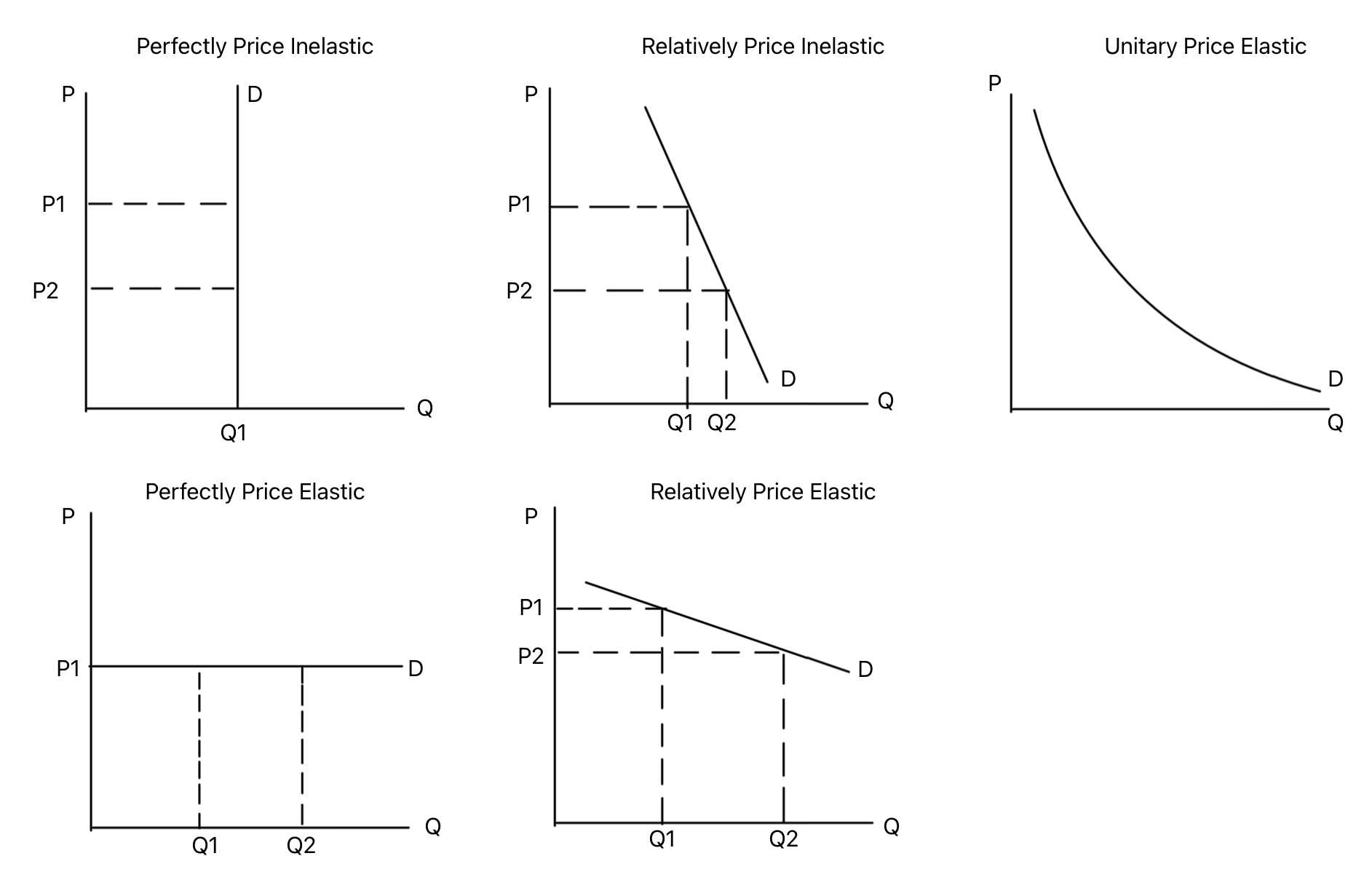
Ignore the minus sign when you classify. What matters is the size of the number: −2 is more elastic than −0.5.
| PED (ignoring the sign) | Demand is | What it means |
|---|---|---|
| 0 | Perfectly inelastic | Quantity demanded does not change at all |
| Between 0 and 1 | Price inelastic | Quantity changes by a smaller percentage than price |
| 1 | Unitary elastic | Quantity changes by the same percentage as price |
| Greater than 1 | Price elastic | Quantity changes by a larger percentage than price |
| Infinite | Perfectly elastic | Any rise in price and sales fall to zero |
The number also tells you the size of the response. A PED of −0.4 means a 10% price rise cuts quantity demanded by 4%.
PED and Total Revenue
Total revenue: the money a firm receives from selling its product (also called sales revenue): \[ \text{Total revenue} = \text{Price} \times \text{Quantity sold} \]
A price change pulls total revenue two ways: more money on each unit, but fewer units sold, or the reverse. PED tells you which effect wins.
- Inelastic demand: price rises 10% → sales fall by less than 10% → the higher price outweighs the lost sales → total revenue rises. A price cut makes revenue fall.
- Elastic demand: price rises 10% → sales fall by more than 10% → the lost sales outweigh the higher price → total revenue falls. A price cut makes revenue rise, as it did for the takeaway.
- Unitary elastic demand: the two effects cancel out, so total revenue stays the same.
Higher revenue is not the same as higher profit. The takeaway's revenue rose by £288, but it made 60 more pizzas. If each costs £4 in ingredients and packaging, costs rise by £240 and profit by only £48. Before you recommend a price cut, check what the extra units cost to make.
Pricing in Niche and Mass Markets
Mass market: a large market in which many firms sell similar products to customers with broadly the same needs.
Niche market: a small, clearly defined part of a larger market, with its own particular needs (unit 2.1.5).
PED usually differs between the two, and so does the right price:
- A firm in a mass market: many rivals sell near-identical products → customers have plenty of close substitutes → demand for one firm's product is price elastic → a price rise loses so many sales that revenue falls. Firms price close to their rivals and rely on high volume at a low margin.
- A firm in a niche market: a specialist product with few substitutes and loyal buyers → demand is price inelastic → the firm can charge a premium and lose few sales → a high margin on a low volume.
This is why firms work to make demand less price elastic, through branding and other non-price competition (unit 2.2.3).
How useful PED is for setting a price depends on:
- How rivals react: in a mass market, a price cut that rivals match wins few extra sales, so revenue falls for everyone.
- How reliable the estimate is: PED is worked out from past sales, while tastes, incomes and rivals' prices keep changing. It also holds only for small price changes.
Factors Influencing PED
Demand is more price elastic when:
- There are more, and closer, substitutes: customers can switch easily when the price rises. This is the most important factor.
- The product is a luxury, not a necessity: people can go without a meal out, but not without heating their home.
- It takes a large share of income: a 10% rise in the price of a car is noticed far more than a 10% rise in the price of salt.
- Customers have more time to respond: in the short run people are stuck with their habits. Over time they find alternatives, so demand becomes more elastic.
- The market is defined narrowly: demand for petrol is inelastic, but demand for petrol from one filling station is elastic, because the next one is a short drive away.
Demand is less elastic where buyers are loyal to a brand or the product is habit-forming, such as cigarettes.
Stuck on this topic? Work through it with an online A-Level Economics tutor in a free 15-minute intro call, or send an essay on it for A-Level Economics essay marking.