International Trade
Specialisation and International Trade
Countries specialise for the same reason workers do: each gets better at what it focuses on, and trades for the rest (unit 1.2.4). The question is which goods a country should specialise in.
Absolute advantage: when one country can make more of a good than another country with the same quantity of resources.
Comparative advantage: when one country's opportunity cost of making a good is lower than another country's, so it gives up less of other goods to make it.
The theory of comparative advantage says each country should specialise in the goods it makes at the lowest opportunity cost, then trade. Each country can then consume more than it could make alone.
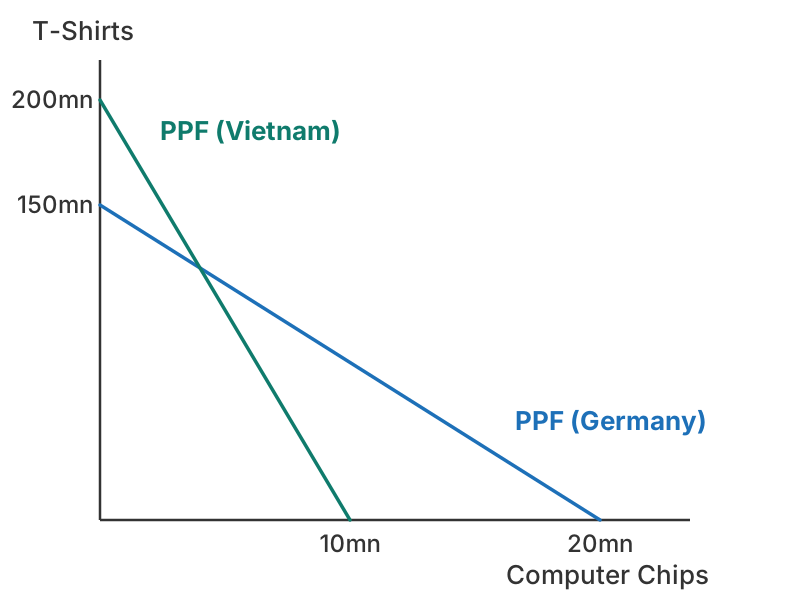
Worked Example: Germany and Vietnam
Using the figures in Figure 1, the opportunity cost of one good is what the country gives up of the other.
| Step | Germany | Vietnam |
|---|---|---|
| Opportunity cost of 1 chip | 200 ÷ 20 = 10 T-shirts | 150 ÷ 10 = 15 T-shirts |
| Opportunity cost of 1 T-shirt | 20 ÷ 200 = 0.1 chips | 10 ÷ 150 = 0.07 chips |
| Output when fully specialised | 20mn chips | 150mn T-shirts |
| After trading 5mn chips for 60mn T-shirts | 15mn chips and 60mn T-shirts | 5mn chips and 90mn T-shirts |
| The most it could make alone, with the same chips | 15mn chips and 50mn T-shirts | 5mn chips and 75mn T-shirts |
Germany has the absolute advantage in both goods, but the lower opportunity cost only for chips; Vietnam's is lower for T-shirts. After specialising and trading, Germany has 10mn more T-shirts than it could make alone and Vietnam 15mn more, so both consume beyond their own PPF. Both gain as long as a chip swaps for between 10 and 15 T-shirts.
Real-world gains are smaller than the model suggests:
- Transport costs and trade barriers eat into the extra output.
- Resources do not switch easily. Workers and machines in a declining industry cannot move into the growing one overnight.
- Over-specialisation is risky. A country that relies on one or two exports is hit hard if demand or prices for them fall.
Comparative advantage is about opportunity cost, not being best. A country that is better at making everything still gains from trade, by specialising in the goods where its lead is largest and importing the rest. In an answer, work out the opportunity cost for each country before saying who should specialise in what.
Trading Blocs
Trading bloc: a group of countries that agree to reduce or remove barriers to trade between themselves, such as the EU.
Firms inside a bloc can sell to the other members without tariffs, which gives them a larger home market. Firms outside it can face tariffs and extra paperwork, which is why many foreign firms set up inside a bloc to sell to it. The types of bloc and their costs and benefits are covered in unit 3.1.3.
Trade and Growth
Trade can raise a country's economic growth in three ways:
- Exports: foreign demand for UK goods rises → UK firms sell more and expand output → they hire more workers, whose spending raises demand further → higher real GDP (unit 4.4.1).
- Bigger markets: firms sell to the world, not just one country → they produce on a larger scale → economies of scale lower their average costs → more competitive prices and higher profits to invest.
- Competition: imports compete with home producers → firms must cut costs and improve products to survive → higher productivity, which raises the economy's capacity to grow.
It works the other way too: as incomes grow, people buy more, including more imports, so growth itself raises trade.
How much trade adds to growth depends on:
- Imports as well as exports: spending on imports leaves the country, so if imports replace home production, the gain from exports is partly offset.
- What the country exports: a country that relies on raw materials, whose prices swing widely, gets less steady growth than one exporting a mix of goods and services.
Imports and Exports: Visibles and Invisibles
Exports: goods and services produced in one country and sold to buyers in another, so money flows into the exporting country.
Imports: goods and services bought from another country, so money flows out.
Visible trade: trade in goods, things you can see and touch, such as cars, medicines or oil.
Invisible trade: trade in services, such as banking, insurance, tourism and education.
What matters is which way the money flows. An American tourist spending money in London is an invisible export for the UK, because money comes in. A UK family on holiday in Spain is an invisible import. The UK imports more goods than it exports but exports more services than it imports (ONS).
Impact of Cheap Imports on Standards of Living
Standard of living: the quantity and quality of goods and services people can afford, which depends on their real income.
When cheap imports come into the UK:
- Consumers gain: imported clothes, food and electronics cost less → each pound buys more → real incomes rise → a higher standard of living, with more choice too.
- Firms using imported inputs gain: cheaper materials and components → lower costs → lower prices for their own customers, or higher profit.
- Competing UK producers lose: cheap imports win customers from them → sales and profits fall → factories close and jobs go → lower incomes for workers in those industries and the towns that depend on them.
Whether living standards rise overall depends on:
- Whether workers find new jobs: if they can retrain or move into growing industries, the loss is short term. If their skills don't fit and jobs are elsewhere, they can stay unemployed for years.
- Why the imports are cheap: low prices from lower costs or better methods are a genuine gain. Prices kept low by poor safety standards or by selling below cost to win a market can hurt consumers and UK firms later.
Stuck on this topic? Work through it with an online A-Level Economics tutor in a free 15-minute intro call, or send an essay on it for A-Level Economics essay marking.