Specialisation and Trade
Absolute and Comparative Advantage
Absolute advantage: a situation in which a country can produce more of a good with the same resources than another country. This is based on productivity and efficiency.
Comparative advantage: a situation in which a country can produce a good at a lower opportunity cost than another country. This is based on the trade-offs between producing different goods.
The Theory of Comparative Advantage suggests that countries should specialise in producing goods for which they have a comparative advantage, leading to more efficient allocation of resources and increased overall global output.
Illustrating Comparative Advantage with PPFs
Absolute Advantage
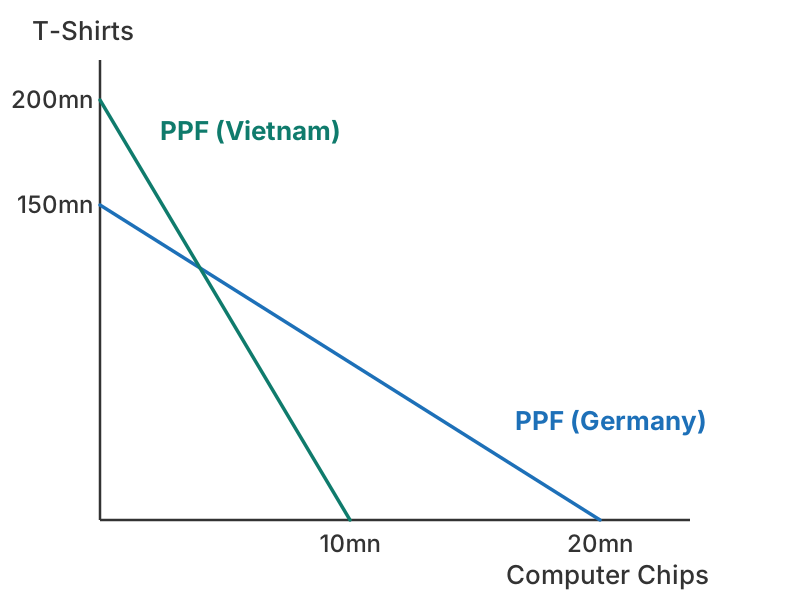
In the diagram, Germany has an absolute advantage in computer chips because it can produce more computer chips with the same resources than Vietnam, while Vietnam has an absolute advantage in T-shirts.
If Germany produces both goods, it can produce 10m computer chips and 75mn T-shirts. If Vietnam produces both goods, it can produce 5m computer chips and 100mn T-shirts.
This generates a global output of 15m computer chips and 175mn T-shirts.
Comparative Advantage
Opportunity cost can be calculated using the output that must be given up to produce more of the other good.
Opportunity cost of 1 computer chip: T-shirts given up divided by computer chips gained.
- Germany: For every 1 computer chip, it gives up 7.5 T-shirts, so the opportunity cost is 7.5 T-shirts per computer chip.
- Vietnam: For every 1 computer chip, it gives up 20 T-shirts, so the opportunity cost is 20 T-shirts per computer chip.
Opportunity cost of 1 T-shirt: Computer chips given up divided by T-shirts gained.
- Germany: For every 1 T-shirt, it gives up 0.13 computer chips, so the opportunity cost is 0.13 computer chips per T-shirt.
- Vietnam: For every 1 T-shirt, it gives up 0.05 computer chips, so the opportunity cost is 0.05 computer chips per T-shirt.
According to the theory of comparative advantage, the country with the lower opportunity cost should specialise in that good.
In this case, Germany has a comparative advantage in computer chip production, while Vietnam has a comparative advantage in T-shirt production.
By following the theory of comparative advantage, the total global output can be increased to 20m computer chips and 200mn T-shirts, which is higher than the output that would be produced if both countries produced both goods without specialisation.
Assumptions of the Comparative Advantage Model
- Zero transport costs: does not account for the costs of moving goods between countries
- Perfect knowledge: assumes all agents have full information about prices, technology, and resources
- Factors of production are mobile within countries: assumes that resources can move freely between industries within a country
- Constant returns to scale: assumes that doubling inputs will double outputs
- No trade barriers: assumes there are no tariffs, quotas, or other restrictions on trade
Impacts of Specialisation and Trade
Advantages of Specialisation and Trade
- Increased efficiency: countries can produce goods at a lower opportunity cost, leading to more efficient allocation of resources.
- Higher output: specialisation allows for increased production and global output, benefiting all countries involved in trade.
- Lower prices: increased competition from international trade can lead to lower prices for consumers.
- Greater variety of goods: trade allows countries to access a wider range of products that they may not be able to produce domestically.
- Economic growth: trade can stimulate economic growth by providing access to larger markets and encouraging innovation and investment.
Disadvantages of Specialisation and Trade
- Dependency on other countries: countries may become reliant on imports for essential goods, making them vulnerable to supply chain disruptions.
- Job losses in certain industries: domestic industries may struggle to compete with foreign producers, leading to unemployment in those sectors.
- Income inequality: trade can exacerbate income disparities between skilled and unskilled workers, as well as between countries.
- Environmental concerns: increased production and transportation associated with trade can lead to higher carbon emissions and environmental degradation.
- Exploitation of workers: some countries may have lower labour standards, leading to poor working conditions and exploitation of workers in certain industries.
Stuck on this topic? Work through it with an online A-Level Economics tutor in a free 15-minute intro call, or send an essay on it for A-Level Economics essay marking.