The Economic Problem
The Problem of Scarcity
Scarcity: the situation where people's wants are unlimited but the resources available to satisfy them are finite.
This is the economic problem. There is only so much land, labour, capital and enterprise to go round, yet people always want more. Satisfy one want and another takes its place.
Scarcity is not the same as poverty: a billionaire still has only 24 hours in a day. Because resources cannot stretch to meet every want, someone has to decide how they are used.
Choices and Trade-Offs
Trade-off: giving up some of one thing in order to have more of another.
Scarcity means every use of a resource rules out another use of it, and someone must choose between them. Every choice involves a trade-off:
- A sixth-former with a free Saturday can work a shift at a café or spend the day revising, but not both.
- A car maker with one factory can build more electric models only by building fewer petrol ones.
- A Chancellor who wants to cut income tax has less to spend on public services, unless the government borrows more.
Opportunity Cost
Opportunity cost: the benefit given up from the next best alternative when a choice is made.
The price tells you what you pay. The opportunity cost tells you what you go without, which makes it the real cost of any decision. The spec asks you to apply it to consumers, producers and the government.
| Agent | Example choice | Opportunity cost | Why it matters |
|---|---|---|---|
| Consumers | Spending £40 of wages on a gig ticket | The trainers you were saving towards | Income and time are limited, so comparing what each purchase rules out helps a consumer get the most satisfaction from what they have. |
| Producers | A bakery fills its ovens with sourdough loaves | The croissants those ovens could have baked | Premises, staff and finance all have other uses. A product earning a thin profit may be blocking a better one, and money tied up in a project could have earned interest in the bank. |
| Government | Building a new hospital | The next best project, such as new schools | Public services may be free to use, but they are not free to provide. Every pound spent in one area is a pound unavailable elsewhere, or extra tax or borrowing. |
Showing Opportunity Cost on a PPF
Production possibility frontier (PPF): a curve showing the largest combinations of two goods an economy can produce when all its resources are fully and efficiently employed.
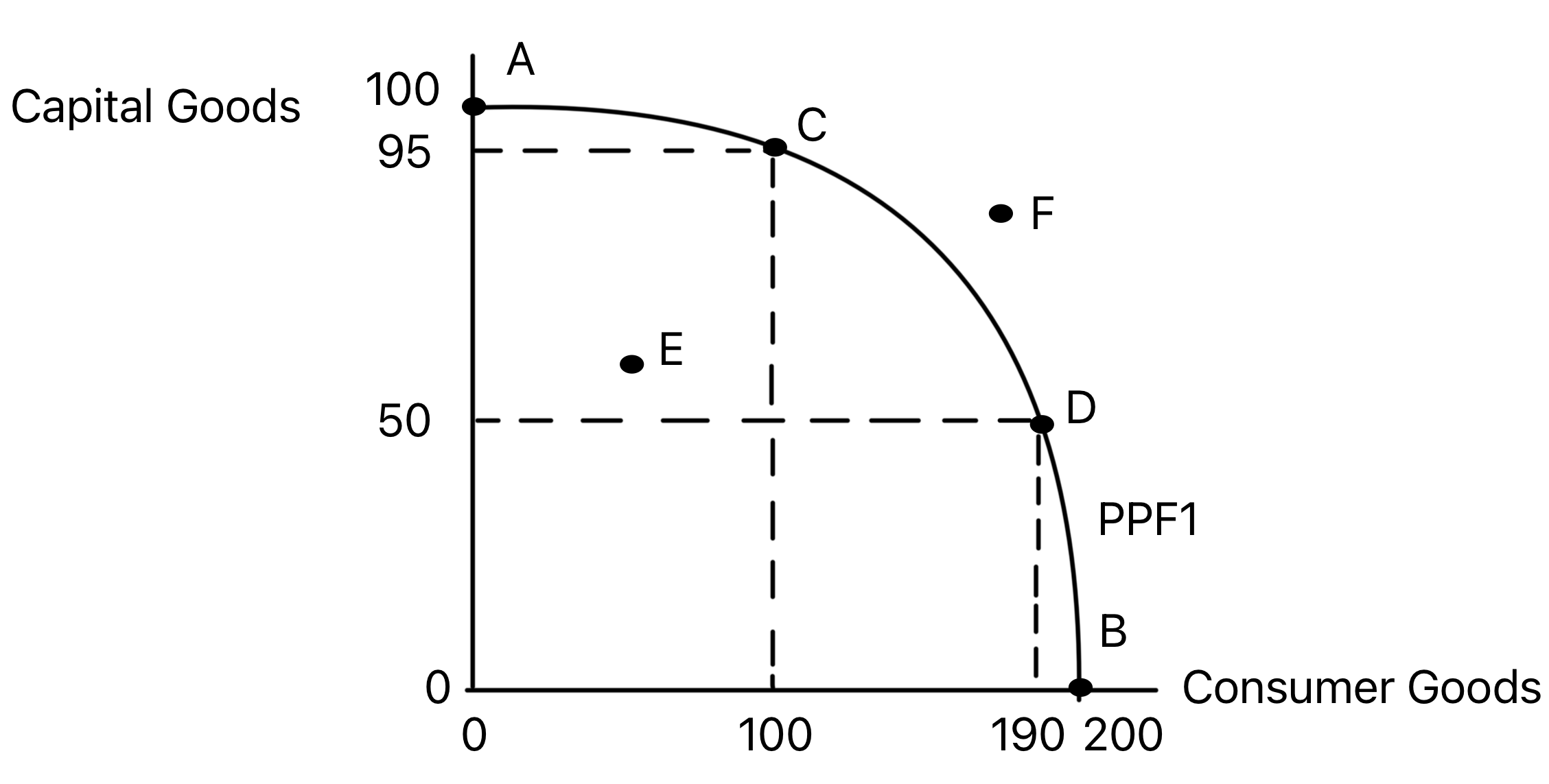
Every point on the curve uses all the economy's resources, so making more of one good means making less of the other. The amount given up is the opportunity cost:
- A to C: 100 extra consumer goods cost just 5 capital goods.
- C to D: 90 extra consumer goods cost 45 capital goods.
- D to B: 10 extra consumer goods cost 50 capital goods.
The opportunity cost of each extra consumer good rises as the economy moves down the curve. Resources are not equally good at everything, so the last ones switched across are the least suited to making consumer goods. That is why a PPF bows outwards.
Point E lies inside the curve, so some resources are unemployed and output of both goods could rise with no opportunity cost. Point F is out of reach with today's resources and technology.
Name one alternative, not a list. Opportunity cost is the single option you would otherwise have chosen, so pick the most likely one and say why. Writing that a hospital "could have been schools, roads or tax cuts" shows you know the idea but doesn't apply it. Asking what else the money could have bought is also a quick evaluation point on any question about a spending decision.
Stuck on this topic? Work through it with an online A-Level Economics tutor in a free 15-minute intro call, or send an essay on it for A-Level Economics essay marking.