Taxation
Types of Tax Systems
Progressive Tax: A tax where the percentage of income paid in tax rises as income rises. Examples include income tax and inheritance tax.
Proportional Tax: A tax where the percentage of income paid in tax remains constant regardless of income level. There are few examples of purely proportional taxes, but some flat-rate taxes can be considered proportional.
Regressive Tax: A tax where the percentage of income paid in tax falls as income rises. Examples include VAT and demerit good taxes e.g. tobacco and alcohol duties.
Effects of changes to Direct and Indirect Taxes
Direct taxes are levied on income or profits, such as income tax, corporation tax, and National Insurance.
These often tend to be progressive.
Indirect taxes are levied on spending, such as VAT and excise duties.
These often tend to be regressive.
Economic Effects of Changes in Tax Rates
| Economic Variable | Explanation |
|---|---|
| Incentives to Work | Higher income taxes can reduce the incentive to work, as individuals retain a smaller proportion of their earnings. This can lead to a decrease in labour supply and potentially lower productive capacity in the economy. |
| Income Distribution | Progressive taxes (e.g. income tax) can help reduce income inequality by redistributing wealth from higher-income individuals to fund public services and welfare programmes. Conversely, regressive taxes (e.g. VAT) can exacerbate income inequality, as lower-income households spend a larger proportion of their income on taxed goods and services. |
| Real Output and Employment | Changes in tax rates can influence aggregate demand and supply, thereby affecting real output and employment. Higher taxes can reduce disposable income and consumption, potentially leading to lower demand for goods and services and a decrease in employment. |
| Price Level | Changes in tax rates can influence the overall price level in the economy. Higher indirect taxes, such as VAT, can increase the cost of goods and services, decreasing SRAS leading to higher cost-push inflation. |
| Trade Balance | Changes in tax rates can affect the trade balance by influencing domestic consumption and production. Higher taxes can reduce disposable income and consumption, potentially leading to lower imports. However, if higher taxes reduce domestic production, it may lead to increased imports to meet demand, worsening the trade balance. |
| FDI | Changes in tax rates can influence foreign direct investment (FDI) by affecting the after-tax returns on investment. Higher corporate taxes can reduce the attractiveness of a country for foreign investors, potentially leading to lower FDI inflows. Conversely, lower corporate taxes can attract more FDI, boosting economic growth and employment. |
The Laffer Curve and Tax Revenue
The Laffer Curve shows the theoretical relationship between tax rates and total tax revenue.
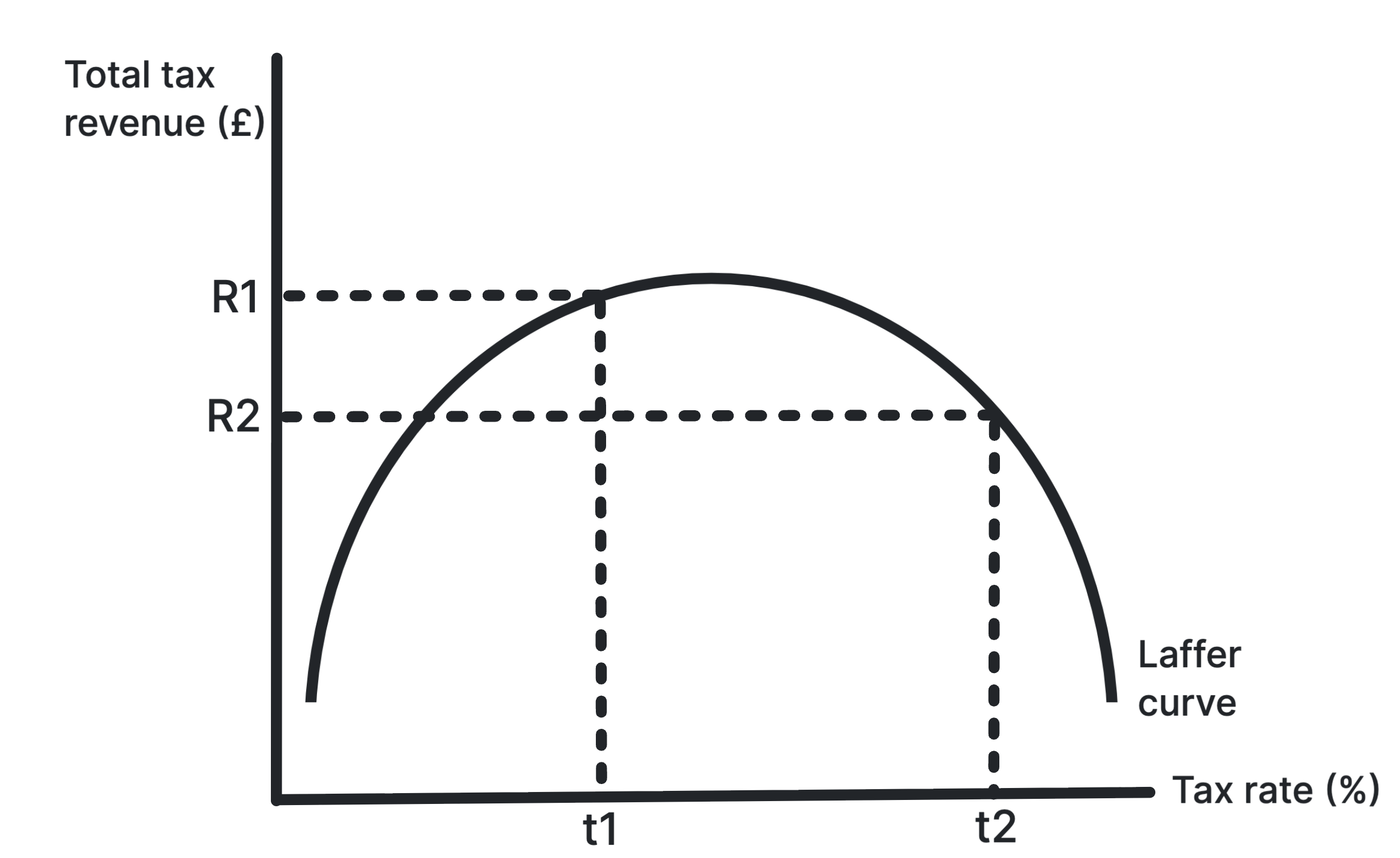
The Laffer Curve suggests that there is an optimal tax rate that maximises revenue. Tax rates above this point can lead to decreased revenue due to:
- Reduced incentives to work and invest: Higher tax rates can discourage individuals from working or investing, leading to lower economic activity and reduced tax revenue.
- Increased tax avoidance and evasion: Higher tax rates can incentivise individuals and businesses to find ways to avoid or evade taxes, reducing the overall tax base.
- Brain drain and capital flight: High tax rates can encourage skilled workers and businesses to relocate to countries with lower tax rates, reducing the domestic tax base and overall revenue.
As shown on the diagram, increasing the tax rate from t1 to t2 leads to a decrease in tax revenue from R1 to R2, as the higher tax rate reduces incentives to work and invest, leading to lower economic activity and tax revenue.
Stuck on this topic? Work through it with an online A-Level Economics tutor in a free 15-minute intro call, or send an essay on it for A-Level Economics essay marking.