Strategies Influencing Growth and Development
Market-Orientated Strategies
These strategies rely on free market forces and private sector activity to drive development.
| Strategy | Explanation | Evaluation |
|---|---|---|
| Trade liberalisation | Reducing tariffs and other trade barriers to encourage international trade, which can achieve growth through increased demand for exports and access to cheaper imports. | Depends on the country's comparative advantage and may expose domestic industries to competition, potentially harming infant industries. |
| Promotion of FDI | Encouraging foreign firms to invest in the country, bringing capital, technology, and expertise, which should increase productive capacity and create jobs. | Depends on the extent to which profit repatriation occurs and whether MNCs exploit local resources without benefiting the domestic economy. |
| Removal of subsidies | Encourages firms to operate efficiently and reduces government spending, which can be redirected to more productive uses. | Depends on whether the removal of subsidies leads to higher prices for essential goods, which can harm low-income households and increase inequality. |
| Floating exchange rate system | Allows the currency to adjust to market forces, which can help correct trade imbalances and attract FDI. | Depends on the country's vulnerability to exchange rate volatility, which can harm exporters and increase inflationary pressures, especially if the country is dependent on export demand or imports for essential goods. |
| Microfinance | Provides small loans to individuals or small businesses who lack access to traditional banking, enabling them to invest in income-generating activities e.g. setting up a small clothes mending business. | Depends on the interest rates charged and whether individuals use the loans productively or for consumption, which can lead to debt cycles. |
| Privatisation | Transfers ownership of state-owned enterprises to private investors, aiming to improve efficiency through profit incentives and reduce government expenditure. | Depends on the strength of regulation and whether privatisation leads to monopolies or reduced access to essential services for low-income households. |
Interventionist Strategies
These are government-led actions designed to correct market failure and direct development.
| Strategy | Explanation | Evaluation |
|---|---|---|
| Development of human capital | Investment in education and healthcare to improve the skills and productivity of the workforce, which can increase productive capacity and attract investment. | Depends on the quality and accessibility of education and healthcare, as well as the time lag before benefits are realised, which can limit short-term growth. |
| Protectionism | Imposing tariffs, quotas, or subsidies to protect domestic industries from foreign competition, allowing them to grow and develop. | Depends on the risk of retaliation from trading partners and whether protectionism leads to inefficiency and higher prices for consumers, which can harm overall welfare. |
| Managed exchange rate | The government or central bank intervenes in the foreign exchange market to stabilise the currency, which can support export competitiveness, reduce inflationary pressures, and attract FDI. | Depends on the cost of foreign currency reserves, and the impact of intervention on costs of imports, which can affect inflation and living standards, especially if the country relies on imported goods for essential consumption. |
| Infrastructure development | Government investment in transport, energy, and communication networks to improve productivity, and attract investment. | Depends on the efficiency of investment and whether infrastructure projects are well-targeted to support economic growth, as poorly planned projects can lead to wasted resources and limited development impact. |
| Promoting joint ventures with global companies | Encouraging partnerships with global companies can bring in foreign investment and technology transfer, which increase productive capacity and create jobs. | The success depends on the terms of the joint ventures, the ability to manage large corporations effectively, and the impact on local businesses and employment. |
| Buffer stock schemes | The government buys and sells commodities to stabilise prices, which can help smooth income for producers of volatile commodities. This leads to more investment and growth in the agricultural sector, which can support overall development. | Depends on the cost of maintaining the buffer stock and whether it effectively stabilises prices without distorting market signals, as well as the risk of overproduction or underproduction if the scheme is not well-managed. |
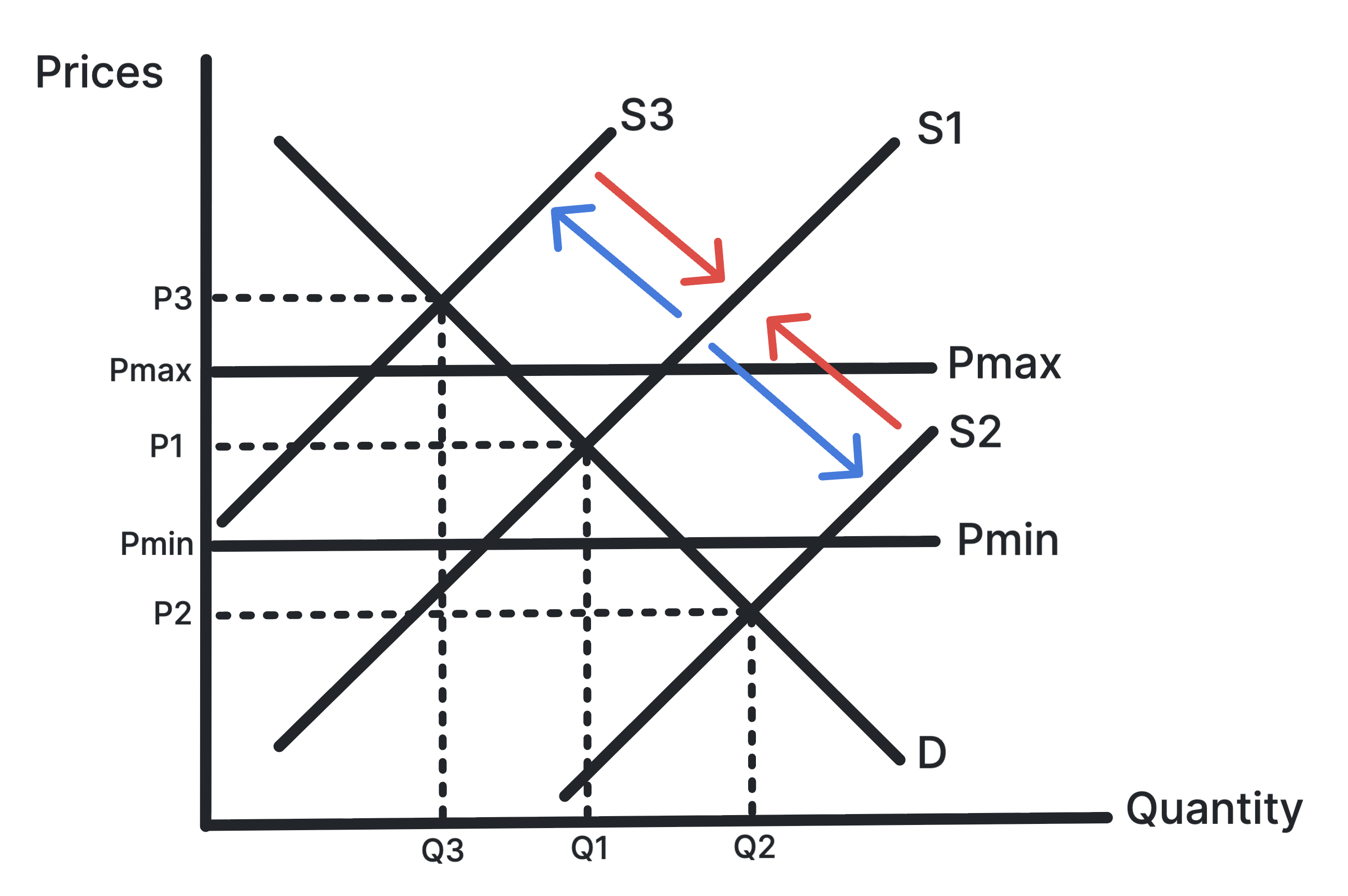
How Buffer Stock Schemes Work
A buffer stock scheme involves the government or an international organisation buying a commodity when prices are low (due to high supply) and selling it when prices are high (due to low supply). This helps to stabilise prices and income for producers, which can encourage investment in the sector and support overall economic development.
Other Development Strategies
Industrialisation: the Lewis Model
The Lewis model explains how labour from the agricultural sector can be transferred to the industrial sector, leading to economic growth and development. This is because the industrial sector has the ability to add more value to goods/services, resulting in higher Real National Income and improved living standards.
However, the model assumes that there is a surplus of labour in the agricultural sector, which may not always be the case. Additionally, the model does not account for potential negative externalities such as environmental degradation or social inequality that may arise from industrialisation.
Development of Tourism
Tourism can generate foreign exchange, create jobs, and stimulate investment in infrastructure. However, it may also lead to environmental degradation and vulnerability to external shocks such as pandemics or natural disasters.
Development of Primary Industries
Countries may exploit their comparative advantage in commodities such as oil or coffee, which can generate export revenue and stimulate growth. However, reliance on primary industries can make economies vulnerable to price volatility and limit diversification, which can hinder long-term development.
Fairtrade Schemes
Fairtrade schemes guarantee minimum prices and producer premiums. They can raise incomes, improve working conditions, and support community development.
However, the benefits may be limited to a small number of producers, and the higher prices for consumers may reduce demand for Fairtrade products, which can limit the overall impact on development.
Foreign Aid
Aid can take the form of grants, soft loans, or humanitarian support. It can fund vital projects, provide emergency relief, and support long-term development.
However, aid can create dependency, may be misallocated or misused, and can be influenced by donor countries' political agendas, which can limit its effectiveness in promoting sustainable development.
Debt Relief
Debt relief can free up resources for investment in development projects, improve creditworthiness, and reduce the burden of debt servicing.
However, it may not address underlying structural issues, and there is a risk that countries may accumulate new debt if fiscal discipline is not maintained, which can limit the long- term impact on development.
Role of International Institutions
World Bank
The World Bank has the aim of reducing poverty and promoting development through long-term loans for infrastructure and development projects. It also provides technical assistance and policy advice to support economic growth and development.
International Monetary Fund (IMF)
The IMF has the aim of promoting global financial stability and providing short-term loans to countries facing balance of payments crises. It also provides policy advice and technical assistance to support economic stability and growth.
These loans often come with conditions, such as implementing structural adjustment programmes, which can include austerity measures and economic reforms.
Non-Governmental Organisations (NGOs)
NGOs are non-profit organisations that operate independently of governments. They often focus on specific development issues such as education, healthcare, or human rights. NGOs can provide aid, implement development projects, and advocate for policy changes to support sustainable development.
For example, the most well known NGO is Oxfam, which works to alleviate global poverty and promote social justice through a range of development projects and advocacy campaigns.
Stuck on this topic? Work through it with an online A-Level Economics tutor in a free 15-minute intro call, or send an essay on it for A-Level Economics essay marking.