Exchange Rates
Exchange Rate Systems
Floating exchange rate: an exchange rate system determined by market forces of demand and supply for a currency, with no government intervention.
- Appreciation occurs when the value of a currency rises in a floating system.
- Depreciation occurs when the value of a currency falls in a floating system.
Fixed exchange rate: an exchange rate system where the central bank fixes the currency at a certain value, often by pegging it to another currency.
- Revaluation occurs when the central bank raises the value of a currency in a fixed system.
- Devaluation occurs when the central bank lowers the value of a currency in a fixed system.
Managed exchange rate: an exchange rate system where the central bank fixes the currency within a certain range, but allows it to fluctuate within that range.
Central banks can use the following tools to influence exchange rates in a fixed or managed system:
- Buying or selling currency: The central bank can buy its own currency to increase demand and cause a revaluation, or sell its own currency to increase supply and cause a devaluation.
- Interest rate changes: Raising interest rates can attract hot money inflows and cause a revaluation, while lowering interest rates can lead to hot money outflows and cause a devaluation.
Factors Influencing Floating Exchange Rates
Changes in the demand for a currency or the supply of a currency cause its value to change.
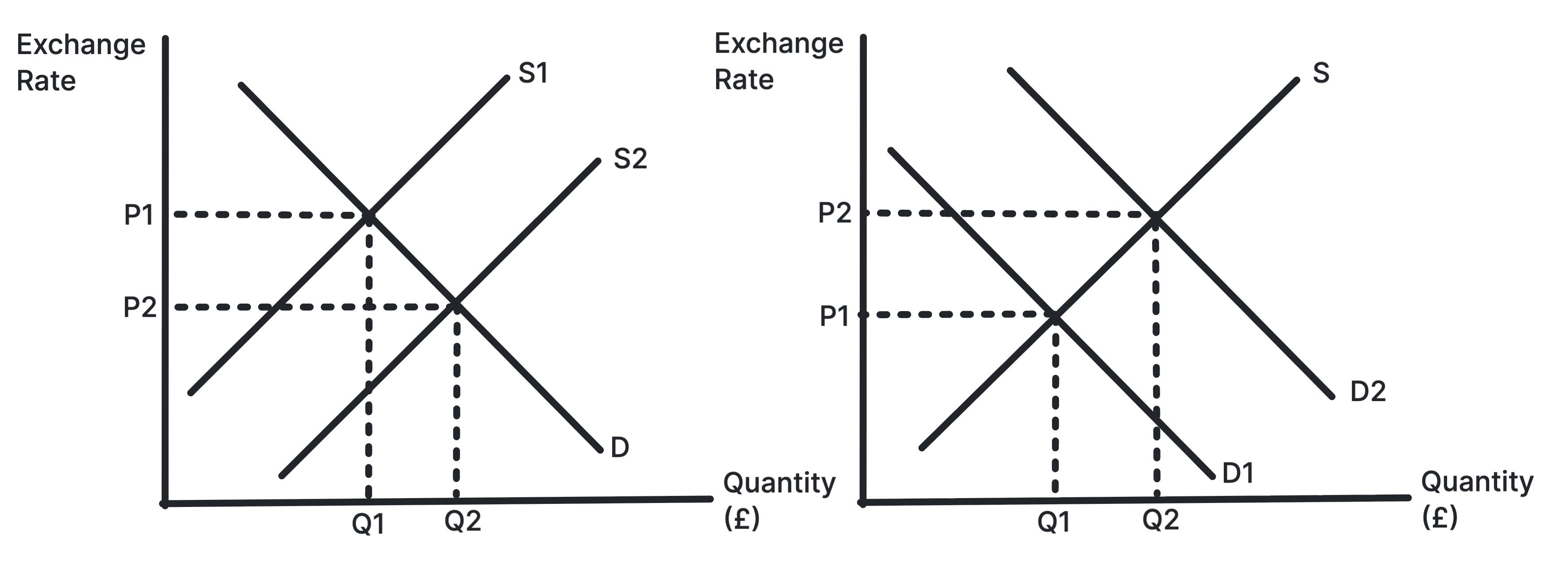
Demand-side Factors:
- Relative interest rates: a higher interest rate in a country attracts hot money inflows, increasing demand for the currency and causing an appreciation.
- Relative inflation rates: a lower inflation rate in a country increases the purchasing power of its currency, attracting foreign investment and causing an appreciation.
- Current Account: A surplus in the current account increases demand for the country's currency, leading to an appreciation, while a deficit decreases demand, leading to a depreciation.
- Foreign Direct Investment (FDI): Inflows of FDI increase demand for the country's currency, leading to an appreciation, while outflows decrease demand, leading to a depreciation.
- Speculation: If investors believe a currency will appreciate in the future, they may buy it now, increasing demand and causing an appreciation. Conversely, if they expect a depreciation, they may sell the currency, increasing supply and causing a depreciation.
Supply-side Factors:
- Quantitative easing: An increase in the money supply through central bank actions can lead to a depreciation of the currency, while a decrease can lead to an appreciation.
- Foreign Currency Reserves: Changes in a country's foreign currency reserves can affect the supply of its currency. An increase in reserves can lead to an appreciation, while a decrease can lead to a depreciation.
Competitive Devaluation
Competitive devaluation is when a government deliberately pushes down the value of its currency to make exports cheaper and gain a trade advantage.
The risks include:
- Retaliation: Other countries may respond by devaluing their own currencies, leading to a "currency war" and reduced global trade.
- Imported inflation: A weaker currency makes imports more expensive, which can lead to higher inflation and reduced purchasing power for consumers.
- Debt burden: If a country has significant foreign-denominated debt, a weaker currency can increase the cost of servicing that debt, leading to financial instability.
Impact of changes in Exchange Rates
Current Account:
- Appreciation: Exports become more expensive, leading to a decrease in demand for exports and an increase in demand for imports, which can worsen the current account balance.
- Depreciation: Exports become cheaper, leading to an increase in demand for exports and a decrease in demand for imports, which can improve the current account balance.
Inflation:
- Appreciation: Imported goods become cheaper, which can reduce inflationary pressures in the economy. Additionally, export demand falls, reducing demand-pull inflationary pressures.
- Depreciation: Imported goods become more expensive, which can increase inflationary pressures in the economy. Additionally, export demand rises, increasing demand-pull inflationary pressures.
Economic Growth:
- Appreciation: Can lead to slower economic growth due to reduced export demand and increased import competition.
- Depreciation: Can stimulate economic growth by boosting export demand and reducing import competition.
Unemployment:
- Appreciation: Can lead to higher unemployment in export-oriented industries due to reduced demand for exports.
- Depreciation: Can lead to lower unemployment in export-oriented industries due to increased demand for exports.
Living Standards:
- Appreciation: Can improve living standards by making imported goods cheaper and increasing purchasing power. However, it may also lead to job losses in export-oriented industries.
- Depreciation: Can reduce living standards by making imported goods more expensive and decreasing purchasing power. However, it may also create jobs in export-oriented industries.
J-Curve and Marshall-Lerner Condition
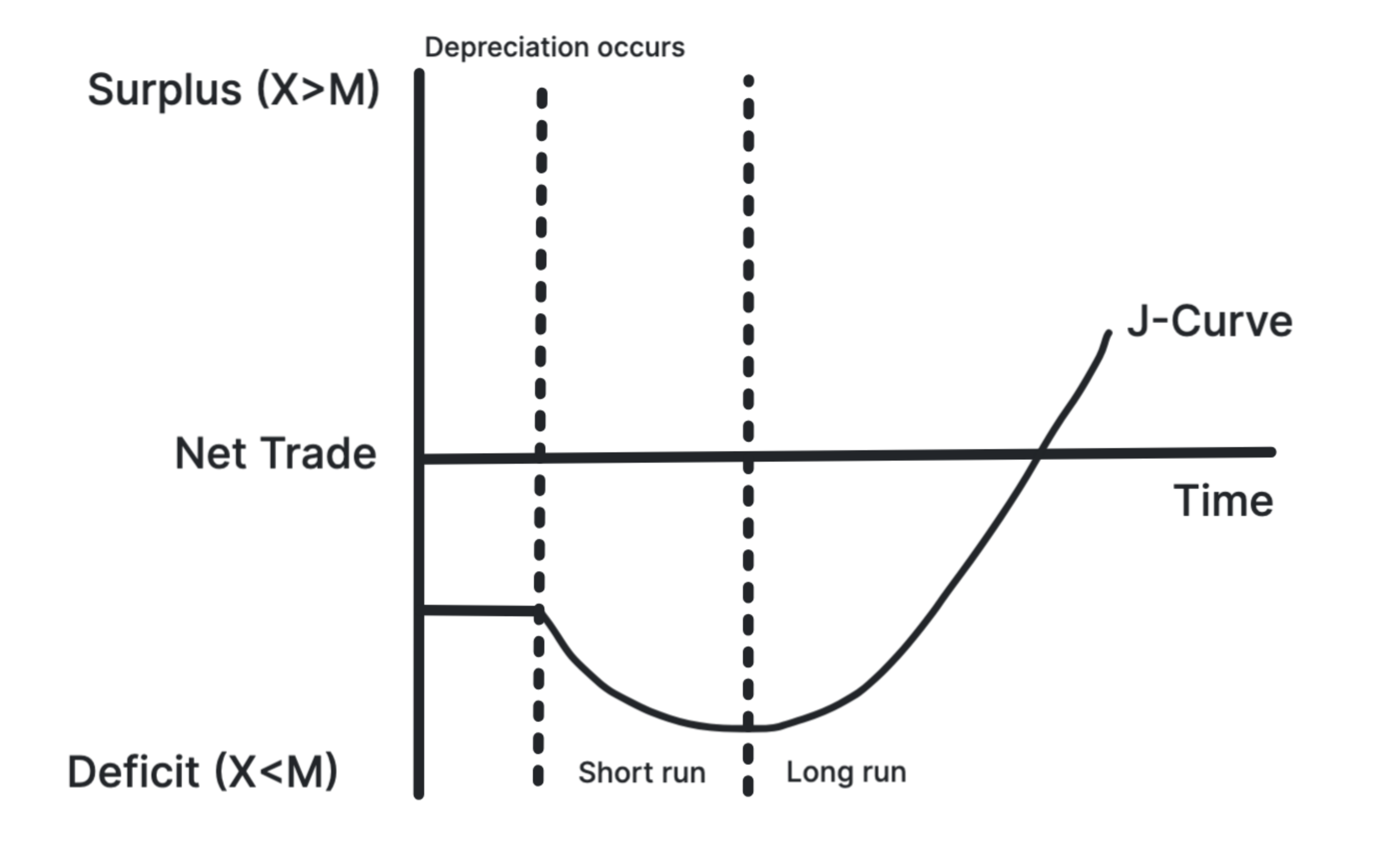
The J-curve effect describes how in the short-run, a depreciation of a currency may initially worsen the current account balance since the PEDX and PEDM are often inelastic. This is because:
- Exporters and importers may have existing contracts that fix prices in the short term, so they cannot immediately benefit from the depreciation.
- Consumers may take time to adjust their consumption habits and switch to cheaper domestic alternatives, so import demand may not fall immediately.
Therefore, only in the long run, when consumers and businesses have fully adjusted, does the current account balance improve as the value of exports rise and imports fall.
The Marshall-Lerner condition states that a depreciation will only improve the current account balance if the combined price elasticities of demand for exports (PEDX) and imports (PEDM) satisfy:
If this condition is not met — that is, if combined demand is relatively inelastic — a depreciation may instead worsen the current account balance.
Stuck on this topic? Work through it with an online A-Level Economics tutor in a free 15-minute intro call, or send an essay on it for A-Level Economics essay marking.