Restrictions on Free Trade
Reasons for Protectionism
Governments may restrict free trade in order to protect domestic industries even though free trade can create efficiency gains.
| Reason | Explanation |
|---|---|
| Protect infant industries | New industries may need temporary protection until they become established and competitive. |
| Protect strategic industries | Some industries are important for national security and may need protection from foreign competition. |
| Protect sunset industries | Industries that are declining may need protection to preserve jobs and allow time for workers to transition to new sectors. |
| Protect jobs | Protecting jobs in certain industries can be a reason for implementing trade restrictions, especially in sectors that are vital for the economy or have high employment. |
| Prevent dumping | Dumping occurs when foreign producers sell goods below cost to gain market share. Protectionist measures can prevent this practice. |
| Balance of payments | Trade restrictions can help improve a country's balance of payments by reducing imports and supporting domestic industries. |
| Environmental and labour standards | Trade restrictions can be used to enforce environmental and labour standards, ensuring that imported goods meet certain ethical and sustainability criteria. |
Methods of Protectionism
Tariffs
A tariff is a tax on imports. It raises the price of imported goods, making domestic goods relatively cheaper.
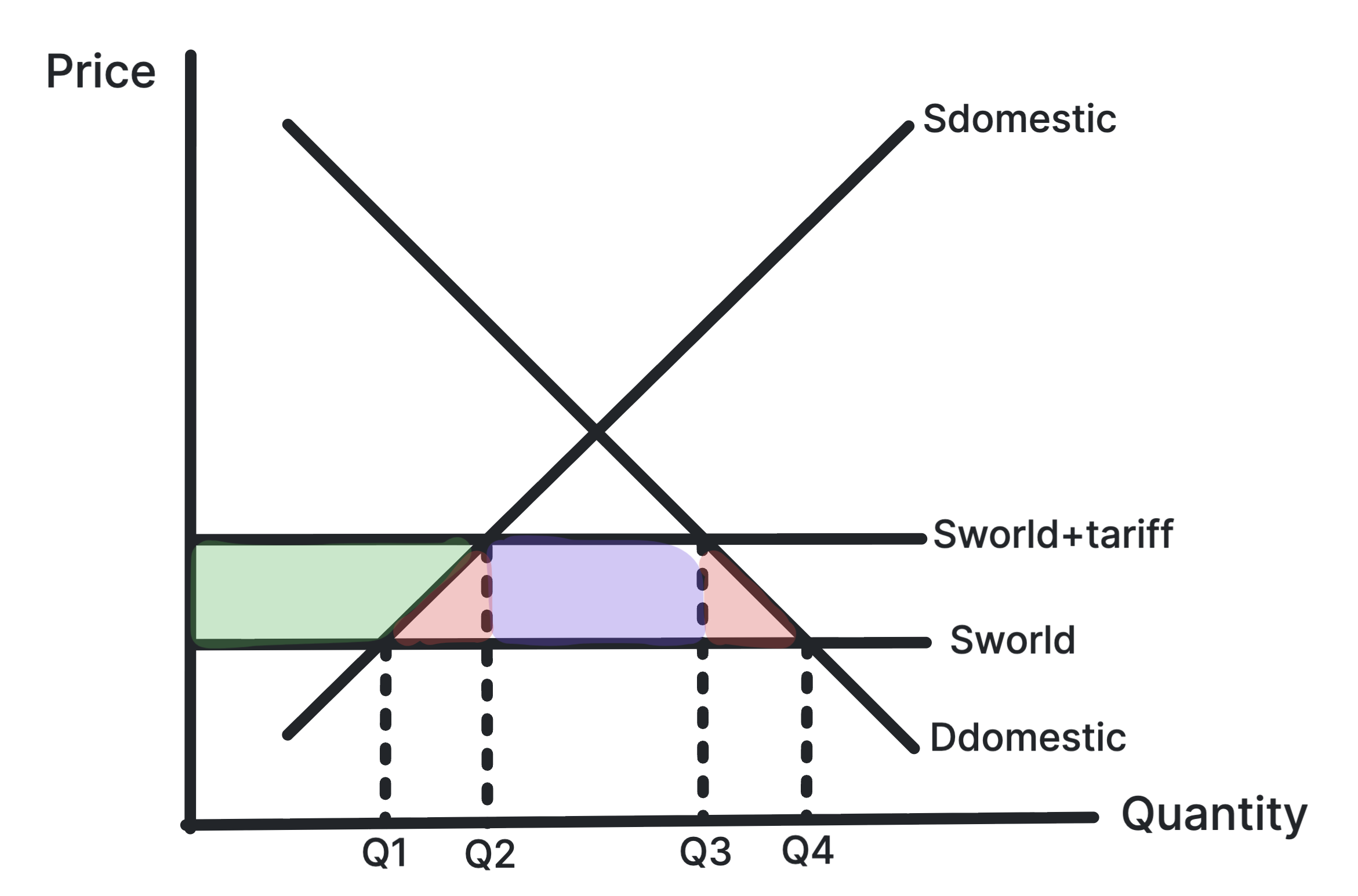
Before the tariff:
- Domestic sales: Q1
- Imports: Q4 - Q1
- Consumption by domestic consumers: Q4
After the tariff:
- Domestic sales: Q2
- Imports: Q3 - Q2
- Consumption by domestic consumers: Q3
The tariff raises the price of imports from P1 to P2, which reduces imports and increases domestic production, but also raises prices for consumers.
Areas on the diagram:
- Purple Area: Tariff revenue for the government
- Green Area: Gain in domestic producer surplus
- Red Area: Net welfare loss resulting from the tariff. It is the sum of the loss of consumer surplus, less the gain in domestic producer surplus and tariff revenue.
Quotas
A quota is a physical limit on how much of a good can be imported. It restricts supply and raises the price of imports, benefiting domestic producers but harming consumers.
Subsidies to Domestic Producers
Subsidies lower production costs for domestic firms and allow them to compete more effectively with imports, benefiting domestic producers.
Non-Tariff Barriers
Non-tariff barriers include product standards, health and safety rules, and administrative procedures that make imports more difficult and costly, effectively protecting domestic industries without using tariffs or quotas.
Evaluations of Protectionist Policies
The effectiveness of protectionist policies depends on the following:
- The elasticity of demand for imports: If demand is inelastic, tariffs and quotas may not significantly reduce imports.
- The ability of domestic producers to increase production: If domestic producers cannot meet the increased demand, or the UK does not produce effective alternatives, prices may rise further.
- The potential for retaliation by trading partners: Other countries may impose their own trade restrictions in response, leading to trade wars which harm consumers and producers in both countries.
- The long-term impact on efficiency and innovation: Protectionism such as subsidies may support inefficient firms and reduce incentives for innovation and productivity growth.
Stuck on this topic? Work through it with an online A-Level Economics tutor in a free 15-minute intro call, or send an essay on it for A-Level Economics essay marking.