Government Intervention
Intervention to control Monopoly Power
Competition and Markets Authority (CMA): The main independent regulator of markets in the UK. They aim to protect competition and consumer interests in markets by investigating anti-competitive practices, reviewing mergers and enforcing consumer protection laws to ensure markets are fair.
Controlling Mergers
The CMA can prevent mergers or acquisitions that would create a firm with more than 25% market share or would substantially lessen competition.
If there are concerns that a merger is not in the best interests of consumers, the CMA can either block the merger completely, or force the combined firm to sell certain assets in order to limit its market share.
For example: the CMA blocked the proposed merger between Sainsbury's and Asda in 2019 over fears that the price of essential goods such as groceries and fuel would increase.
Regulating Existing Monopolies
This is especially important in natural monopolies e.g. Water companies.
| Intervention | Impact | Evaluation |
|---|---|---|
| Price Regulation (RPI-X) | Without regulation, monopolies will profit maximise by producing where MC=MR, resulting in higher prices for consumers. Maximum prices can be implemented to lower the prices set by monopolies. For example, RPI-X is a price cap that means monopolies can only increase prices by RPI (inflation), subtract X (an efficiency factor). | Price caps may reduce the ability of the firm to invest, or incentivise the firm to cut costs to remain profitable. Both could result in lower quality goods/services. |
| Profit Regulation | Usually set as a percentage of revenue, profit caps can prevent monopolies profiteering at the expense of higher prices and low quality products for consumers. Monopolies are incentivised to lower prices closer to their average costs. | Instead of lowering prices, firms may reduce efficiency and allow costs to inflate to reduce their profit margins. Consequently, consumers may not benefit from lower prices. |
| Quality Standards / Performance Targets | Sets minimum service or quality standards, such as requiring a certain percentage of trains to arrive on time. If firms fail to meet targets, they may face large fines. Quality standards help to increase the quality of goods/services that monopolies provide. | Unintended consequences can occur. For example, firms may only provide high quality products at high prices, reducing the availability of goods/services for lower income households. |
Intervention to Promote Competition and Contestability
Governments may try to make markets more competitive and easier for new firms to enter.
- Promotion of small businesses: grants/subsidies to startups, tax breaks for startups, and business advice.
- Deregulation: removing barriers to entry to increase contestability e.g. removing legal protection over Royal Mail delivering parcels.
- Competitive tendering: putting government contracts out to open tender so firms compete for them.
- Privatisation: selling state-owned assets to the private sector to increase efficiency through profit incentives and competition.
Privatisation
A Natural Monopoly can either be state-owned (red), or privatised (blue).
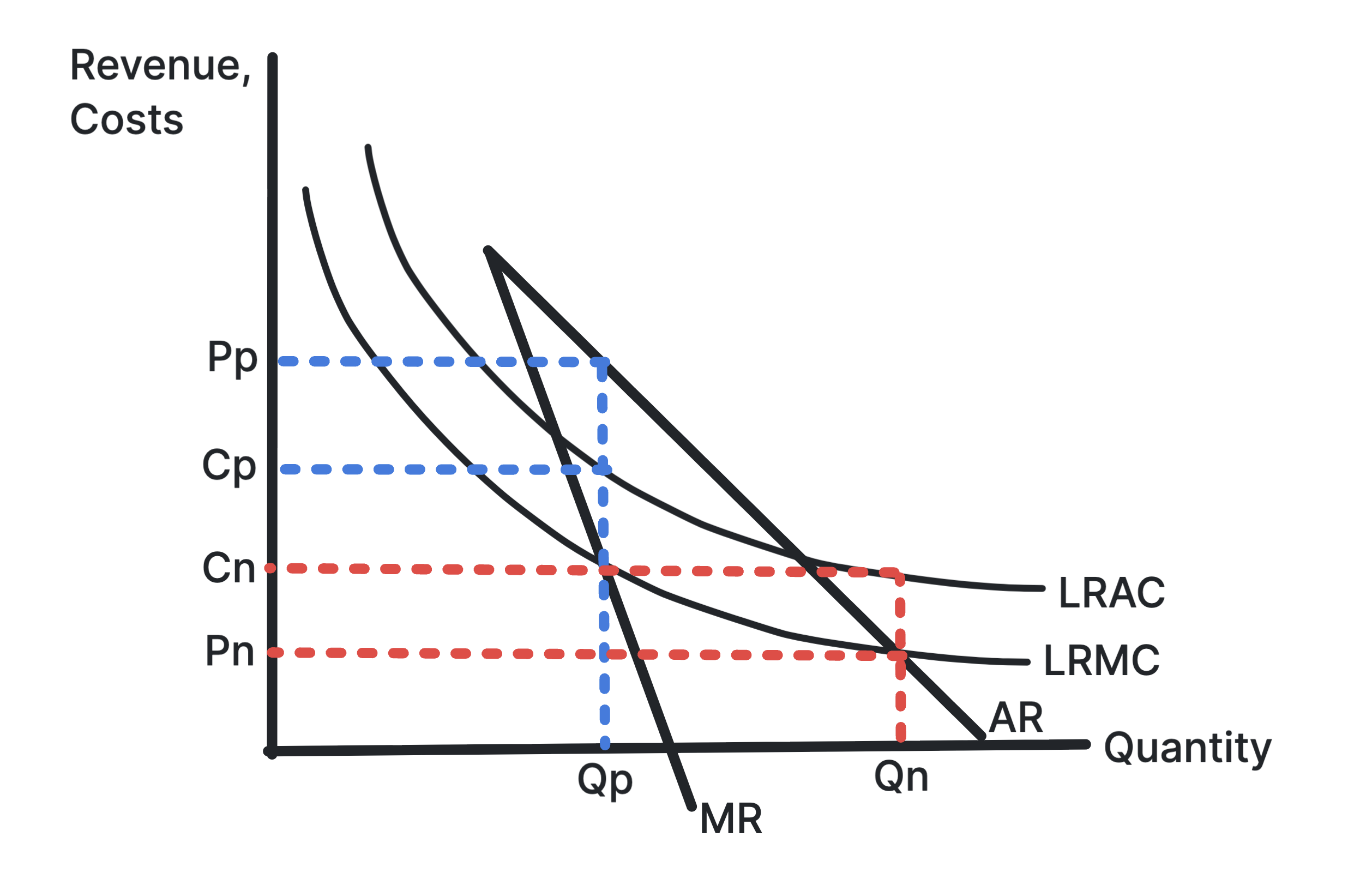
The benefit of privatising a natural monopoly is that the firm is owned by shareholders that want to increase the share price of the business. This creates an incentive to profit maximise, which can result in the business becoming more productively efficient and lower prices passed onto consumers. Additionally, privatised firms are dynamically efficient, enable the business to reinvest into innovation and improving product quality over time.
However, the disadvantage of privatising a business is that the main objective of the business is no longer to provide a service that is available to all individuals in society. Therefore, consumers may suffer from higher prices, and if there is a lack of competition the privatised firm may reduce quality to cut costs and increase its profits further.
Evaluation: whether privatisation benefits consumers depends on:
- The level of competition/contestability: if a privatised industry is competitive e.g. parcel delivery, then consumers benefit from lower prices, higher quality services and strong choice. If a market is uncompetitive e.g. Water Companies, then consumers suffer from a lack of choice, lower quality, and higher prices.
- The level of regulation: if privatised firms are regulated effectively, then consumers interests are more likely to be met. The effectiveness of regulation depends on whether regulatory capture occurs.
Intervention to Protect Suppliers and Employees
Protecting Suppliers from Monopsony Power
A dominant buyer, such as a supermarket, may force down the prices it pays to suppliers.
Possible government responses include:
- Minimum Prices: a legally enforced price floor to ensure a fair price for suppliers.
- Supporting cooperatives: allowing suppliers to aggregate their supply to help counter monopsony power.
- Merger control: the CMA can actively prevent increases in monopsony power by blocking mergers.
Protecting Employees from Monopsony Employers
- National Minimum Wage: a legally enforced wage floor to ensure workers are paid a fair wage.
- Employment legislation: rules on health and safety, maximum working hours, and unfair dismissal.
- Support for trade unions: collective bargaining to counter monopsony power.
- Labour market transparency: requiring employers to disclose salaries of employees to put social pressure on employers to pay a fair wage.
Stuck on this topic? Work through it with an online A-Level Economics tutor in a free 15-minute intro call, or send an essay on it for A-Level Economics essay marking.