Wage Determination
Wage Determination in a Competitive Labour Market
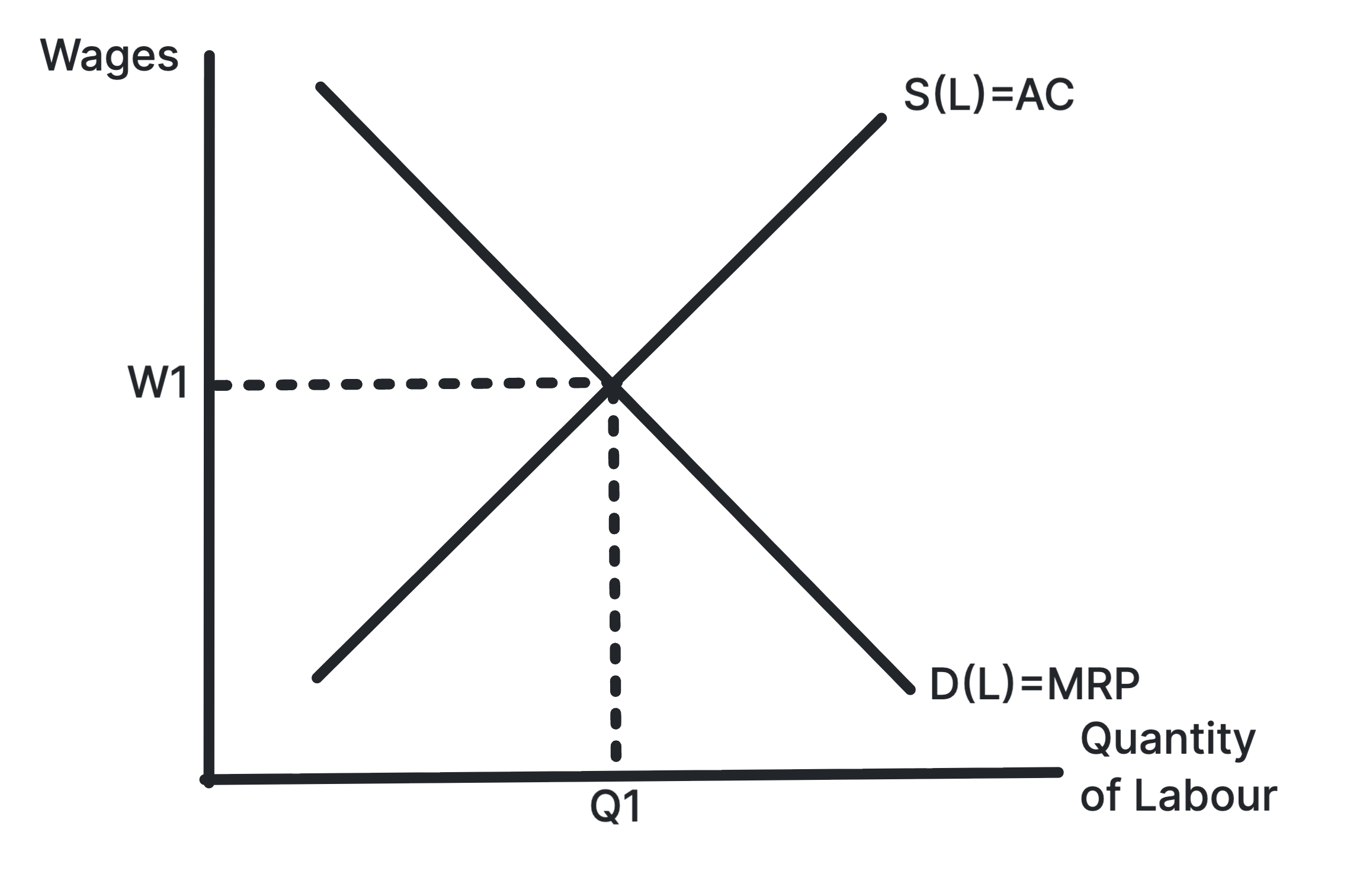
In a competitive labour market, there are many firms demanding labour and many workers supplying labour.
Both firms and workers are wage takers, so they accept the market equilibrium wage.
Wage Determination in a non-competitive Labour Market
Monopsony Power
A monopsony exists when there is a single or dominant buyer of labour. For example, the NHS is a monopsonist in the UK healthcare labour market.
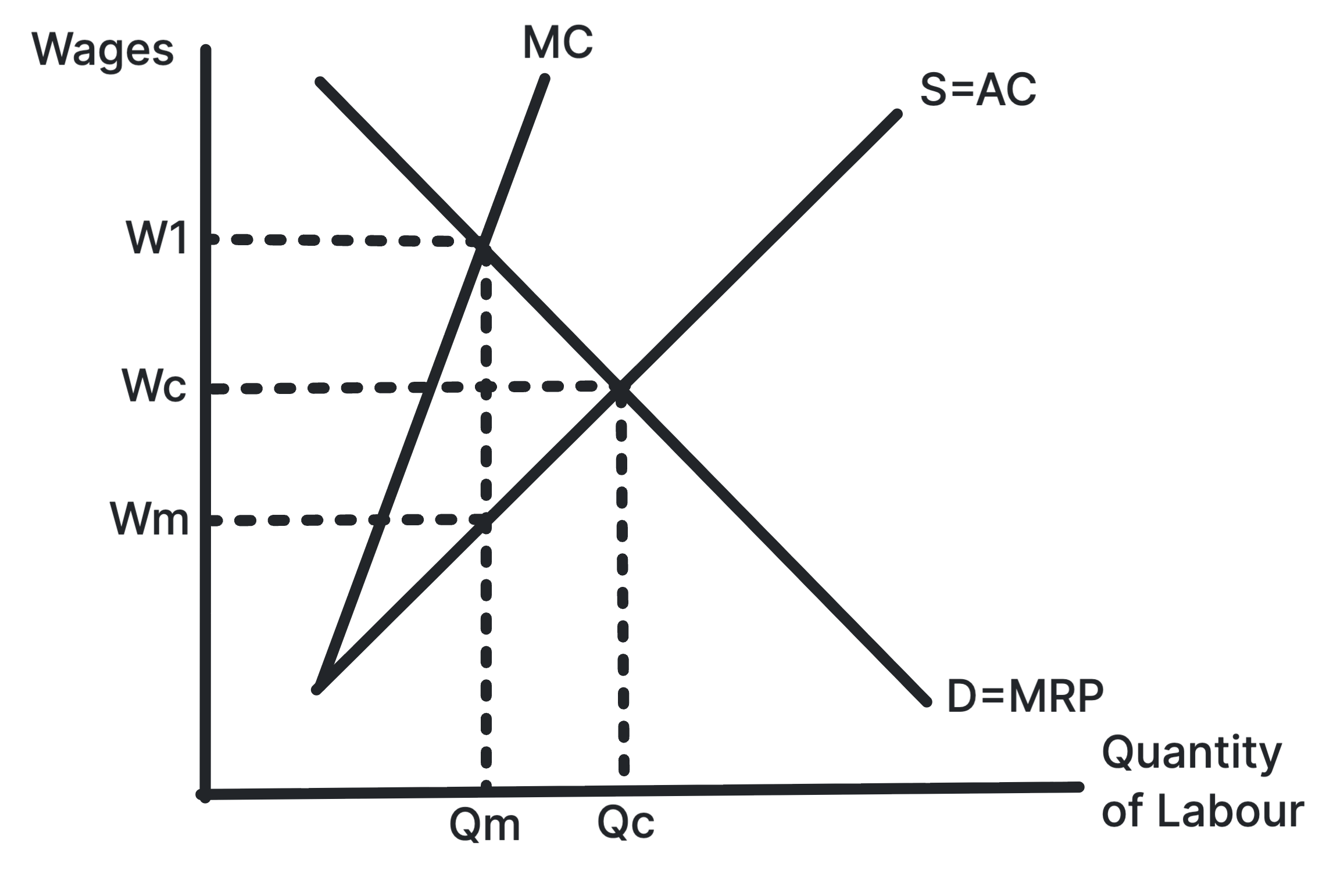
In a monopsony, the firm faces the entire labour supply curve (S=AC) and must pay a higher wage to attract more workers. Therefore, the marginal cost of labour (MCL) lies above the supply curve since the firm must also increase wages to existing workers when hiring additional ones.
The monopsonist maximises profit by hiring workers where the marginal cost of labour (MCL) equals the marginal revenue product of labour (MRPL).
Since the monopsonist has wage setting power, the monopsonist pays workers the lowest wage that they are willing to accept whilst still supplying their labour. Therefore, an equilibrium is created at (Wm, Qm), meaning a monopsony employs fewer workers and pays them a lower wage compared to a competitive labour market (Wc, Qc)
The gap between what the last worker adds to the firm's revenue and the wage that worker is actually paid is known as monopsonistic exploitation. At Qm the monopsonist hires where MCL = MRPL, but pays only Wm — the wage read off the supply curve — so each worker is paid less than the value of what they produce. The larger the gap between MRPL and Wm, the greater the exploitation.
Trade Union
Trade Union: an organisation formed by workers to protect their rights, improve pay and secure better working conditions.
Trade unions use their collective bargaining power to negotiate with employers for higher wages, by threatening industrial action i.e. Strikes.
The power that a trade union has over its employer is dependent on its Union Density, which measures the proportion of the total workforce that are members of the trade union.
Other factors that influence the power of trade unions include:
- Size of the union: Larger unions have more bargaining power.
- Profitability of the firm: Unions are more likely to be successful in negotiations if the firm is profitable.
- Economic conditions: In a booming economy, unions are more likely to be successful in negotiating higher wages, as firms are more profitable and can afford to pay higher wages.
- Government policies: Governments can either support or restrict the power of trade unions through labour laws and regulations.
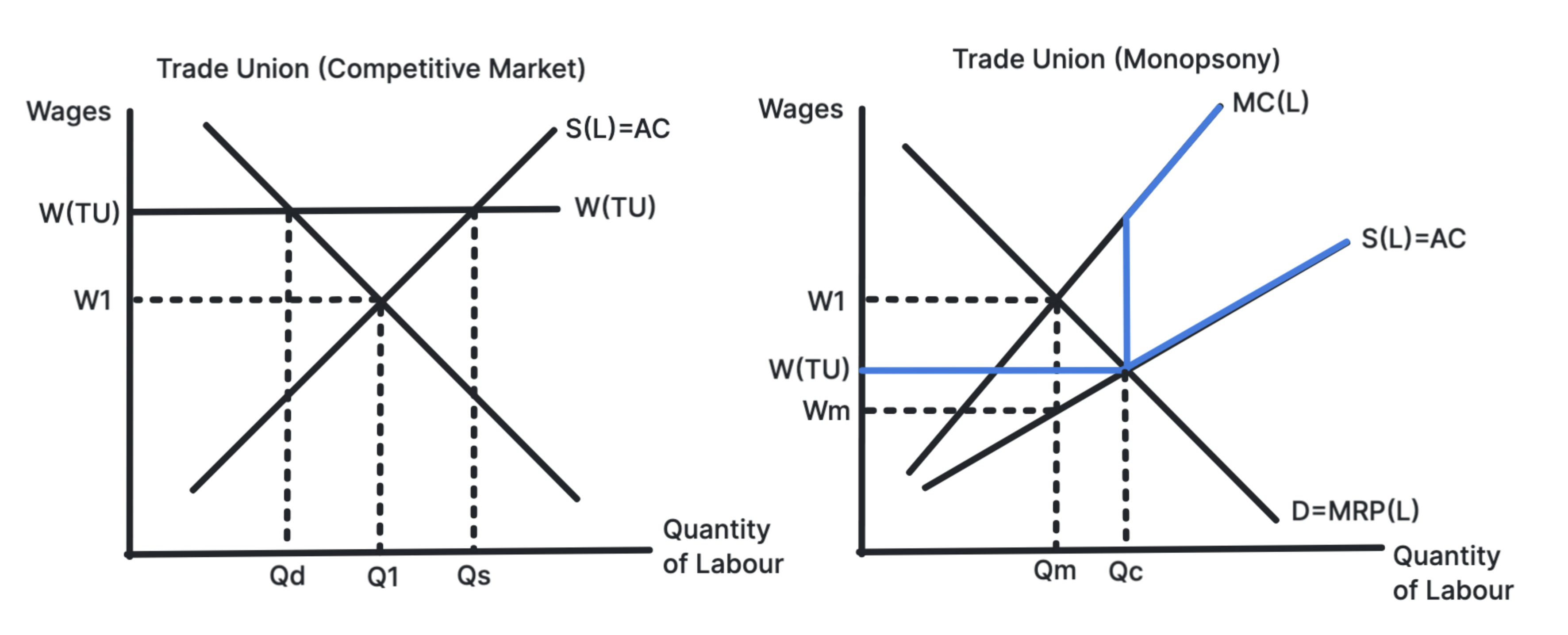
In a competitive market: Successful trade unions increase wages from W1 to W(TU). However, since this increases labour costs for businesses, employment falls from Q1 to Qd. The unemployment created by the trade union is known as real wage unemployment.
In a monopsony: Successful trade unions counter the power of monopsonies, creating a bilateral monopoly, meaning there is a single buyer (the monopsonist) and a single seller (the trade union) of labour. This results in higher wages of W(TU) and an increase in employment from Qm to Qc.
Government Intervention in Labour Markets
National Minimum Wage
The national minimum wage (NMW) is a legally enforced price floor set above the market equilibrium wage.
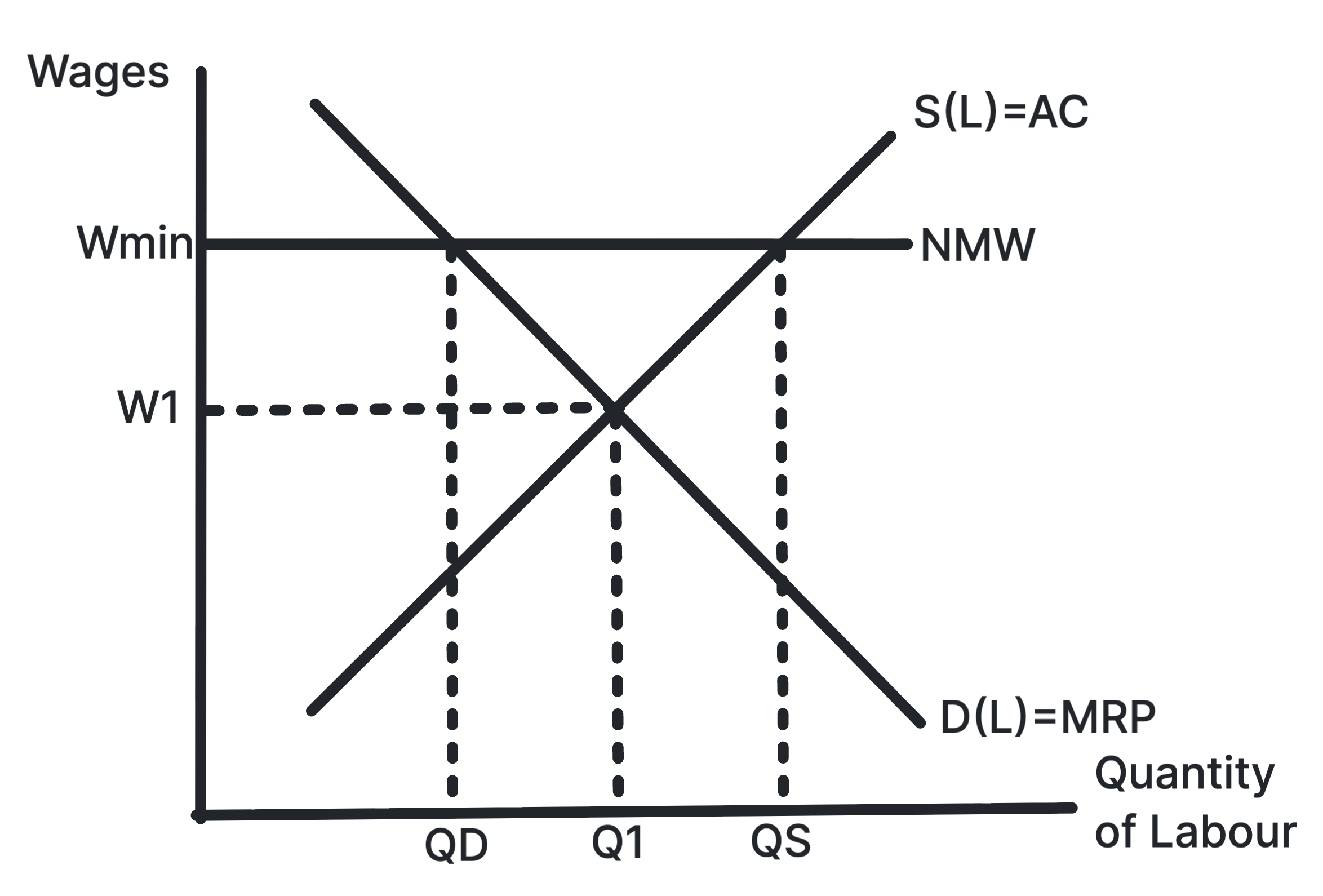
The minimum wage creates a rigid wage floor at Wmin, increasing the wages of lower income earners from W1 to Wmin. This helps to reduce income inequality.
However, minimum wages increase the costs of employing labour for businesses, and as a result the demand for labour contracts from Q1 to Qd, resulting in a lower level of employment for lower income workers. This is known as Real Wage Unemployment.
Evaluations for the impact of a minimum wage include:
- Depends on the size of the minimum wage: if the minimum wage is significantly above the equilibrium, this significantly increases incomes but creates a substantial level of real wage unemployment.
- Depends on the Wage Elasticity of Demand for Labour: if the demand for labour is wage elastic, then the unemployment created will be more significant. Minimum wages are more effective in markets with wage inelastic demand.
- Depends on improvements to worker motivation: if the higher wages cause workers to become more motivated, this may increase their productivity. As a result this offsets the rise in ATC for firms, reducing the size of the unemployment created.
Wage Elasticity of Demand for Labour
The wage elasticity of demand for labour measures how responsive the quantity of labour demanded is to a change in the wage rate.
It is influenced by several factors:
- PED of the final product: The more elastic product demand is, the more elastic labour demand will be.
- Ease of substituting labour: If capital can easily replace labour, demand is more elastic.
- Labour's share of total costs: If labour is a high proportion of total cost, demand is more elastic.
- Time period: Labour demand is more elastic in the long run because firms have more time to reorganise production.
Wage Elasticity of Supply of Labour
The wage elasticity of supply of labour measures how responsive the quantity of labour supplied is to a change in the wage rate.
It is influenced by several factors:
- Time period: Supply is more elastic in the long run because workers have more time to acquire new skills or change occupations.
- Availability of substitutes: If there are many alternative ways to provide labour, the supply is more elastic.
- Occupational mobility: If workers can easily switch between jobs or industries, the supply is more elastic.
- Geographical mobility: If workers can easily move to areas with higher wages, the supply is more elastic.
- Available pool of labour: A larger pool of unemployed available labour increases the supply elasticity.
- Vocational aspect: If the occupation requires specific skills or qualifications, the supply is less elastic.
Policies to tackle Labour Market Immobility
- Occupational mobility: Education and training programmes, apprenticeships, and career guidance can help workers acquire new skills and transition to different occupations.
- Geographical mobility: Subsidised housing, relocation assistance, improved transportation, and better access to information about job opportunities can help workers move to areas with more employment options.
Stuck on this topic? Work through it with an online A-Level Economics tutor in a free 15-minute intro call, or send an essay on it for A-Level Economics essay marking.