Demand for Labour
Demand for Labour
Demand for labour refers to the quantity of workers that firms are willing and able to employ at a given wage rate.
The Marginal Revenue Product Theory
Firms base their demand for labour on the marginal revenue product (MRP) of workers.
\[ MRP = MPP \times MR \]
Marginal Physical Product (MPP): The extra output produced by one more worker.
Marginal Revenue (MR): The extra revenue gained from selling that extra output.
The MRP curve is the demand curve for labour, labelled D(L), and it slopes downward because of the law of diminishing returns.
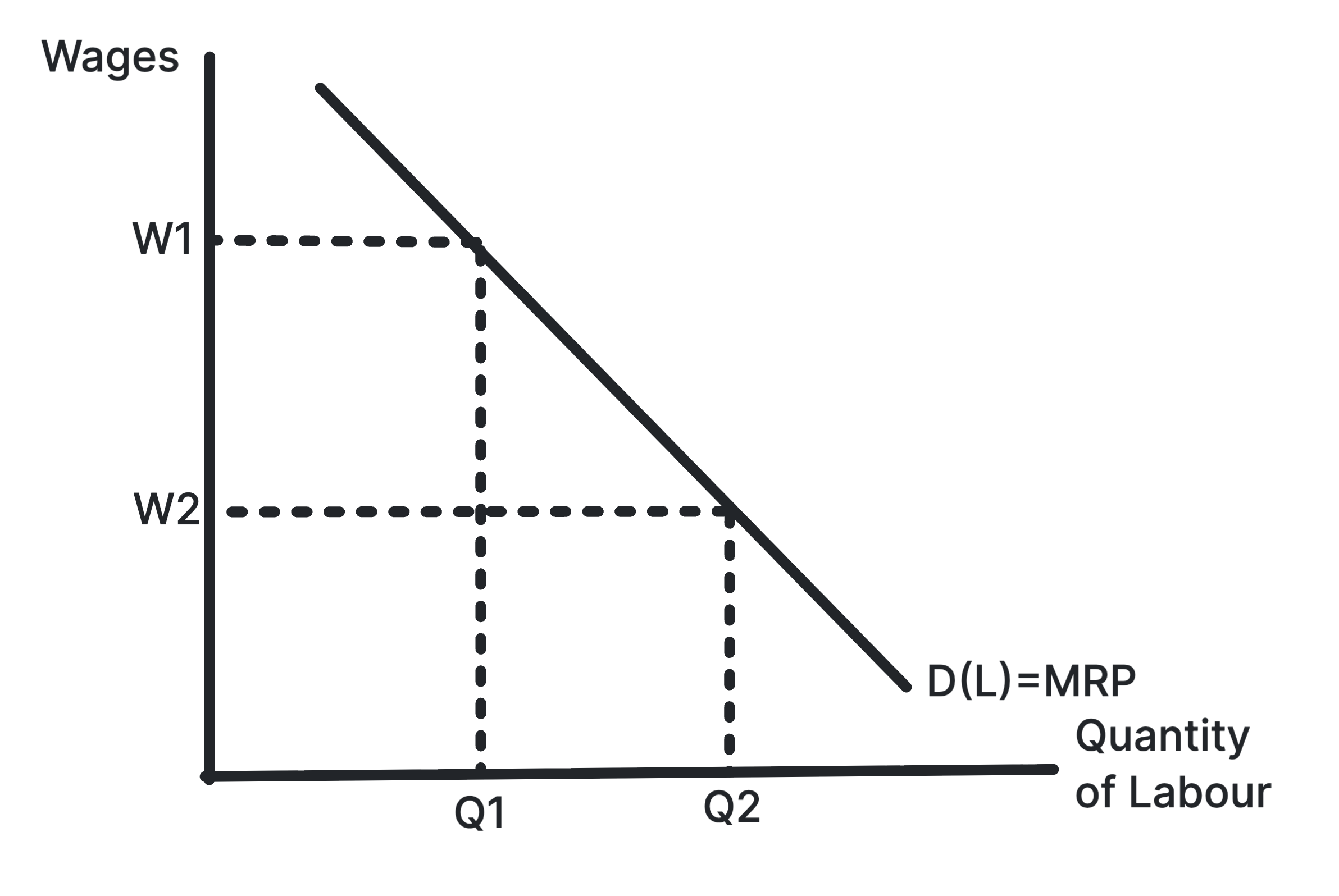
Worked Example: Calculating Marginal Revenue Product
A firm sells its output at a constant £5 per unit, so MR is £5. Adding workers changes total output as follows:
| Workers | Total Output | MPP | MRP = MPP × MR |
|---|---|---|---|
| 1 | 20 | 20 | £100 |
| 2 | 46 | 26 | £130 |
| 3 | 66 | 20 | £100 |
| 4 | 78 | 12 | £60 |
MPP rises to the second worker and falls after it - this is the law of diminishing returns setting in, and it is what makes the MRP curve slope downward. A firm hires an extra worker only while MRP is at least the wage, so at a wage of £80 it employs three workers: the fourth would add £60 of revenue but £80 of cost.
Factors That Shift the Demand for Labour Curve
Any factor that changes the MRP of labour shifts the demand curve for labour.
| Factor | Explanation |
|---|---|
| Demand for the final product | An increase in demand for the final product raises the MRP of labour, shifting the demand curve to the right. This is called derived demand because labour demand is derived from the demand for the goods and services that labour helps to produce. |
| Price of the final product | An increase in the price of the final product raises the MRP of labour, shifting the demand curve to the right. |
| Labour productivity | An increase in labour productivity raises the MPP and therefore the MRP of labour, shifting the demand curve to the right. |
| Changes to the substitutability of labour | If capital becomes a better substitute for labour, the demand for labour will fall, shifting the demand curve to the left. |
Wage Elasticity of Demand for Labour
The wage elasticity of demand for labour measures how responsive the quantity of labour demanded is to a change in the wage rate.
It is influenced by several factors:
- PED of the final product: The more elastic product demand is, the more elastic labour demand will be.
- Ease of substituting labour: If capital can easily replace labour, demand is more elastic.
- Labour's share of total costs: If labour is a high proportion of total cost, demand is more elastic.
- Time period: Labour demand is more elastic in the long run because firms have more time to reorganise production.
Stuck on this topic? Work through it with an online A-Level Economics tutor in a free 15-minute intro call, or send an essay on it for A-Level Economics essay marking.