Contestability
What Is a Contestable Market?
A contestable market is one where there is freedom of entry and exit.
The important idea is that the threat of potential competition, rather than just the number of existing firms, disciplines firm behaviour.
A key distinction is that competition refers to the number of firms in the market, whereas contestability refers to how easy it is for firms to enter and leave.
Key Characteristics of a Contestable Market
- There are no barriers to entry or exit, or barriers are very low.
- Sunk costs are minimal or zero.
- New entrants face no competitive disadvantage upon entering the market. For example because they can access the same technology and resources as existing firms.
- Perfect information is available, so there is no major informational advantage for incumbent firms.
- Hit-and-run competition is possible, where firms enter quickly to earn short-run supernormal profit and then leave once profits return to normal.
Implications for Firms
Even if there are only a few actual firms, the threat of hit-and-run entry can force them to behave more competitively.
Disciplined Behaviour
Incumbent firms may avoid exploiting market power because they know supernormal profits will attract new entrants. Therefore, they may set prices lower and output higher than they would in a less contestable market, as well as providing better quality and service to retain customers.
Limit Pricing
A common strategy is limit pricing, where firms set price below the profit-maximising level so that they earn only normal profit.
In simplified form, this means price may be set around \( AR = AC \), removing the profit signal that would otherwise attract entry.
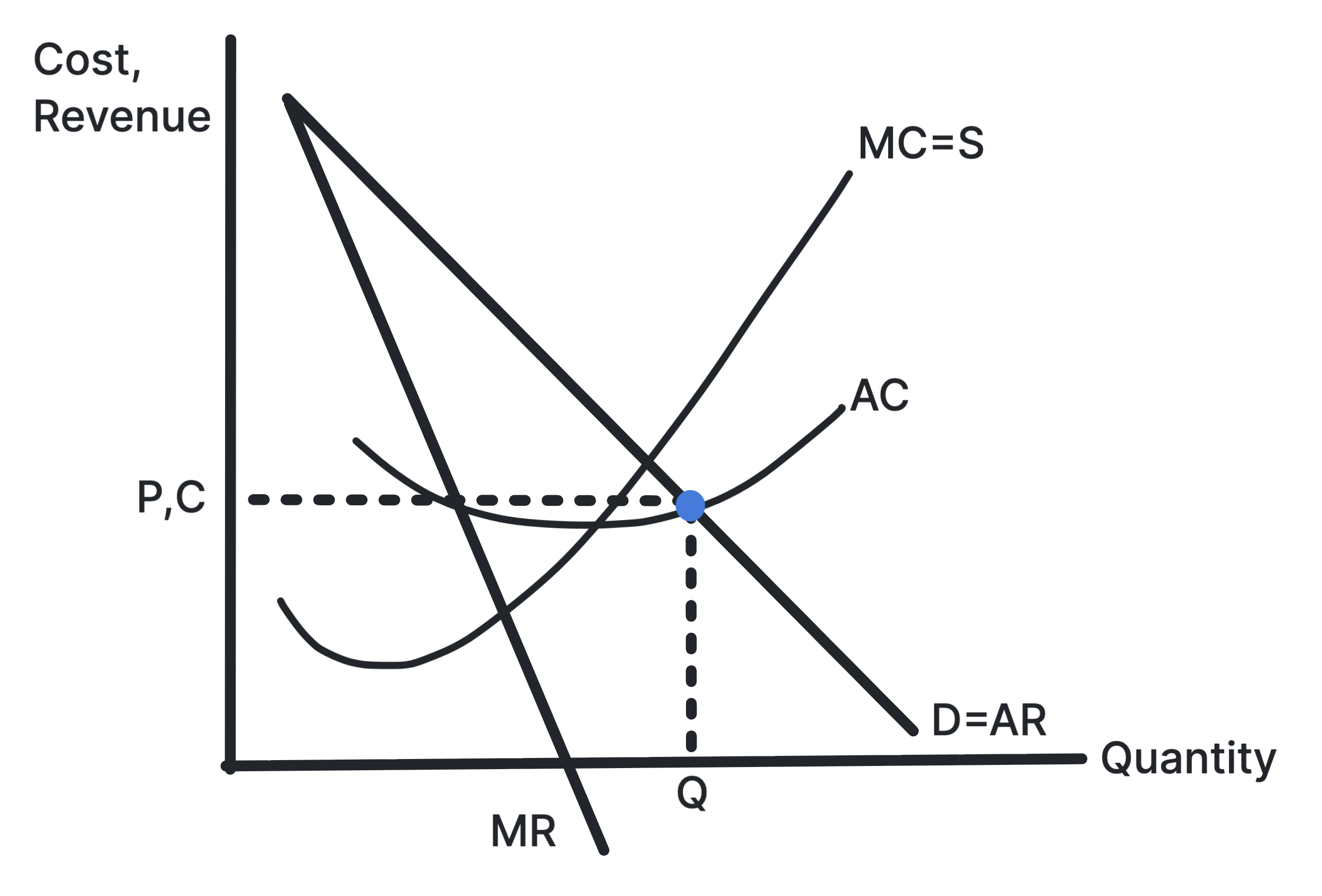
Outcome
The more contestable the market, the more firm behaviour tends to resemble perfect competition, with lower prices, higher output, and greater allocative efficiency.
This means it is possible for a market to be highly concentrated, yet still behave competitively if it is highly contestable. For example, Amazon and eBay are both highly concentrated online marketplaces, yet they face the threat of new entrants and therefore behave competitively.
Types of Barriers to Entry
| Barrier | Explanation |
|---|---|
| Economies of scale | Large existing firms may have much lower unit costs, making entry difficult for new small firms. |
| High startup costs | Significant initial investments required to enter the market. |
| Legal barriers | Government regulations or patents that restrict entry into the market. |
| Brand loyalty | Consumers are loyal to existing brands, making it difficult for new entrants to gain market share. |
| Ownership of essential resources | Control over key inputs or resources needed to produce goods or services. |
| Anti-competitive practices | Actions taken by existing firms to prevent or reduce competition, such as predatory pricing or exclusive dealing. |
Sunk Costs - The Main Barrier to Exit
Sunk costs are costs that cannot be recovered if a firm leaves the market.
Examples include specialised machinery, advertising, rent and research and development.
The lower the sunk costs, the more contestable the market is likely to be. The higher the sunk costs, the less contestable the market is, because firms are less willing to enter if exit is costly.
Stuck on this topic? Work through it with an online A-Level Economics tutor in a free 15-minute intro call, or send an essay on it for A-Level Economics essay marking.