Monopoly
Key Characteristics
- A monopoly is a market structure where there is a single seller of a product with no close substitutes.
- Monopolies have high barriers to entry, which prevent new firms from entering the market and competing away supernormal profit.
- There is asymmetric information in a monopoly, as the firm has more information about the market than consumers.
- Monopolies provide a unique product, which is highly differentiated and may be protected by patents or copyrights.
The result of these characteristics is that a monopoly has significant market power, called monopoly power, and has the ability to set its own prices. Therefore, monopolies are price makers.
Pure Monopoly: a market structure where there is a single seller of a product with no close substitutes. For example, a local water company like Thames Water.
Legal/Working Monopoly: Defined by the Competition and Markets Authority (CMA) as a firm with a market share of 25% or more. For example, Google has a market share of over 90% in the search engine market in the UK, making it a legal monopoly.
Diagrammatic Analysis
A monopoly maximises profit where \( MC = MR \).
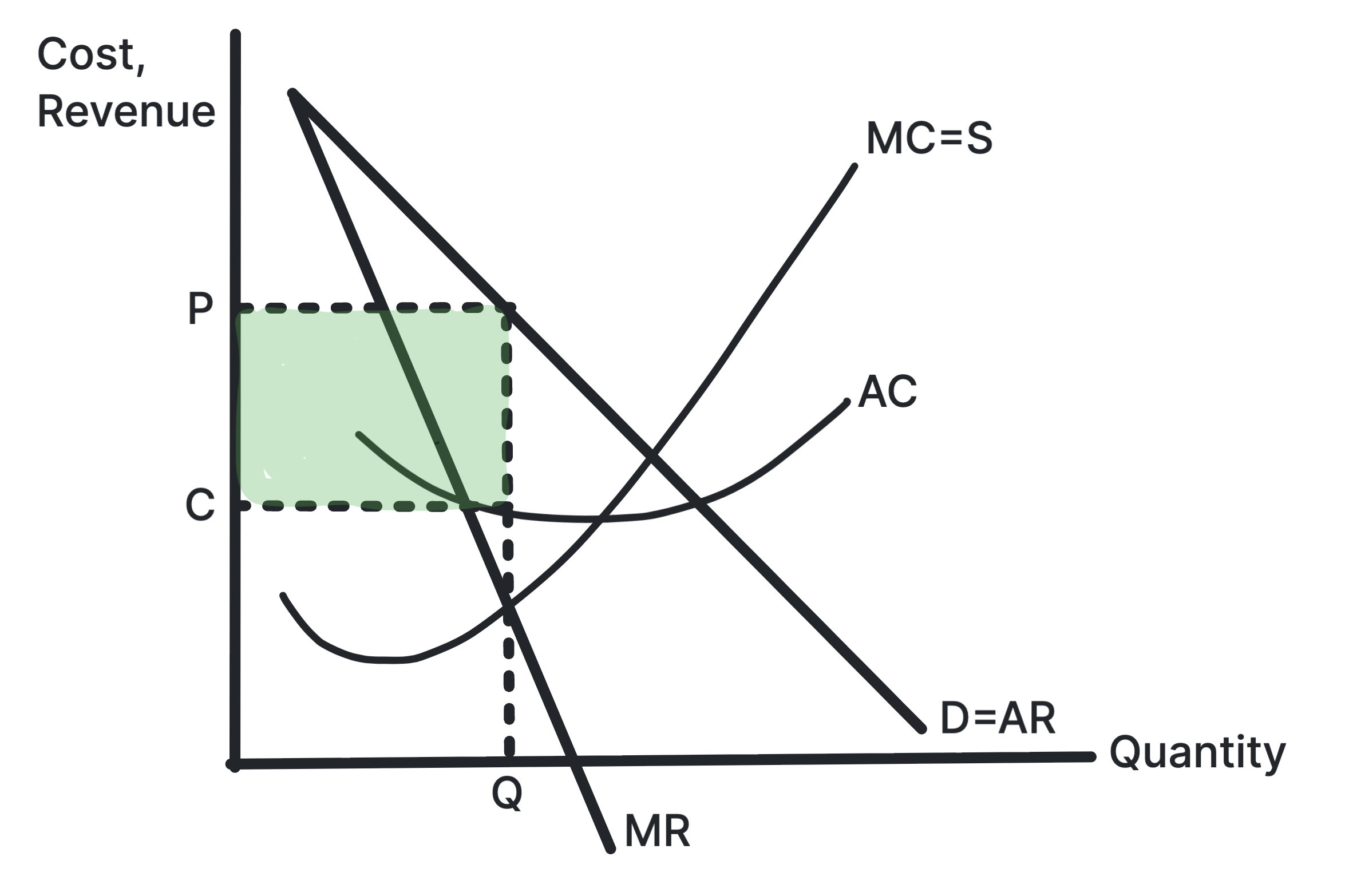
Unlike more competitive markets, monopoly can sustain supernormal profit in the long run because barriers to entry protect the firm from new competition.
Efficiencies:
- Allocative efficiency: No - The firm does not produce where \( AR = MC \), so resources are not allocated efficiently and there is a welfare loss to society.
- Productive efficiency: No - The firm does not produce at the lowest point of the AC curve, so it is not producing at minimum cost.
- Dynamic efficiency: Yes - The firm may have the ability to innovate or improve efficiency, as it earns supernormal profit in the long run.
- X-inefficiency: Possible - The firm may have less incentive to minimise costs due to lack of competition, leading to inefficiency. Whether this occurs depends whether the monopoly is pure or legal, and the level of competition in the market.
Third-Degree Price Discrimination
Third-degree price discrimination occurs when a monopoly charges different prices to different consumer groups for the same product based upon a characteristic such as age, location, or income. This allows the firm to increase total profit.
Conditions Required
- The firm must have market power. Therefore there must be few/no substitutes available.
- Different sub-markets must have different PED and the firm must be able to identify these differences. For example, peak and off-peak train travel, or student and adult cinema tickets.
- The firm must be able to separate the markets and prevent resale of cheaper products or arbitrage. Often this is achieved through the use of ID.
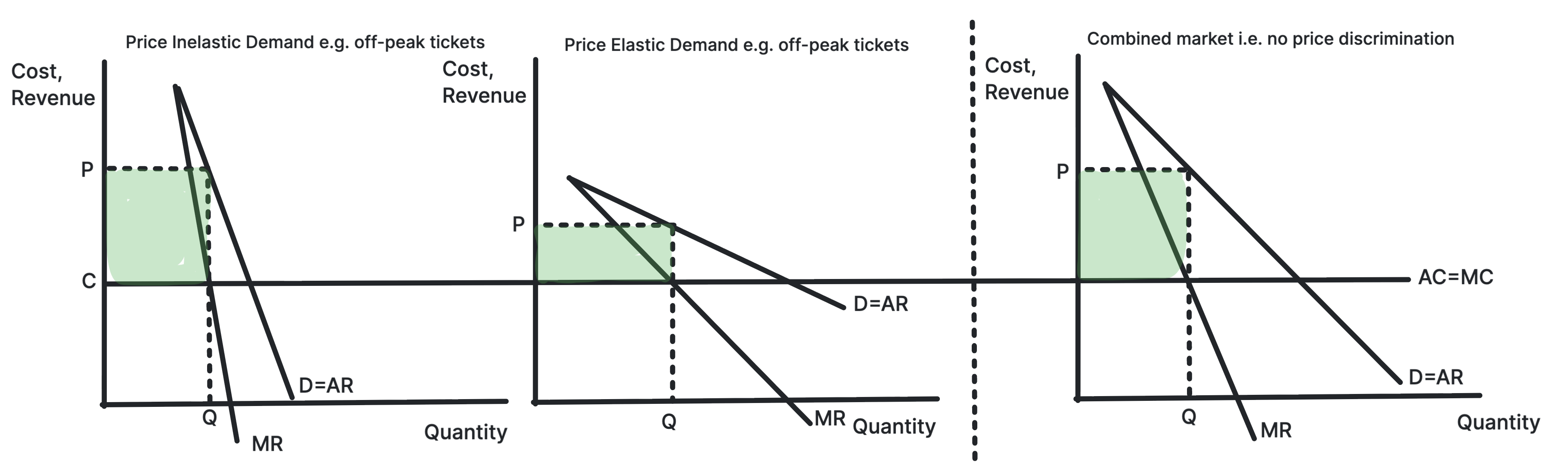
The result is that the monopoly charges a higher price in the market with more inelastic demand, and a lower price in the market with more elastic demand, increasing total profit compared to charging a single price for all consumers.
Costs and Benefits of Price Discrimination
Consumers:
- Consumers with more inelastic demand may pay a higher price than they would in a single-price monopoly, reducing consumer surplus.
- Consumers with more elastic demand may pay a lower price than they would in a single-price monopoly, increasing consumer surplus.
- Consumers with more elastic demand may enjoy quieter services or more availability of products at a lower price.
- Consumers in general may benefit from higher quality products or services, as the monopoly can use the additional profit to invest in research and development.
Firm:
- The firm can increase total profit by charging different prices to different consumer groups, allowing it to capture more consumer surplus.
- The firm may incur additional costs to identify different consumer groups and prevent resale, which may reduce the overall profit gained from price discrimination.
Costs and Benefits of Monopoly
| Stakeholder | Potential Benefits | Potential Costs |
|---|---|---|
| Firm | Economies of scale, supernormal profit, ability to invest in research and development, and potential for dynamic efficiency. | Government regulation, potential for X-inefficiency, and risk of public backlash or negative publicity. |
| Consumers | Lower prices due to economies of scale, improved product quality, and innovation. | Higher prices, lower output, reduced choice, poorer quality, and allocative inefficiency. |
| Workers | Enhanced job security due to the firm's market power and potential for higher wages in profitable firms. | Potential for lower wages, reduced job security, and limited career progression due to lack of competition. |
| Suppliers | Stable demand for their products, long-term contracts, and potential for higher prices due to the monopoly's market power. | Reduced bargaining power, lower prices, and potential for delayed payments or non-payment due to the monopoly's market power. |
Natural Monopoly
A natural monopoly exists when an industry has such a high proportion of fixed costs that it is more efficient for a single firm to supply the entire market than for multiple firms to compete.
This is often the case in industries with high infrastructure costs and low marginal costs, where the long-run average cost (LRAC) curve continues to fall over the entire range of market demand.
Examples include water supply, rail networks, and energy grids.
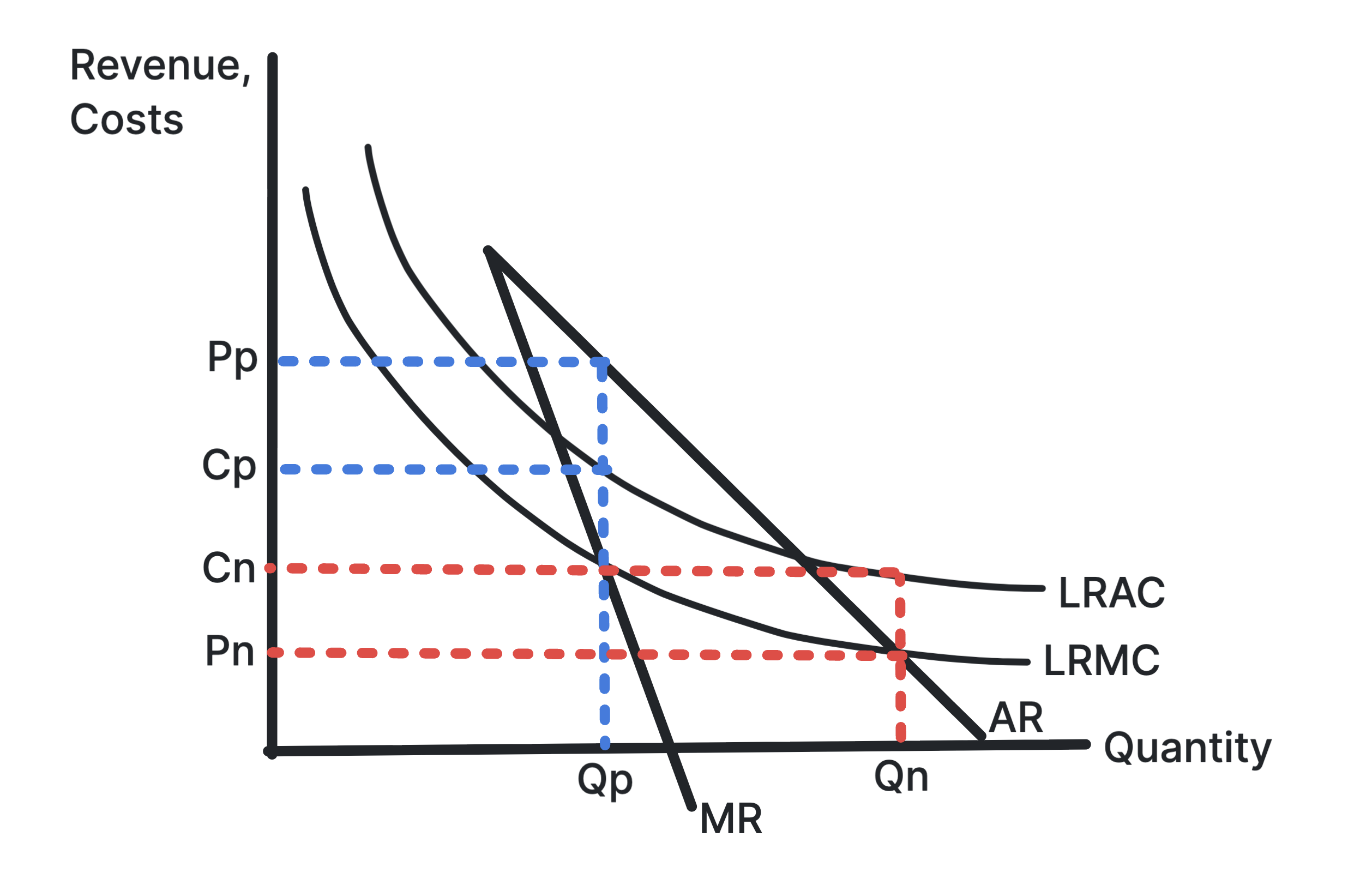
In a natural monopoly, LRAC falls over the entire range of market demand since the firm can spread its fixed costs over a larger output and does not suffer from diseconomies of scale. This means that a single firm can produce at a lower average cost than multiple firms, making competition inefficient.
The diagram above shows the difference in efficiency between a natural monopoly run by the government (red) and a privatised natural monopoly (blue). This is explored further in Theme 3.6.1 Government Intervention.
Stuck on this topic? Work through it with an online A-Level Economics tutor in a free 15-minute intro call, or send an essay on it for A-Level Economics essay marking.