Oligopoly
Key Characteristics
- Few large firms: A small number of firms dominate the market, each with a significant market share. This results in a high concentration ratio, which measures the degree of market concentration.
- Interdependence: Firms must consider the potential reactions of rivals when making decisions about price, output, and marketing strategies. This leads to strategic behaviour and the use of game theory to analyse decision-making.
- Barriers to entry: High barriers to entry, such as economies of scale, brand loyalty, and legal restrictions, limit competition from new entrants.
- Product differentiation: Products are highly differentiated, with firms competing on factors such as quality, branding, and customer service, rather than just price.
Examples:
- UK Supermarkets (e.g., Tesco, Sainsbury's, Asda)
- Airlines (e.g., British Airways, EasyJet, Ryanair)
- Mobile Phone Networks (e.g., EE, Vodafone, O2)
If you are ever stuck for examples, think of large brands you see in day-to-day life. These are often examples of oligopolistic markets.
Concentration Ratios
A concentration ratio measures the degree of market concentration.
For example, a 3-firm concentration ratio of 80% means that the top three firms account for 80% of total market sales.
A high ratio means the market is more concentrated and generally less competitive.
Calculation: \[ \frac{\text{Total revenue of top } n \text{ firms}}{\text{Total market revenue}} \times 100 \]
Worked Example: Calculating a Concentration Ratio
Six firms supply a market. Their annual sales are:
| Firm | Annual Sales |
|---|---|
| A | £240m |
| B | £180m |
| C | £120m |
| D | £40m |
| E | £15m |
| F | £5m |
| Sales of the largest three firms | £240m + £180m + £120m = £540m |
| Total market sales | £600m |
| 3-firm concentration ratio | \( \frac{540}{600} \times 100 = 90\% \) |
The three largest firms supply 90% of the market between them, leaving 10% for the other three. A ratio this high marks a highly concentrated market in which the leading firms are strongly interdependent.
Collusive and Non-Collusive Behaviour
Because firms are interdependent, the market can result in collusion or competition.
Collusion
Collusion takes place when firms agree, formally or informally, to restrict supply and raise price, acting like a monopoly to earn supernormal profit.
- Overt collusion: A formal agreement to collude. This is illegal and can be proven in court. Examples include British Airways and Virgin Atlantic colluding to fix fuel surcharges in 2007.
- Tacit collusion: An informal understanding to collude, often through price leadership, where the market leader sets a price and others follow. This can result in the same outcome as overt collusion but is harder to prove.
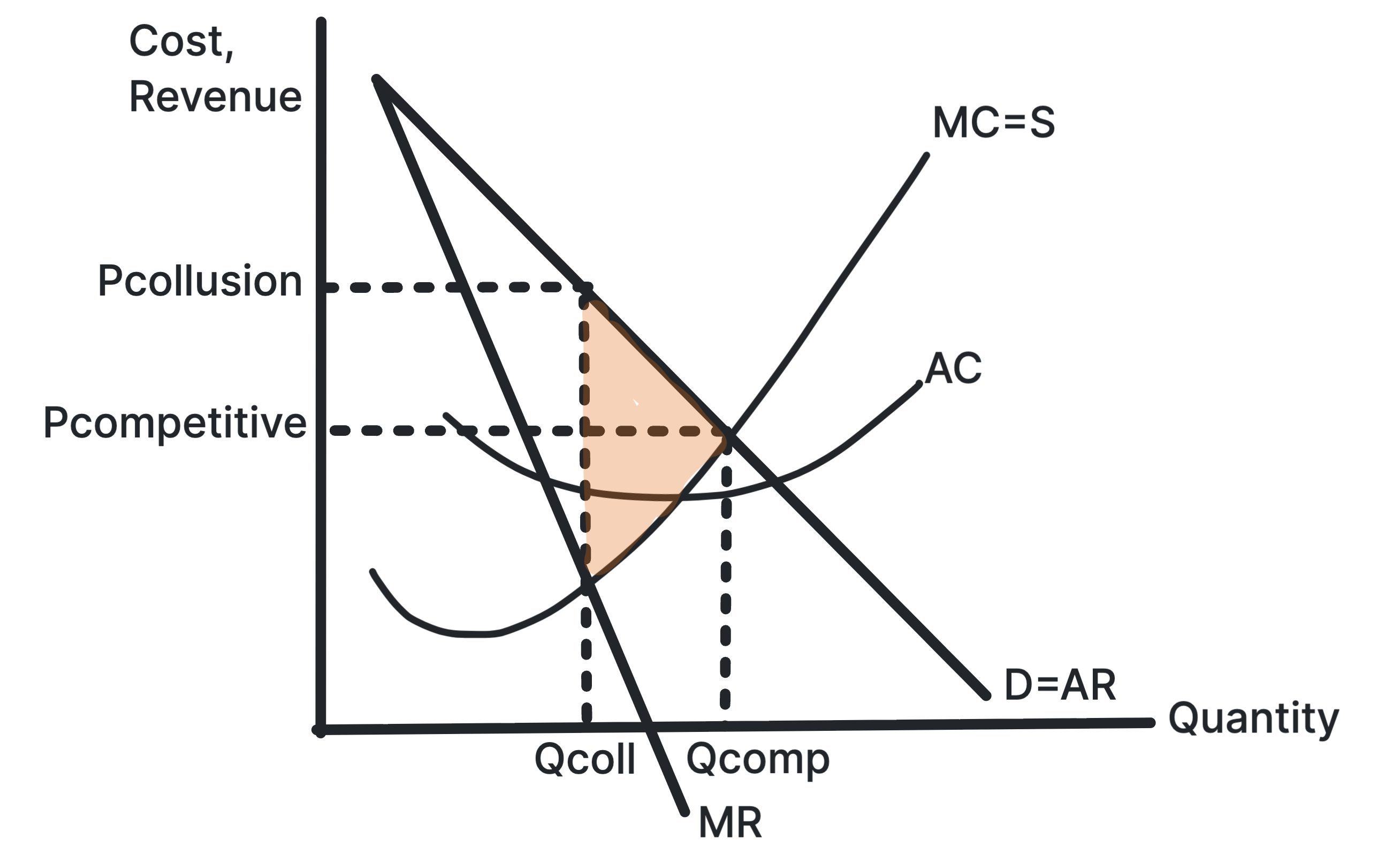
The diagram shows how collusion can lead to a higher price and lower output compared to a competitive market. Collusion creates a deadweight loss, as the market produces less than the socially optimal quantity. This is represented by the orange area.
Competitive Behaviour - The Kinked Demand Curve
In a non-collusive oligopoly, firms actively compete, often through non-price competition as there is price rigidity. The kinked demand curve model explains why prices may remain stable even in a competitive market.
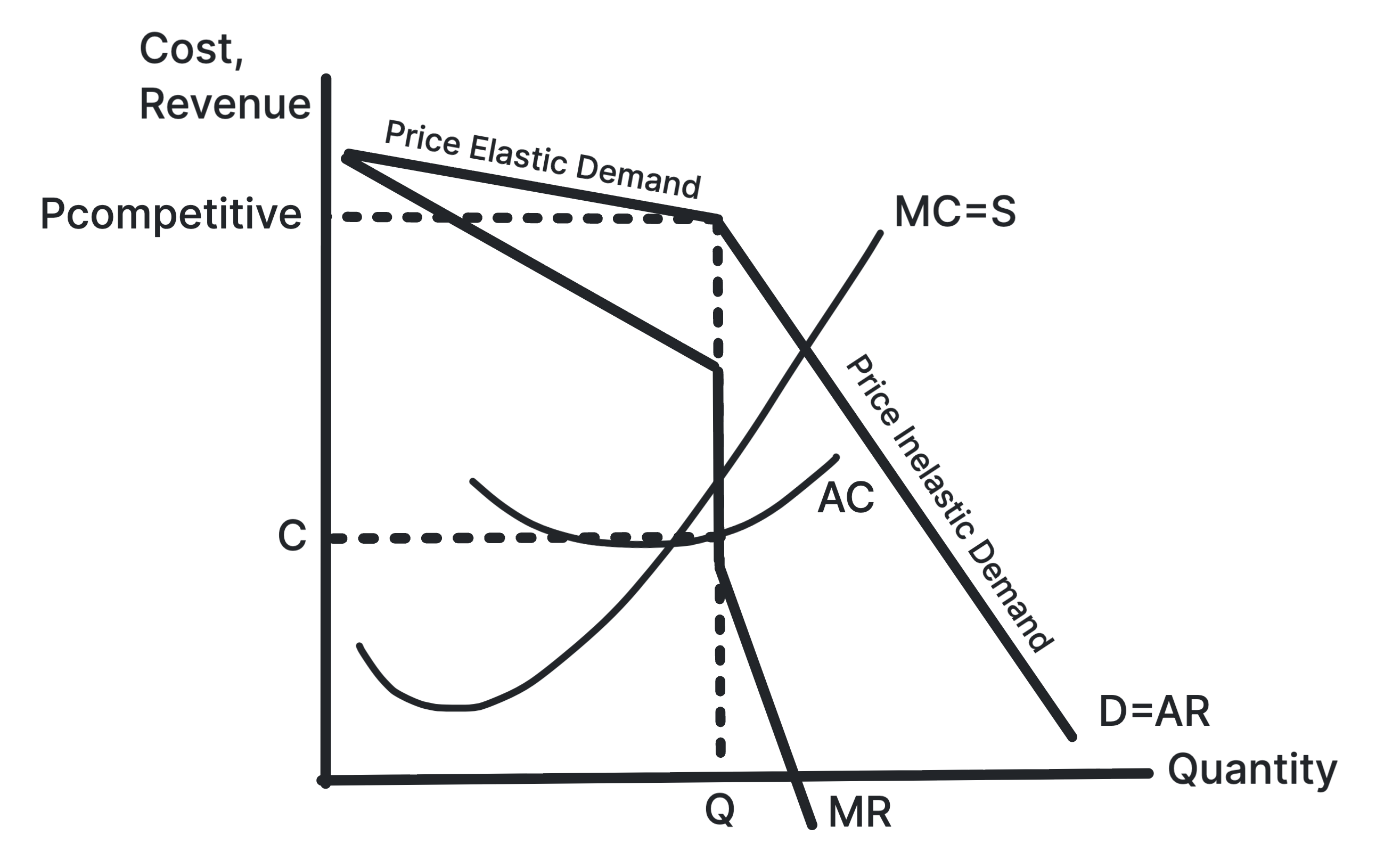
If firms in a competitive oligopoly attempt to increase prices, their demand curve is price elastic, since there are a number of close substitutes available. Therefore consumers will switch to competitors, leading to a reduction in revenue and profits for the firm.
If firms in a competitive oligopoly attempt to reduce prices, their demand curve is price inelastic, since competitors are likely to match the price cut. Therefore the firm will gain very few extra customers, and revenue and profits will likely decrease. In some cases, this could spark a price war, where firms repeatedly cut prices to undercut rivals, damaging profits for all firms in the market.
This creates a kinked demand curve and a discontinuous marginal revenue curve. Firms have little incentive to change price, which can result in "sticky" prices even in a competitive market, shown by the price of P_competitive in the diagram above.
Consequently, competitive oligopolies are forced to compete on factors other than price, such as product differentiation and advertising.
Types of Competition
Price Competition
- Price wars: Repetitive price cutting by firms to undercut rivals, often leading to lower profits for all firms in the market.
- Predatory pricing: Temporarily setting prices below average cost to drive smaller competitors that lack economies of scale out of the market, with the intention of raising prices later. This is illegal in many countries, including the UK and US.
- Limit pricing: Setting price low enough to deter new entrants, by making large supernormal profits unattainable for potential competitors.
Non-Price Competition
Non-price competition is very common in oligopoly and includes:
- Product differentiation: Firms compete by offering unique products, such as through branding, quality, or features.
- Advertising and marketing: Firms invest in advertising to increase brand awareness and loyalty, which can reduce price elasticity of demand.
- Customer service: Firms may compete by offering superior customer service, such as free delivery, extended warranties, or loyalty programmes.
- Location/convenience: Firms may compete by being more conveniently located or offering services that make it easier for customers to access their products such as next day delivery or click-and-collect.
- Loyalty schemes: Firms may offer loyalty programmes to retain customers and encourage repeat purchases, such as points systems or exclusive discounts for members.
Game Theory and the Prisoner's Dilemma
Game theory: A framework for analysing strategic decision-making, where the outcome for each participant depends on the actions of others. In oligopoly, firms must consider the potential reactions of rivals when making decisions about price, output, and marketing strategies.
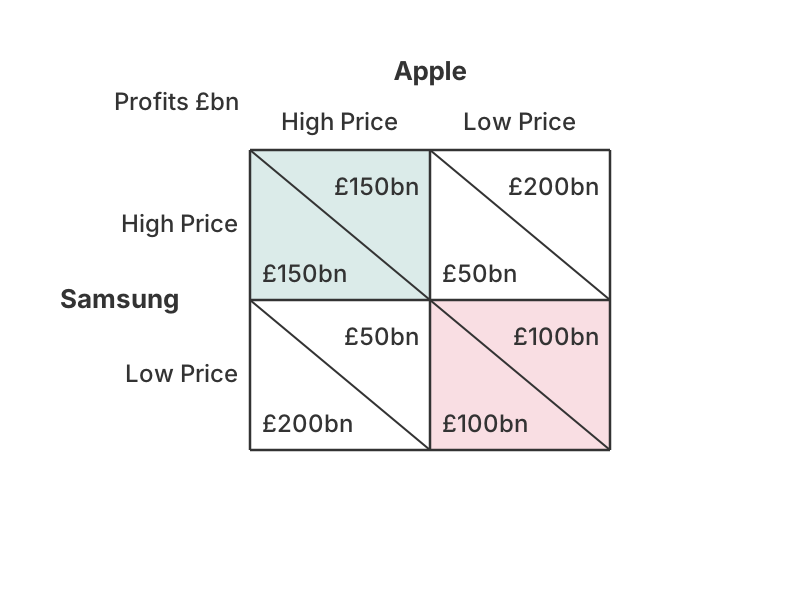
The Prisoner's Dilemma is a classic example of game theory that illustrates why firms may choose to compete rather than collude, even when collusion would benefit both. In the diagram above, both Samsung and Apple would benefit from colluding and charging a high price, earning £150bn in profit each.
However, if given the option to cheat and charge a low price, each firm has an incentive to do so, as they could earn £200bn in profit while the other firm earns only £50bn. This creates a dominant strategy for both firms to compete (charge a low price), leading to a Nash equilibrium where both firms earn lower profits (£100bn each) than if they had colluded.
Therefore, the Prisoner's Dilemma demonstrates how interdependence in oligopoly can lead to suboptimal outcomes for firms, as they may choose to compete rather than collude, even when collusion would be mutually beneficial. Collusion can only be achieved if there is trust and effective communication between firms, which is often difficult to maintain in practice.
Stuck on this topic? Work through it with an online A-Level Economics tutor in a free 15-minute intro call, or send an essay on it for A-Level Economics essay marking.