Monopolistic Competition
Key Characteristics
- Many firms in the market, each with a small market share.
- Product differentiation — products are not identical, so firms can charge different prices. The core product is similar, but firms differentiate their products through branding, quality, features, or marketing.
- Low barriers to entry and exit, so new firms can enter the market if there are profits, and leave if there are losses.
The result of these characteristics is that firms have some control over their pricing decisions, meaning they are price makers.
Examples of monopolistic competition include the restaurant industry, clothing brands, and hairdressers. If you are ever stuck for examples, think of local businesses near you that sell similar but differentiated products.
The Firm's Demand Curve
Because products are differentiated, each firm faces a downward-sloping demand curve, which is also its average revenue (AR) curve.
This gives each firm a small degree of market power and ability to set prices.
Short-Run Equilibrium
The firm maximises profit where \( MC = MR \).
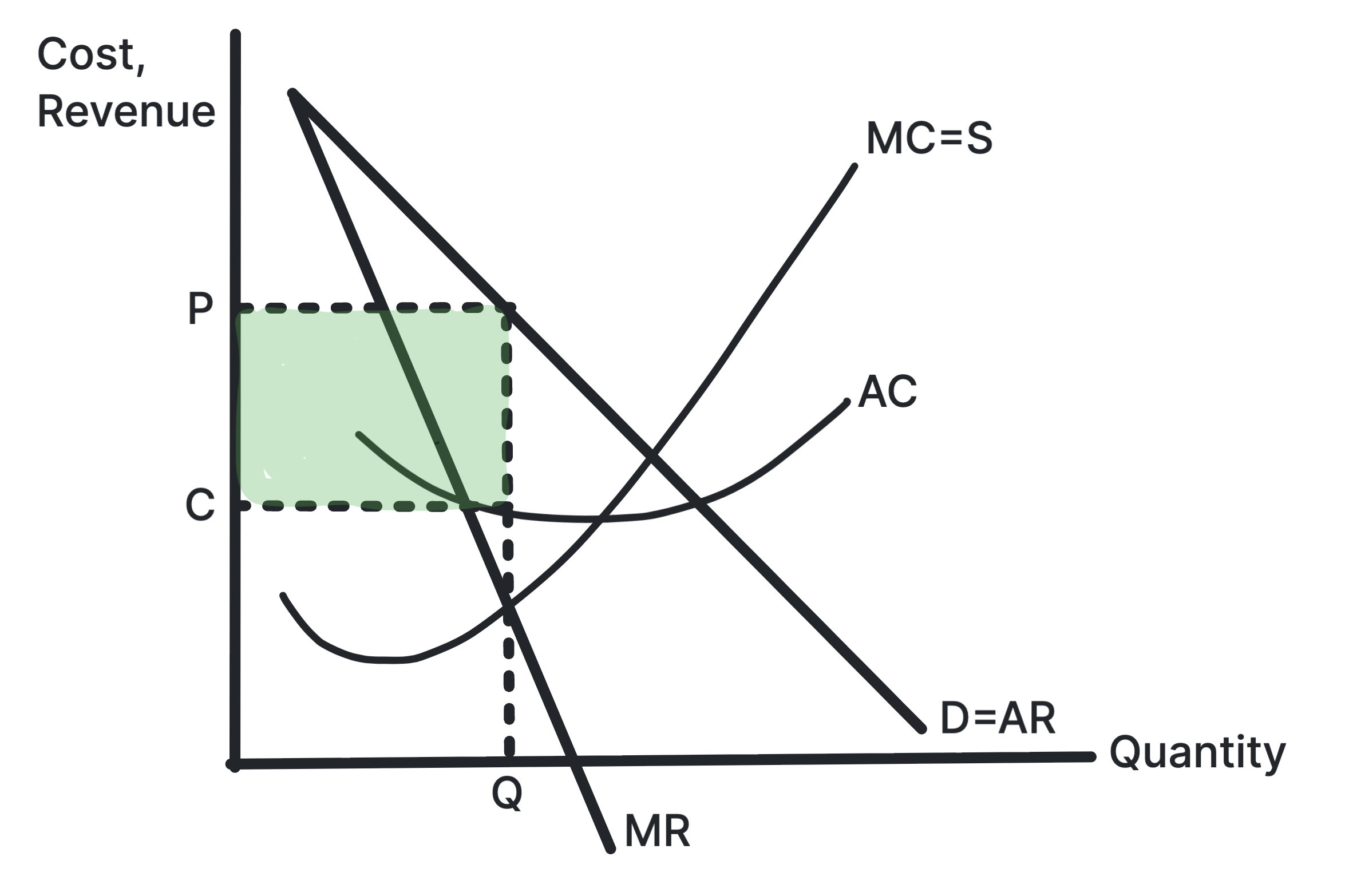
Firms can also make losses in the short run if \( AR < AC \) at the profit-maximising output.
Long-Run Equilibrium
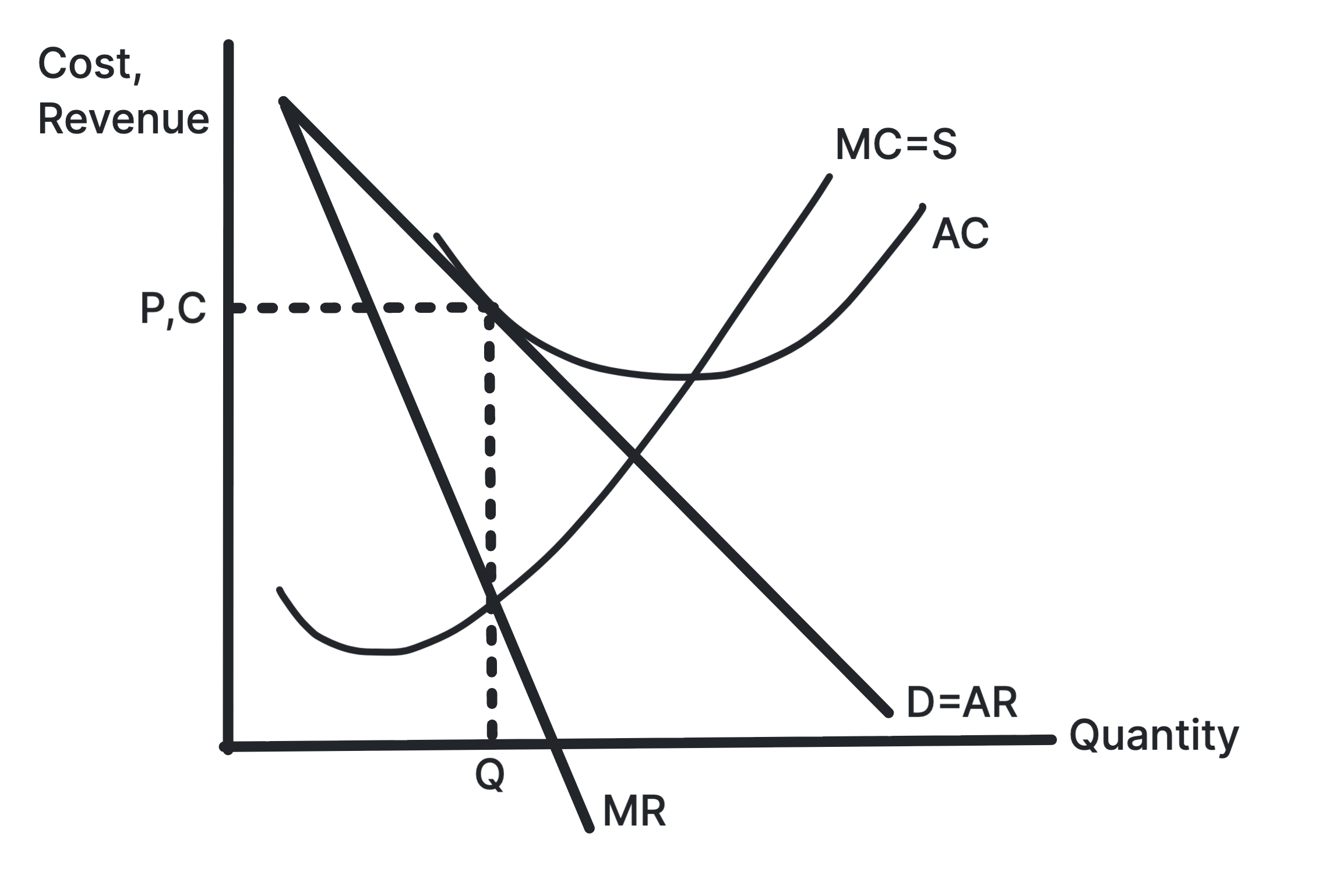
Because there are low barriers to entry and exit, the market adjusts to a long-run equilibrium where all firms earn normal profit.
If firms earn short-run supernormal profit, this attracts new entrants. This increases competition and reduces the market share of existing firms and shifts each firm's demand curve left until supernormal profit is removed.
The opposite happens if firms make losses: firms leave the market, reducing competition and shifting each firm's demand curve right until remaining firms earn normal profit.
Drawing the shifts of AR and MR is difficult, so instead you are allowed to show the long run equilibrium via shifting only the AC curve as shown, ensuring that \( AR = AC \) at the profit-maximising output.
Efficiency in Long-Run Equilibrium
Productive efficiency: No - The firm does not produce at the minimum point of the AC curve, resources are not fully utilised.
Allocative efficiency: No - The firm does not produce where \( P = MC \), so resources are not allocated efficiently
Dynamic efficiency: No - The firm does not have the ability to innovate or improve efficiency, as it earns only normal profit in the long run. However, firms are able to earn supernormal profit in the short run, which may allow them to invest in research and development to some extent.
Non-Price Competition
Firms in monopolistic competition often engage in non-price competition since they only have a small degree of market power and cannot rely on price alone to attract customers. Examples include:
- Product quality and features
- Customer service and support
- Loyalty programmes and promotions
- Convenience and Location
Impact on Consumers
Prices
- Prices may be higher in monopolistic competition due to product differentiation and branding, which can create perceived value and allow firms to charge a premium. Firms are also small and lack economies of scale, which can lead to higher production costs and prices.
- Prices may be lower in monopolistic competition due to the presence of many firms and low barriers to entry, which can increase competition and drive prices down.
Quality
- Quality may be higher in monopolistic competition due to the high level of competition and the need for firms to differentiate their products and attract customers.
- Quality may be lower in monopolistic competition due to the limited ability to make supernormal profits in the long run, which can reduce the resources available for investment in quality improvement.
Choice
- Choice may be higher in monopolistic competition due to the variety of differentiated products available in the market.
- Choice may be lower in monopolistic competition as differentiation can be surface-level and not meaningful, leading to a lack of real choice for consumers.
Stuck on this topic? Work through it with an online A-Level Economics tutor in a free 15-minute intro call, or send an essay on it for A-Level Economics essay marking.