Economies and Diseconomies of Scale
The Long-Run Average Cost Curve
In the long run, firms can change their scale of production. This creates economies and diseconomies of scale, which shape the LRAC curve.
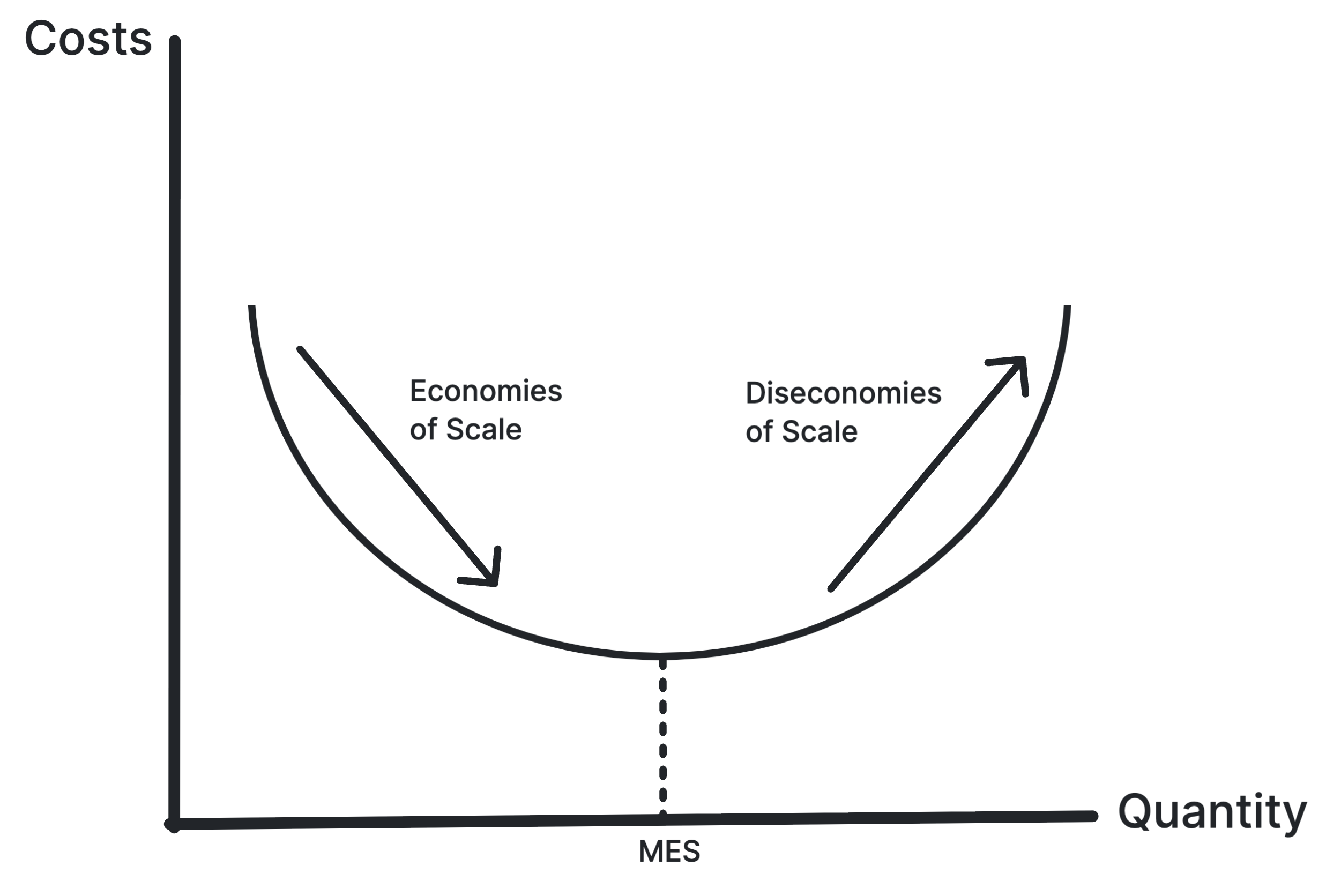
Minimum Efficient Scale (MES) is the lowest level of output at which a firm can achieve the lowest possible average total cost in the long run.
Economies of Scale
Internal Economies of scale the reasons within a business why Average Total Costs fall as size/output of the business increase. These are internal to the firm and cause LRAC to fall.
| Type | Explanation | Example |
|---|---|---|
| Purchasing | Bulk-buying discounts on raw materials. As the size of the business increases, the firm places larger orders with suppliers. Therefore the order represents a higher proportion of the supplier's revenue, meaning they are willing to offer a lower cost per unit. | Tesco can negotiate a lower price per unit for milk from daily suppliers compared to a small local shop. |
| Technical | Use of more efficient, large-scale machinery or technology. As the size of the business increases, it has higher revenue and can afford the larger upfront cost of more productive machinery. This increases productivity and lowers ATC. | A car factory uses robotic assembly lines, automating the production process. |
| Financial | Easier and cheaper access to finance, such as lower interest rates. As the size of a business increases, it is seen as less risky by lenders due to higher revenue and assets which can be offered as security on loans. Therefore banks will be willing to offer lower interest rates on loans. This decreases TFC - lower AFC - lower ATC. | A large PLC gets a better loan rate than a small business. |
| Managerial | Specialisation of management. As a business increases in size, it has higher revenue and can afford to pay the higher salary of experienced managers. Therefore these managers can improve productivity of the business, decreasing ATC. | Large profitable businesses like Amazon can afford to hire experienced and proven managers. |
| Marketing | Spreading advertising costs over a larger output. Marketing/advertising is a fixed cost. Therefore larger firms can spread the fixed cost over more units of output. This decreases AFC and thus ATC. | A global brand's television advertising cost per unit sold is very small. |
| Risk-bearing | Diversification across products or markets spreads risk. A larger business often has multiple products or operates in multiple markets. This means that if one product or market performs poorly, the losses can be offset by better performance in other areas, reducing overall risk and potentially lowering costs. | A conglomerate can absorb losses in one area. |
Diseconomies of Scale
Diseconomies of scale are the reasons why ATC starts to increase as the size/output of a business becomes too large. These are internal to the firm and cause LRAC to rise.
| Type | Explanation |
|---|---|
| Communication/Managerial | Miscommunication and distortion of messages across many layers or departments. As a business grows, it often develops a complex organisational structure with multiple layers of management and departments. This can lead to communication breakdowns, where important information is distorted, delayed, or lost as it passes through the hierarchy. This can result in inefficiencies, mistakes, and slower response times, increasing costs. |
| Motivational | Workers may feel alienated, causing lower productivity and linking to the principal-agent problem. As a business becomes larger, the contribution of each employee can become less noticed and rewarded. This results in decreased motivation of workers, lower productivity and thus ATC increases. |
| Geographical | Coordination problems between distant plants or offices. As a business expands geographically, it may operate multiple plants or offices in different locations. This can lead to coordination problems, such as difficulties in managing supply chains, ensuring consistent quality, and maintaining effective communication across locations due to language etc. These issues can increase operational costs and reduce efficiency. |
Diseconomies of scale are not diminishing returns. Diminishing returns are a short-run effect, caused by adding a variable factor to a fixed one, and they push marginal cost up. Diseconomies of scale are a long-run effect, occurring once all factors have been increased, and they push long-run average cost up. If a question describes a firm building a bigger plant or expanding its scale, it is testing diseconomies.
External Economies of Scale
External economies of scale are the reasons outside of the business why as size/output of all firms in an entire industry increases. They are external to the individual firm and cause the LRAC curve to shift downwards for all firms in the industry, reducing costs.
| Source | Explanation | Example |
|---|---|---|
| Geographic clusters | Ancillary firms (related businesses such as suppliers, clients)locate nearby, reducing transport and logistics costs. As the market grows, firms in the same industry may choose to locate close to major manufacturers or suppliers. This creates a geographic cluster, where firms can benefit from reduced transport and logistics costs due to proximity to suppliers and customers. | Financial services in London. |
| Skilled labour pools | A concentration of firms attracts specialised workers, reducing training costs. As the market grows, the availability of skilled labour also increases. This pushes average wages down, decreasing the cost of skilled labour. Additionally, as labour is more likely to be trained it reduces training costs for firms. | The number of Machine Learning Specialists have increased since the introduction of LLM models such as ChatGPT in 2021. |
| Improved infrastructure | Transport and communications improve to serve the industry. As the market grows, infrastructure such as transport and communications may be improved to serve the industry. This reduces costs for all firms in the industry. | Road and rail links near a port. |
| Favourable Legislation | Government policies that support the industry, such as tax incentives or subsidies, can reduce costs for all firms in the industry. As the market grows, it becomes more important to the government due to the tax revenue generated by the industry. Therefore the government may introduce policies to support the industry, such as tax incentives or subsidies. This reduces costs for all firms in the industry. | Pharmaceuticals receive tax credits in the UK for R&D |
Stuck on this topic? Work through it with an online A-Level Economics tutor in a free 15-minute intro call, or send an essay on it for A-Level Economics essay marking.