Written by
Eliot King— First-Class BSc (Hons) Economics, University of Bath · 6+ years teaching A-Level Economics · Edexcel A, Edexcel B, AQA and OCR
Specification Coverage: Edexcel unit 3.3.1 -
Revenue. Students should be able to define and calculate total
revenue, average revenue, and marginal revenue, distinguish
between revenue conditions in perfect and imperfect competition,
and apply the total revenue rule to price changes.
Key Definitions
Total Revenue (TR):\( P \times Q \)
Average Revenue (AR):\( \frac{TR}{Q} \). This is the
price per unit and also the firm's
demand curve.
Marginal Revenue (MR):\( \frac{\Delta TR}{\Delta Q} \). This is the
additional revenue from selling one more unit.
Revenue in Perfect Competition
Firms in
perfect competition
are price takers, so they sell at the
market price.
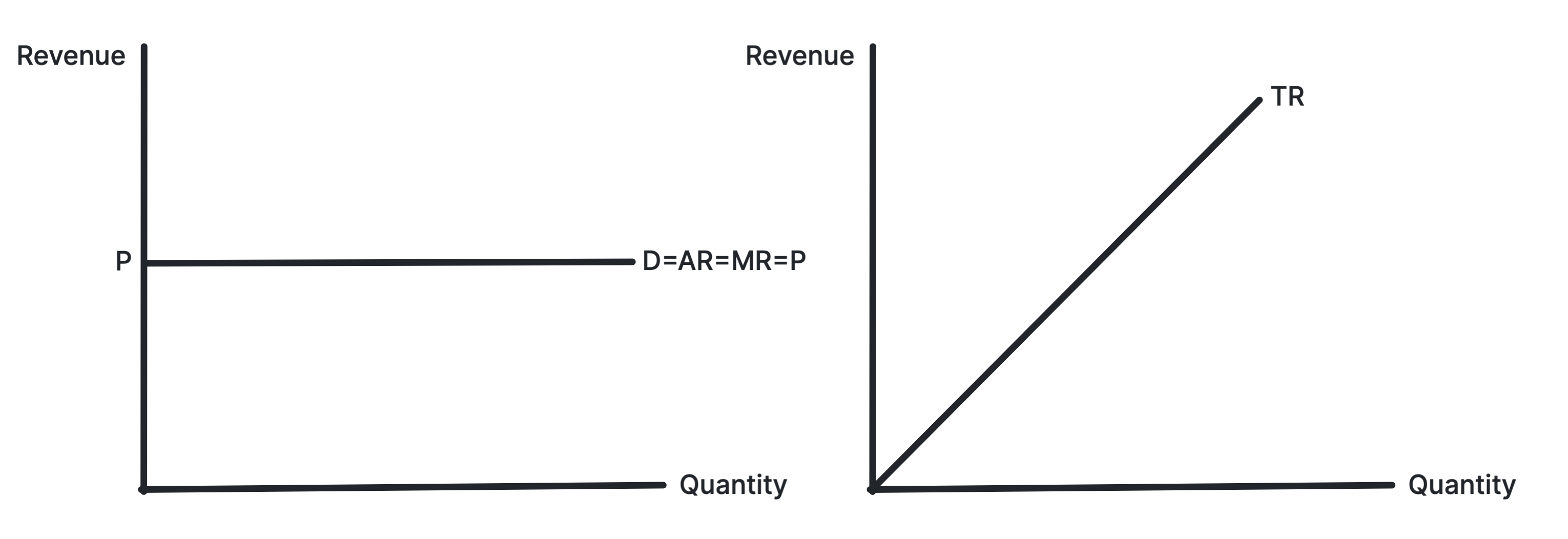
This means \( AR = MR = Price \), and the
demand curve facing the firm is
perfectly elastic, so it is horizontal.
Figure 1: Revenue in Perfect Competition - AR and MR are
horizontal at the market price. TR increases at a constant
rate as quantity increases.
Revenue in Imperfect Competition
Firms in imperfect competition have
market power and are therefore
price makers, so to sell more output they must
lower the price.
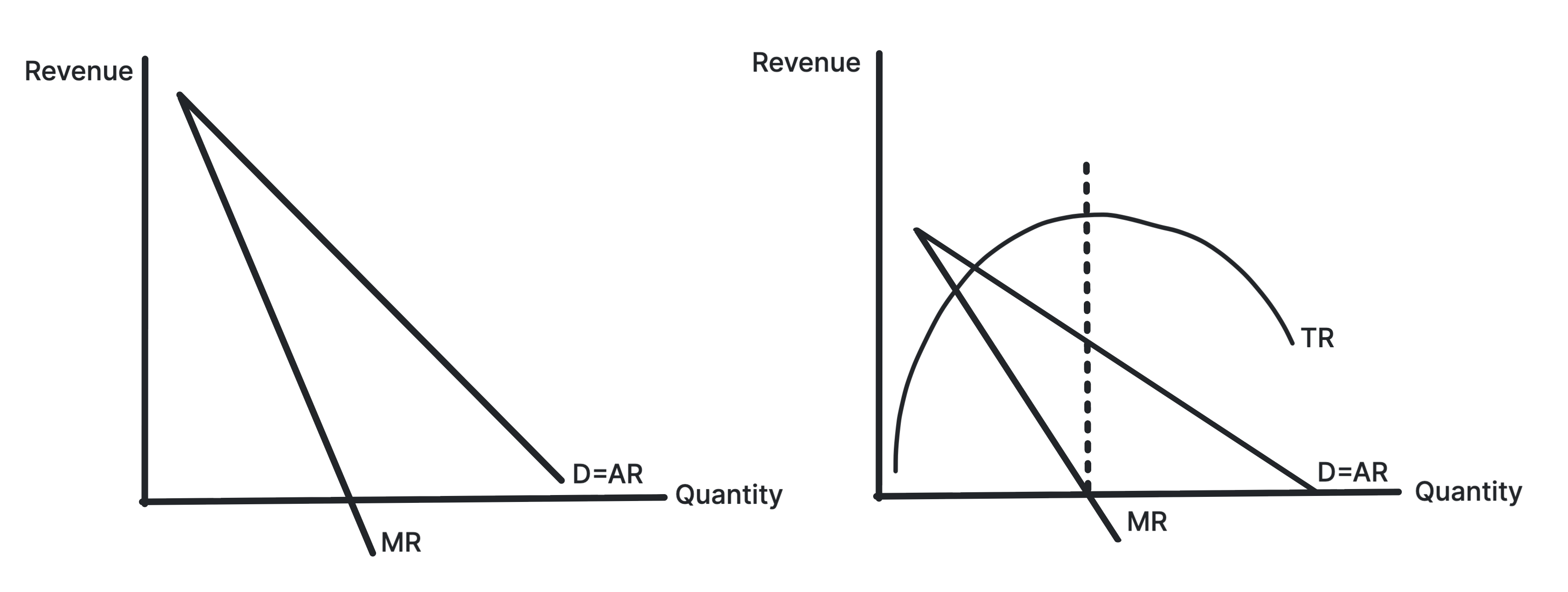
As a result, AR, which is the demand curve, is
downward sloping, and MR is also downward
sloping but lies below AR.
Figure 2: Revenue in Imperfect Competition - AR is downward
sloping, and MR lies below AR. TR increases at a decreasing
rate until MR equals zero, then it decreases.
A key point is that in a linear diagram the
MR curve is twice as steep as the AR curve. The
right hand diagram shows that total revenue is maximised when
\( MR = 0 \).
Worked Example: Total, Average and Marginal Revenue
A firm with market power must lower its price to sell more.
This schedule is read off its demand curve:
Price (AR)
Quantity
TR = P × Q
MR
£10
1
£10
—
£8
2
£16
£6
£6
3
£18
£2
£4
4
£16
−£2
Price and AR are the same figure in every row. MR falls twice
as fast and stays below AR, because to sell
one more unit the firm must cut the price on
every unit, not just the last one. Total
revenue peaks at £18, at the output where MR
turns from positive to negative.
The Total Revenue Rule and PED
The relationship between PED and
total revenue is crucial when firms make
pricing decisions.