Conflicts Between Objectives and Policies
The Core Problem
Governments face trade-offs when trying to achieve all macroeconomic objectives at the same time.
Improving one objective often worsens another, so policy decisions usually involve prioritisation.
Key Trade-Offs Between Objectives
| Trade-Off | Explanation |
|---|---|
| Economic Growth vs. Low Inflation | Economic growth resulting from increased aggregate demand can lead to an increase in demand pull inflation, causing inflation to rise above its target level. |
| Economic Growth vs. Environmental Sustainability | Increased economic activity (production, transport) can lead to higher levels of pollution and carbon emissions, compromising environmental sustainability. It may also deplete natural resources and damage ecosystems. |
| Economic Growth vs. Income Equality | Economic growth tends to benefit higher-income individuals more than lower-income individuals, which can worsen income inequality. For example, growth in high-tech industries may create high-paying jobs for skilled workers, while low-skilled workers may see little benefit. |
| Economic Growth vs. Current Account Balance | Economic growth can lead to a rise in average incomes, which increases demand for imports. This can worsen the current account balance if imports rise faster than exports. |
| Low Unemployment vs. Low Inflation | Lower unemployment results in higher average incomes as individuals move from benefits to a full income. This causes higher consumer spending and demand-pull inflation, which can push inflation above its target level. |
The Short-Run Phillips Curve
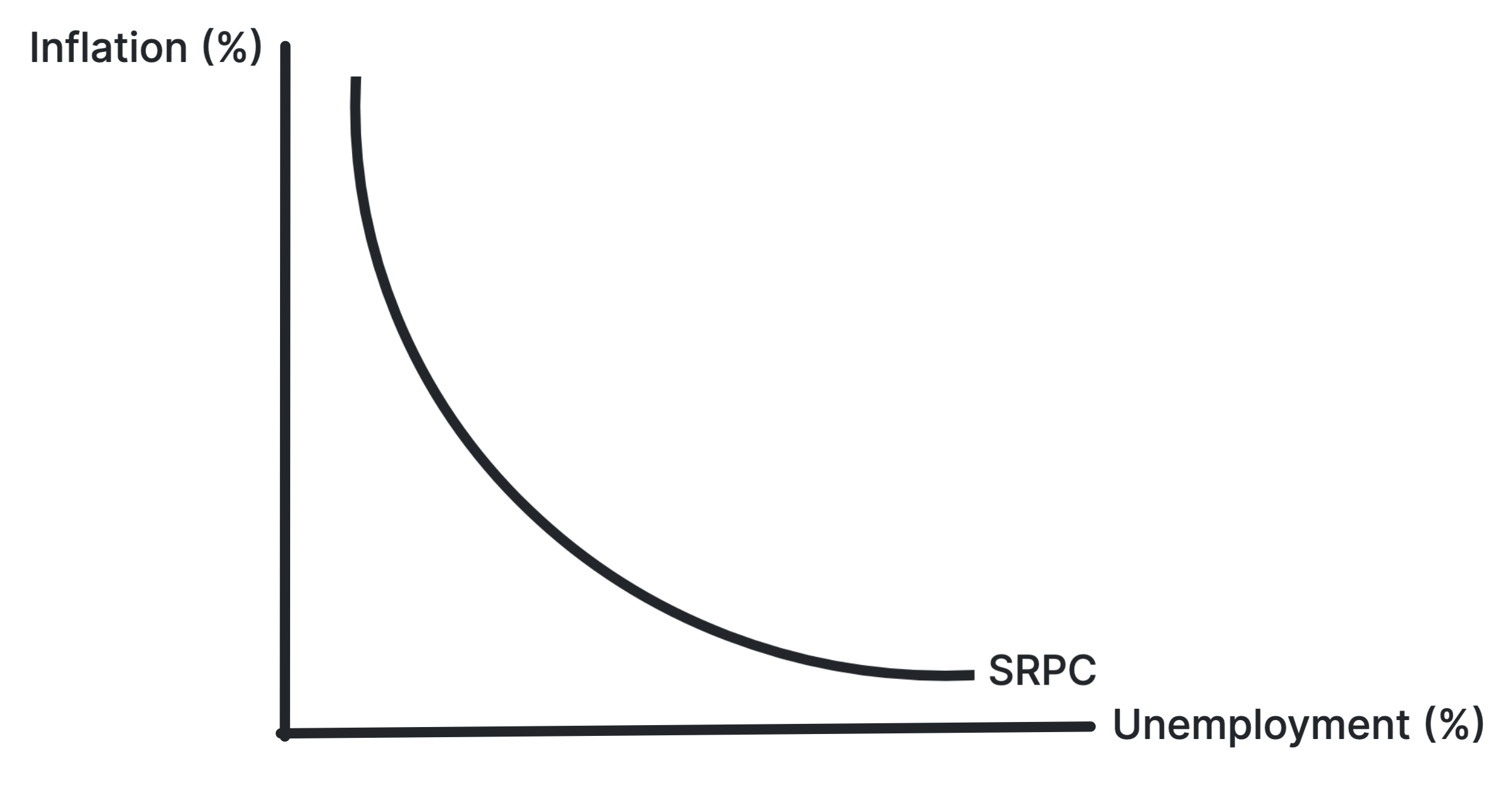
What it shows: A short-run inverse relationship between unemployment and inflation.
Reason: Lower unemployment leads to higher average incomes, which increases consumer spending and demand-pull inflation.
Limitation: This trade-off only applies in the short run. In the long run, the Phillips Curve is vertical at the natural rate of unemployment (NRU).
Policy Conflicts and Trade-Offs
Policy tools can also create conflicts between short-run and long-run goals.
| Policy Conflict | Explanation |
|---|---|
| Monetary Policy: Inflation vs. Growth | Higher interest rates can reduce inflation by lowering AD, but they also reduce investment and consumption, which can slow economic growth. |
| Fiscal Policy: Short Run vs. Long Run | Expansionary fiscal policy (higher government spending or lower taxes) can boost AD and growth in the short run, but it may increase the budget deficit and national debt, which can constrain future growth. |
| Supply-Side Policy: Efficiency vs. Equity | Free-market supply-side policies (e.g. lower minimum wages, lower corporation taxes) can improve efficiency and growth, but they may exacerbate income inequality. In contrast, interventionist supply-side policies (e.g. education and healthcare spending) can reduce inequality but may be less efficient and slower to boost growth, and worsen the government budget deficit. |
Stuck on this topic? Work through it with an online A-Level Economics tutor in a free 15-minute intro call, or send an essay on it for A-Level Economics essay marking.