Supply-Side Policies
What Are Supply-Side Policies?
Supply-side policies:Policies that aim to increase the productive potential/capacity of the economy by shifting the long-run aggregate supply (LRAS) curve to the right.
Productive potential/capacity:The maximum possible output of an economy that occurs when all resources and factors of production are being utilised to their maximum. Also known as the full employment level of output.
Types of Supply-Side Policies
Market-based policies: These aim to increase productive capacity by removing government interventions.
Interventionist policies: These aim to increase productive capacity through government spending.
Available Supply-Side Policies
Market-Based Policies
Lower Income Tax
- Decreasing income tax increases the incentive to supply labour and work. Therefore economically inactive individuals join the labour force, increasing productive capacity.
- Evaluation: Lower income taxes can have a regressive effect if only the top rates of income tax are reduced. In this case income inequality would increase. Additionally, lower income tax can incentivise some workers to decrease their labour supply as they can achieve the same disposable income by working fewer hours (substitution effect).
Lower Corporation Tax
- Decreasing corporation tax increases the incentive of starting/expanding a business. This results in an increased number of startups as well as firms reinvesting their additional retained profit to increase productivity. Therefore productive capacity increases.
- Evaluation: Lower corporation tax reduces the government's taxation revenue. Therefore, there is a conflict in the macro objectives as the budget deficit and national debt increases.
Lower Unemployment Benefits
- Decreasing unemployment benefits increases the income differential between those working and not working. Therefore this increases the incentive to work, resulting in a larger labour force. Thus, productive capacity has increased.
- Evaluation: Lower unemployment benefits can leave those unable to work with reduced disposable income, increasing income inequality and possibly creating poverty.
Lower Minimum Wage
- Decreasing the minimum wage reduces employment costs for firms. This means firms will increase the number of employees hired, which increases business output and productive potential.
- Evaluation: Decreasing the minimum wage decreases the income differential between claiming unemployment benefits and working a low paid job. Consequently, this policy can actually result in a contraction of the labour supply and decrease productive capacity.
Decrease Trade Union Powers
- Decreasing the powers that trade unions have can reduce their negotiating power and result in lower wages rates for firms. This enables firms to employ more workers, increases output and productive potential.
- Evaluation: By reducing the negotiating power of Trade Unions, wages and working conditions may deteriorate, reducing worker motivation and productivity. Therefore, this offsets the rise in the productive capacity.
Deregulation
- Deregulation reduces barriers to entry to markets and reduces costs of production for firms. Therefore, this results in increased competition and output in markets, increasing productive capacity.
- Evaluation: Depending on which regulations are relaxed, deregulation can have significant unintended consequences. For example, if the government removed the requirement for restaurants to display food hygiene ratings, the quality of food may decrease as firms look to cut costs to maximise profits. Additionally, the lower barriers to entry can allow cheaper, low quality foreign products to flood the market and undercut domestic firms, resulting in a loss of GDP and employment.
Privatisation
- By privatising state-owned businesses, it results in private ownership (shareholders) and creates the incentive to maximise profits for increase dividend payments to shareholders. Therefore, in theory privatised firms should become more productively efficient to minimise costs. Consequently, this higher productivity results in increased output and productive capacity.
- Evaluation: In industries where the barriers to entry are very high e.g. railways/water companies, privatisation can result in monopoly power. Without competition this firm lack the incentive to maximise productive efficiency and instead raise prices and lower the quality of goods/services.
Interventionist Policies
Education Spending (Human Capital)
- Improving education in the economy increases the skills of the future workforce. As a result, the productivity of the labour force increases, resulting in a larger productive capacity.
- Evaluation: Education reforms can take 10+ years to impact the labour force, so there is a significant time lag. Additionally, education spending is expensive and therefore incurs an opportunity cost.
Healthcare Spending (Human Capital)
- Improving healthcare increases the health of the labour force and reduce the number of sick days taken by workers. Therefore, the productivity of the labour force increases, resulting in a larger productive capacity.
- Evaluation: Healthcare spending is expensive and therefore incurs and opportunity cost, meaning this expenditure reduces the government's ability to spend on other public services.
Infrastructure Spending
- Infrastructure helps to reduce costs of production and improve efficiency of businesses. As a result, infrastructure spending increases output by firms and therefore productive capacity rises. Examples include transport infrastructure (roads, railways) and communications infrastructure (5G data towers).
- Evaluation: Infrastructure projects are very expensive and take considerable time to complete e.g. HS2 which has been in planning since 2009. Therefore, there are time lags and opportunity costs associated with infrastructure spending.
R&D Spending
- Research & Development helps to innovate new technologies or production processes that can improve the efficiency of businesses and workers. Therefore, successful R&D spending increases productive capacity.
- Evaluation: The effectiveness of R&D depends on the quality of the investment and the time frame. In the long term, technologies are likely to become outdated/replaced and further spending will be required.
Subsidies
- Subsidies reduce the cost of production for businesses, resulting in an improved profit incentive to increase output. Therefore, productive capacity increases.
- Evaluation: Subsidies are expensive and incur a considerable opportunity cost. Additionally, firms may choose not to reinvest the subsidy and instead rely upon it to remain profitable. In this case gains to productivity capacity will be lost following the government's removal of the subsidy.
Impact of Supply-Side Policies
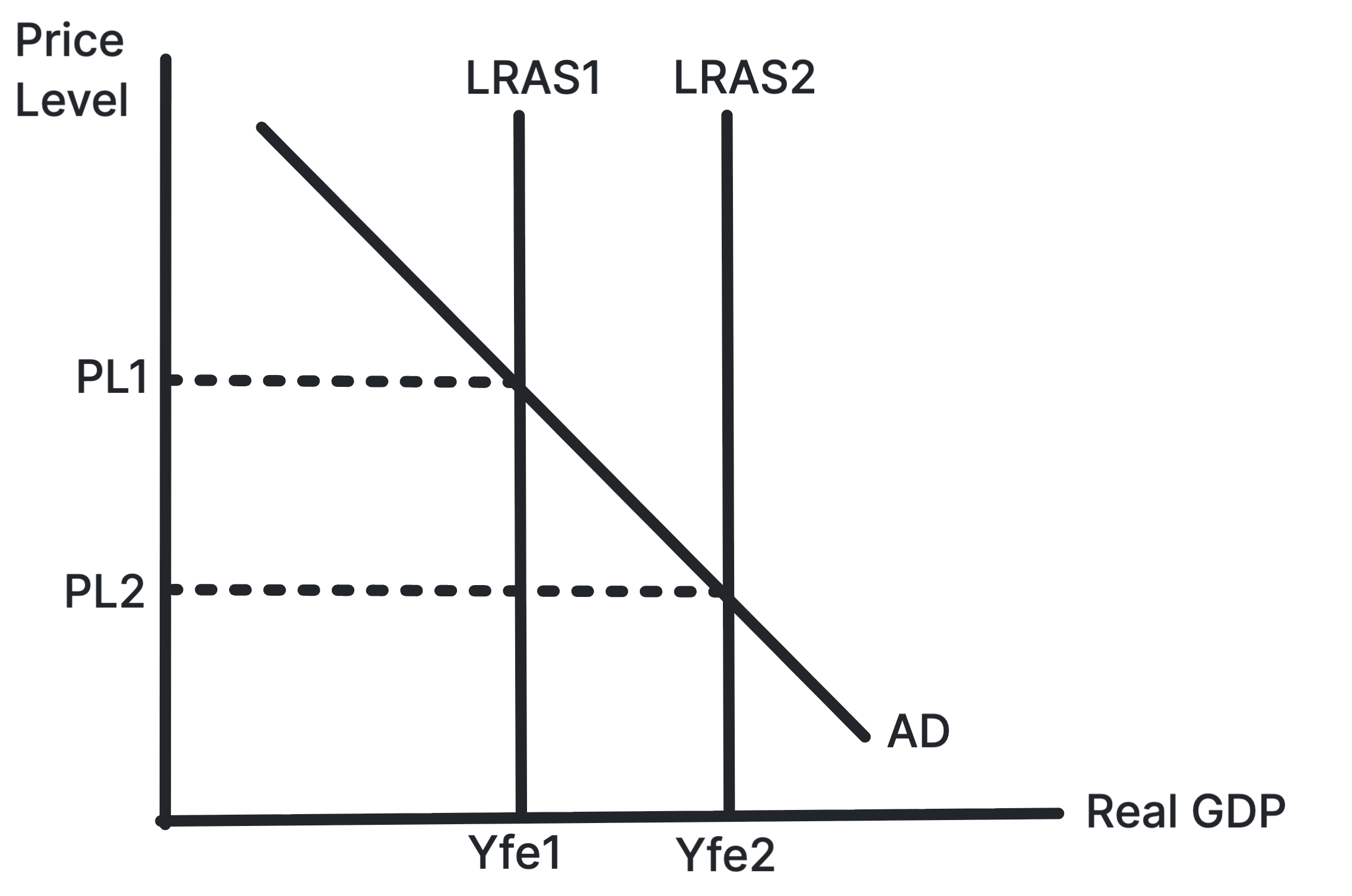
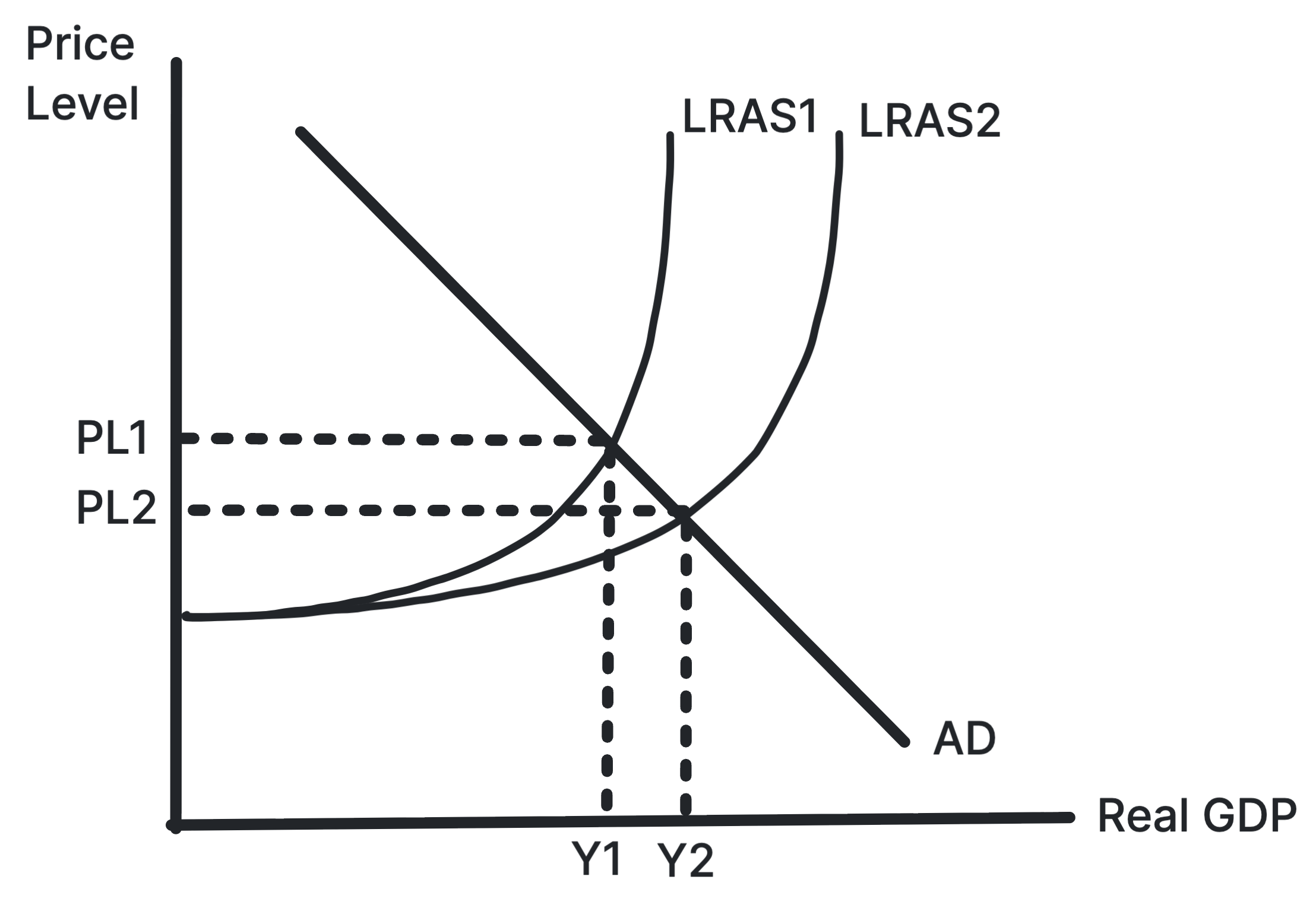
All of the above policies result in LRAS shifting outward from LRAS1 to LRAS2. As a result, real GDP increases from Y1 to Y2 and the price level falls from PL1 to PL2.
Impact on the Macroeconomic Objectives
- Economic Growth: Supply side policies cause RGDP to increase from Y1 to Y2. Real GDP is the measure for economic growth and therefore growth has increased.
- Inflation: Supply side policies cause the Price Level to fall from PL1 to Pl2, resulting in a lower level of inflation.
- Unemployment: Since the actual output of the economy has increased, the derived demand for labour must rise to produce these extra goods and services. Therefore unemployment falls.
- Current Account Balance: Supply side policies may improve the current account balance by increasing the productivity of UK businesses. Therefore exports become more price competitive and the balance of payments improves..
- Government Budget: Supply side policies such as lower income/corporation tax, and interventionist measures can worsen the government budget due to lower taxation revenue or higher government spending. However, they may also increase government revenue through higher economic activity which offsets this impact.
- Income/Wealth Inequality: Many of the free market policies exacerbate income inequality e.g. lower minimum wage and lower unemployment benefits. However, interventionist policies such as education and healthcare spending can reduce income inequality.
- Environmental Sustainability: The increase in economic activity and output may result in higher levels of pollution and carbon emissions. However, supply-side policies that focus on green technology and renewable energy can improve environmental sustainability.
Stuck on this topic? Work through it with an online A-Level Economics tutor in a free 15-minute intro call, or send an essay on it for A-Level Economics essay marking.