Demand-Side Policies
What Are Demand-Side Policies?
Demand-side policies are policies used by the government or central bank to shift the aggregate demand (AD) curve in order to achieve macroeconomic objectives such as low inflation, low unemployment, and economic growth.
Types of Demand-Side Policy
There are two main types of demand-side policy:
- Monetary policy: Managed by the Bank of England, which is independent. It is the manipulation of interest rates and the money supply to meet a desired macroeconomic objective.
- Fiscal policy: Managed by the government. It is the manipulation of government spending (G) and taxation (T) to meet a desired macroeconomic objective.
Monetary Policy
Expansionary monetary policy: aims to increase AD.
- Lower the base interest rate set by the Bank of England
- Increase the money supply through quantitative easing (QE).
Contractionary monetary policy: Aims to reduce AD.
- Raise the base interest rate set by the Bank of England
- Reduce the money supply through quantitative tightening (QT).
How Interest Rates Affect AD
Interest rates: the cost of borrowing and the reward for saving.
They impact aggregate demand through the transmission mechanism:
- Consumption: Lower interest rates decrease the cost of borrowing and reduce the reward for saving. This incentivises consumers to increase consumption (MPC rises). Additionally, lower interest rates increase disposable income for consumers with a variable rate loan e.g. a mortgage, so consumption rises further.
- Investment: Lower interest rates decrease the cost of borrowing for firms, so investment rises.
- Net exports (X-M): Lower interest rates reduce the return on savings in the UK, so foreign investors may sell their pounds to invest elsewhere. This is known as hot flows of money leaving the UK. This increases the supply of pounds in the foreign exchange market, causing the pound to depreciate. A weaker pound makes UK exports cheaper and imports more expensive, so net exports rise.
Therefore, Aggregate Demand (AD) rises when interest rates fall, and AD falls when interest rates rise.
Impacts of Monetary Policy
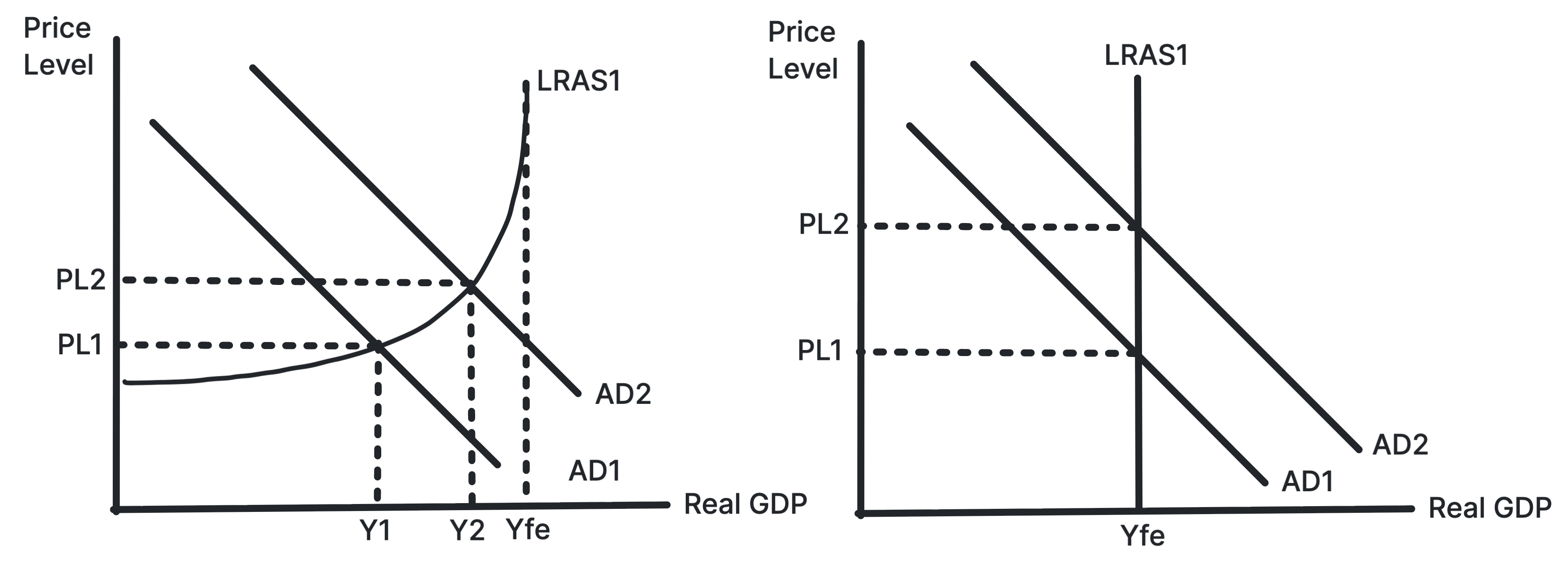
Aggregate Demand shifts right from AD1 to AD2, resulting in a higher level of output/real GDP of Y2 and a higher price level of PL2. The impacts on the macroeconomic objectives are as follows:
- Economic growth: Increases since real GDP increases from Y1 to Y2.
- Inflation: Increases since the price level rises from PL1 to PL2.
- Employment: Increases since there is a higher demand for goods and services. Therefore the derived demand for labour rises, so unemployment falls.
- Balance of Payments: Improves since the weaker pound makes UK exports cheaper and imports more expensive, so net exports rise.
- Income/wealth distribution: Lower interest rates can inflate asset prices, which benefits the wealthy who own more assets. This can worsen income and wealth inequality. For example, lower interest rates make mortgages cheaper, increasing the demand for housing and driving up house prices, which benefits homeowners but makes it harder for first-time buyers to enter the market.
- Environmental sustainability: Higher consumption and investment can increase resource use and pollution, which may worsen environmental sustainability.
- Government budget: Lower interest rates reduce the cost of government borrowing, which can improve the government budget position.
How Quantitative Easing Works
- The central bank prints additional money. This can be physically printed or created digitally.
- The central bank uses this money to buy government bonds from financial institutions, such as commercial banks like Barclays or HSBC.
- This increases the liquidity of commercial banks (the amount of cash they hold), which increases incentive for banks to increase their supply of loans to maximise their profits.
- To increase the supply of loans, banks must lower the interest rate to incentivise firms and consumers to take out additional loans. Thus the commercial interest rate has fallen.
From this point, the lower commercial interest rates have an almost identical effect to the lower central bank interest rates. Consumption, investment, and net exports rise, which increases aggregate demand and shifts the AD curve to the right.
Evaluations to Interest Rates and Quantitative Easing
- Time lags: Monetary policy can take a long time to have an effect on the economy, sometimes up to two years. This is because it can take time for consumers and firms to respond to lower interest rates. For example, consumers that are on fixed rate mortgages may not be impacted by lower interest rates, and firms may take time to plan and implement new investment projects.
- Liquidity trap: This occurs when interest rates are already very low and close to their 0% lower bound, so further cuts have little effect on consumption and investment. In this case, monetary policy may be ineffective at stimulating aggregate demand and quantitative easing may be needed to increase the money supply and encourage lending.
- Asset price bubbles: Lower interest rates can inflate asset prices, which can create bubbles in markets such as housing or stocks. If these bubbles burst, it can lead to a financial crisis and economic downturn.
- Confidence: If consumer or business confidence is low, then lower interest rates may not lead to higher consumption or investment. For example, during a recession, consumers may choose to save rather than spend, and firms may delay investment due to uncertainty about future demand.
Fiscal Policy
Expansionary fiscal policy: aims to increase AD.
- Increase government spending
- Decrease taxation
Contractionary fiscal policy: Aims to reduce AD.
- Decrease government spending
- Increase taxation
Types of Taxation
- Direct taxes: Taxes on income or profits, such as Income Tax and Corporation Tax.
- Indirect taxes: Taxes on spending, such as VAT or Fuel Duty.
The Government Budget
Budget deficit: \( G > T \). This means government spending is greater than tax revenue, so the government must borrow and national debt rises.
Budget surplus: \( T > G \). This means tax revenue is greater than government spending, so the surplus can be used to repay debt.
Balanced budget: \( G = T \).
How Fiscal Policy Affects Aggregate Demand
Increasing Government Spending
The government can spend money on:
- Education
- Healthcare
- Infrastructure
- Research and Development
In any case, when the government increases its expenditure, this increases the G component of AD. Consequently, Aggregate Demand increases and shifts right.
Decreasing Taxes
Depending on which taxes are changes, the impacts on the components of AD differ:
Consumption:
- A fall in income tax increases disposable incomes, resulting in higher consumption.
- A fall in indirect taxes makes goods/services more affordable for consumers, resulting in higher consumption.
Investment:
- A fall in corporation tax increases retained profit for businesses, resulting in more funding available for investment.
- A fall in indirect taxes decreases costs of production for businesses, increases funding available for investment.
Exports:
- A fall in corporation tax can enable domestic firms to reinvest to improve productivity/quality and improve international competitiveness, resulting in a rise in export demand.
- A fall in indirect taxes makes exports relatively cheaper, resulting in a rise in export demand.
Imports:
- A fall in income tax increases disposable incomes for consumers, resulting in a rise in demand for imports.
- A fall in indirect taxes makes domestic goods relatively cheaper, resulting in a fall in demand for imports.
The overall impact will be an increase in aggregate demand, resulting in an outward shift.
Impacts of Fiscal Policy
Aggregate Demand shifts right from AD1 to AD2, resulting in a higher level of output/real GDP of Y2 and a higher price level of PL2. The impacts on the macroeconomic objectives are as follows:
- Economic growth: Increases since real GDP increases from Y1 to Y2.
- Inflation: Increases since the price level rises from PL1 to PL2.
- Employment: Increases since there is a higher demand for goods and services. Therefore the derived demand for labour rises, so unemployment falls.
- Balance of Payments: This may increase or decrease depending on the type of expansionary fiscal policy implemented. If income tax is decreased, the balance of payments worsens, but if indirect taxes are decreased, then the balance of payment improves.
- Income/wealth distribution: Typically, expansionary fiscal policy leads to an improvement in equality. Government spending tends to be aimed at providing services that lower income households would otherwise be unable to afford e.g. education/healthcare. Additionally, income tax is progressive meaning higher income households pay a greater proportion of their income in tax.
- Environmental sustainability: Higher consumption and investment can increase resource use and pollution, which may worsen environmental sustainability.
- Government budget: Expansionary fiscal policy increases the size of the government budget deficit, and increases the national debt.
Evaluations of Government Spending and Taxes
Increasing Government Spending
- Crowding-out effect: Since the UK government consistently runs a government budget deficit, when they decide to increase spending further they must increase their borrowings. This acts as a significant increase in demand in the money market, and hence causes interest rates across the economy to rise. This increases the cost of borrowing for firms and therefore investment falls, offsetting the rise in AD.
- Opportunity Cost: Any spending by the government reduces the ability for this money to be spent elsewhere. Therefore if the government expenditure is not spent effectively, it creates a significant opportunity cost.
- Budget Deficit and National Debt: A rise in spending increases the budget deficit and the national debt. Unsustainable rises in national debt can lead to more expensive borrowing in the future, and a larger taxation burden for future generations. It can also reduce confidence in the economy and reduce inward FDI.
- Multiplier/Confidence: The effectiveness of government spending depends on the size of the multiplier. When confidence is high, the size of the multiplier is likely to be greater and thus government spending will generate greater economic growth.
- Time Lags: Some government spending policies have significant time lags and therefore the effects will not be seen in the short term. For example, education reforms may take 10+ years to have a substantial impact on the labour force.
Lowering Taxes
- Confidence: The impact of lower taxes depends on consumer and business confidence. If income tax/corporation tax falls, the proportion of additional disposable income spending/retained profits invested depends on the state of the economy and the outlook that consumers/firms have for the future of the economy.
- Budget Deficit and National Debt: A fall in taxes increases the budget deficit and the national debt. Unsustainable rises in national debt can lead to more expensive borrowing in the future, and a larger taxation burden for future generations. It can also reduce confidence in the economy and reduce inward FDI.
- Ricardian Equivalence: This is a theory that suggests consumers/firms anticipate future tax raises following a reduction in taxes. Consequently, firms and consumers do not react to lower taxes by increases consumption/investment, but instead save their additional income for the higher future taxes.
- Laffer Curve: This is a very strong evaluation for taxation changes. This is covered in detail in 4.5.2 Taxation.
Stuck on this topic? Work through it with an online A-Level Economics tutor in a free 15-minute intro call, or send an essay on it for A-Level Economics essay marking.